How to Use FPDS for Market Research: A Practical Guide
A practical guide on how to use FPDS for market research: identify incumbents, decode contract vehicles, and connect federal award data to live bid opportunities across every sector.
FPDS holds decades of federal contract award history, but most vendors who use it for market research leave with a spreadsheet of awards and no clear bid strategy. The data is public and powerful. Extracting real intelligence from it requires knowing what to look for, how to read it, and where FPDS ends and a broader research process must begin.
- FPDS reveals incumbents and contract vehicles, the two facts that determine whether a recompete is winnable before you invest a single hour of proposal time.
- Keyword search in FPDS misses related opportunities because award descriptions use procurement shorthand, not the language your proposal team speaks.
- NAICS and PSC codes are more reliable starting points than text search for building an accurate picture of your competitive landscape.
- Compliance requirements buried in past solicitations often repeat in future awards, and automated extraction surfaces them faster than manual review.
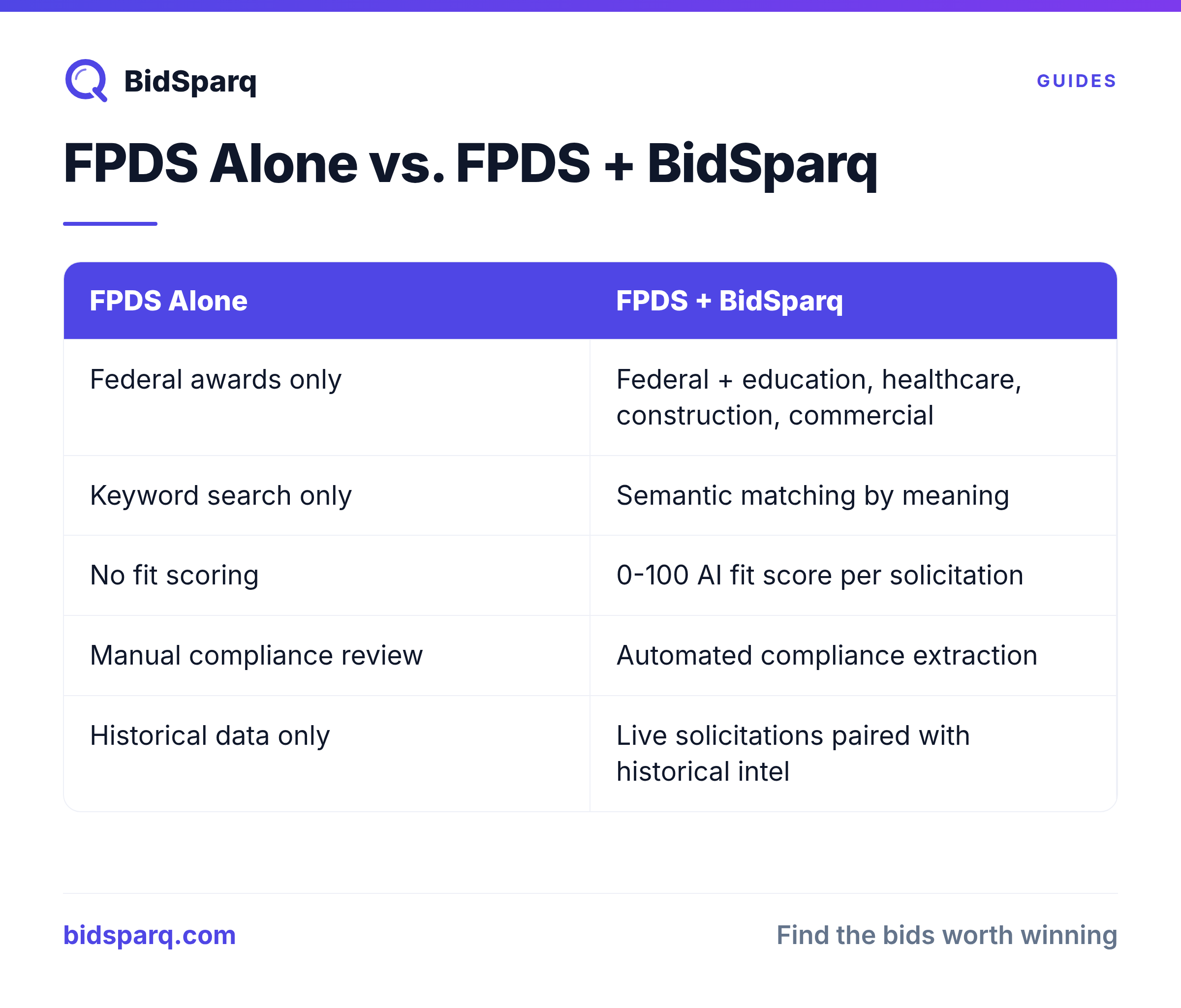
- FPDS covers only federal awards: education, healthcare, construction, and commercial solicitations require separate, broader sourcing.
- AI fit scoring translates historical award patterns into a ranked pursuit list, so research leads directly to action rather than a backlog of unreviewed data.
What FPDS Actually Contains (and What It Does Not)
Start by treating FPDS as a record of decisions already made, not a window into decisions being made now. The Federal Procurement Data System logs every federal contract award above the micro-purchase threshold: awardee, agency, NAICS code, PSC code, award value, period of performance, and contract type. That record covers the entire federal civilian and defense market going back decades. It is the most comprehensive public data source for understanding federal spending patterns.
What FPDS does not contain is equally important. It has no upcoming solicitations, no buyer intent signals, and no state or local government awards. It also has no activity from the procurement markets that often rival the federal budget in aggregate: K-12 education, healthcare systems, commercial construction, and IT services for private organizations. Just as a construction subcontractor mapping school district and hospital expansion projects would not look to a federal database for that work, a federal vendor cannot rely on FPDS alone to see the full competitive picture, even within their own industry.
Searching FPDS Without Getting Lost in the Data
The most common FPDS research mistake is starting with a keyword search and mistaking the result for a complete market view. Award descriptions in FPDS are written by contracting officers in procurement language: abbreviated, inconsistently formatted, and specific to agency conventions. A search for "cybersecurity" will miss awards described as "information systems protection" or "network defense operations." You see a slice and think you see the whole market.
A more reliable method: anchor your search on NAICS and PSC codes that map to your capability. Pull the last three years of awards in those codes. Filter by agency, dollar range, and contract type. This builds a structural market view before you read a single award description. From that foundation, the descriptions become confirmatory rather than exploratory, and the patterns they reveal carry real strategic weight.
Reading Incumbent and Contract Vehicle Intelligence
Every FPDS award record contains the two facts that most directly predict your path into a recompete: who currently holds the contract, and what vehicle was used to award it. The incumbent contractor tells you the competitive baseline your proposal would need to surpass or differentiate from. The contract vehicle type tells you whether you can even submit a bid when the work comes up for competition. A GWAC or IDIQ task order requires existing vehicle access; a full-and-open competition does not.
If the current award was made through a vehicle you do not hold, you face two strategic choices before the recompete opens: pursue the vehicle separately, which takes months, or wait and position for a full-and-open competition if one is expected. FPDS will not make that decision for you, but it gives you the input data to make it yourself. Reviewing vehicle patterns across three to five consecutive awards in a single requirement area will show you whether an agency has a strong preference for a specific vehicle or regularly competes work openly.
Connecting FPDS Research to Live Solicitations
FPDS is backward-looking, and your bid calendar needs to be forward-looking, which means pairing historical award data with a live solicitation feed that covers every market you pursue. Once you have mapped your target agencies, relevant NAICS codes, and incumbent patterns, the practical question becomes: when will the next competitive opportunity post, and how will you catch it?
This is where semantic matching changes the research equation. A platform that reads solicitation language by meaning rather than matching exact keywords surfaces opportunities a manual FPDS-then-SAM workflow would miss. As of July 2026, there are 71,754 open solicitations across the 23,000+ sources BidSparq tracks. Of those, 2,746 reference market-relevant work directly, and 1,258 of them close within the next 14 days. The last 30 days alone saw 4,551 new market-related solicitations post across those channels. That volume cannot be monitored manually alongside a standard FPDS research workflow. A 0-to-100 AI fit score on each incoming opportunity lets your team filter to the top pursuits in minutes, not hours.
Turning Market Research Into a Repeatable Process
Market research that lives in a one-time spreadsheet is not a process: it is a project that expires. The procurement market moves continuously. Contracts end, agencies shift priorities, new vehicles open, and incumbents lose their edge. A research process that refreshes automatically, monitors live solicitation flows, and surfaces compliance requirements as they appear keeps your pipeline current without manual re-runs each quarter.
Automated compliance extraction matters here because requirements repeat. A specific registration type or socioeconomic designation that appeared in an agency's last three awards will almost certainly reappear in the recompete. Knowing those requirements before a solicitation drops gives your team time to address gaps rather than discover them at the deadline. Pairing that with incumbent intelligence drawn from FPDS creates a workflow where historical data and live opportunity signals reinforce each other continuously.
FAQ
How do I search FPDS for market research effectively?
Start with NAICS and PSC codes rather than keyword searches. FPDS award descriptions are written in procurement shorthand, and keyword results are systematically incomplete. Filter by agency, dollar range, contract type, and a three-year date range to build a structural view of your target market. Use the award records to identify incumbents, contract vehicles, and spending patterns, then move to a live solicitation platform to connect that history to current opportunities.
What information does FPDS provide for bid research?
FPDS records the awardee, awarding agency, NAICS code, PSC code, award value, period of performance, contract type, and contract vehicle for each federal award. This data supports incumbent analysis, contract vehicle mapping, spend trend identification, and recompete timing estimates. It does not include upcoming solicitations, state or local government awards, or procurement activity outside the federal government.
Does FPDS show upcoming contract opportunities?
No. FPDS records awards that have already been made, not solicitations that are about to be released. For upcoming federal opportunities, the primary public source is SAM.gov. For a broader view that includes education, healthcare, construction, state and local government, and commercial markets in a single feed with AI fit scoring, you need a platform that aggregates across all public sourcing channels and scores each result by fit.
See your matches free at BidSparq's RFP discovery platform, no credit card needed.
Find RFPs that match your business
BidSparq monitors 23,000+ procurement sources and uses AI to score every opportunity against your capabilities. Try it free for 14 days.
Start Free Trial →