How to Find State and Local Government RFPs Without the Chaos
A practical guide to how to find state and local government RFPs across thousands of scattered portals, and how to surface only the ones actually worth bidding.
There is no master list of state and local government RFPs, and that single fact is why capable teams miss winnable work every quarter. A commercial contractor bidding across universities, health systems, and municipal projects can watch a dozen portals and still miss the one solicitation that mattered. Every state runs its own procurement system, most large counties and cities run their own on top of it, and school districts, transit authorities, water districts, and public hospital systems each publish on separate platforms with separate rules. The problem is not effort. It is fragmentation.
- No master list exists. State, county, city, district, and authority RFPs live on thousands of separate portals with separate rules.
- Portals are the source, not the solution. Register on the official systems, then automate the watching so nothing leaks.
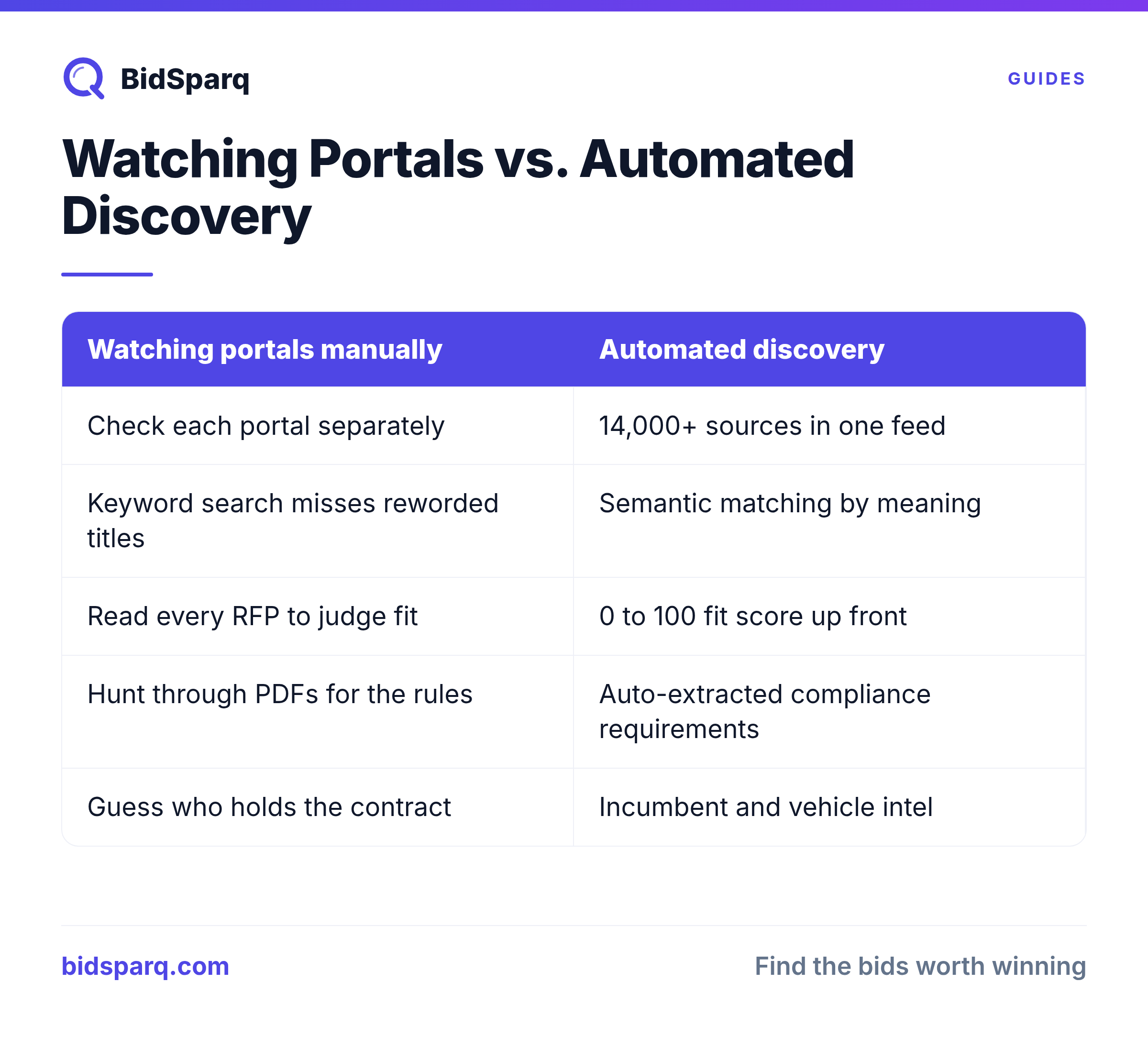
- Keywords miss real matches. Semantic matching surfaces solicitations by what the work is, not the exact words in the title.
- Score before you read. A 0 to 100 fit score lets small teams triage hundreds of bids in minutes.
- Compliance kills late bids. Auto-extracted requirements reveal a no-go before you invest days in writing.
- Know the incumbent. Contract and vehicle intel tells you whether a fresh bid is worth the effort.
Start with the official portals, then stop relying on them
Register on the official state and local procurement portals first, because that is where solicitations legally have to appear. Most states run a central eProcurement system, and many counties, cities, school districts, and transit and water authorities run their own alongside it. Registering gets you into the vendor lists and, sometimes, onto notification emails. The catch is that those alerts are narrow, usually keyword based, and scoped to one jurisdiction. A vendor working across several counties or several states ends up maintaining logins for dozens of systems, each with its own taxonomy and its own idea of what a category name means. Coverage by hand does not scale, and the gaps are exactly where competitors win uncontested.
Search by meaning, not the words a clerk typed
Match opportunities by what the work actually is, not by the exact phrase someone entered in a title field. Public buyers describe the same scope in wildly different language. "Grounds maintenance," "landscaping services," and "turf management" can all point to the same contract, and a keyword alert set for one will silently skip the other two. This is where automated semantic matching beats manual keyword search: it reads the meaning of a solicitation and connects it to what you sell, so a reworded title or an odd category label does not cost you the bid. The payoff shows up as opportunities you never would have thought to search for, arriving without you guessing every synonym a procurement office might use.
Score and triage before anyone reads a full RFP
Put a number on fit before your team spends an hour reading. The real cost of RFP discovery is not finding documents, it is deciding which ones deserve attention. A fit score from 0 to 100 turns a wall of new solicitations into a ranked queue, so a two person team can clear a morning's worth of matches in minutes and push only the strong ones into the proposal pipeline. Manual triage does the opposite: every bid looks equally urgent until someone reads all of it, which means the best opportunities compete for attention with the ones that were never realistic.
Read the compliance requirements before you commit
Find the deal breakers on day one, not day three. State and local RFPs bury the requirements that decide eligibility: bonding, licensing, insurance limits, local presence, set aside status, and submission format. Miss one and the proposal is dead no matter how sharp the pricing. Automated compliance extraction pulls those requirements out of the document and lays them out plainly, so a hard no-go is obvious before the writing starts. That single step protects the scarcest resource a bidding team has, which is the time of the people who write winning proposals.
Know who holds the contract now
Treat every renewal as a question of whether you can beat the incumbent. A large share of state and local work is recompeted, and walking in blind to who currently holds the contract, what vehicle it runs through, and when it expires is how teams waste effort on bids they were never positioned to win. Incumbent and contract vehicle intel answers those questions up front. It tells you where you have a real opening, where you would only be padding a competitor's win rate, and which cooperative or statewide vehicles could let you sell without a fresh full solicitation at all.
FAQ
Where do state and local governments post RFPs?
On official procurement portals run by each jurisdiction: a central state eProcurement system plus separate portals for many counties, cities, school districts, and special authorities. There is no single national feed, which is why vendors either monitor many portals by hand or use an aggregator that pulls them together.
Is there a free way to find government RFPs?
Yes. Every official government portal is free to register on and search, though you are limited to one jurisdiction at a time and mostly keyword based alerts. Aggregation tools also offer free tiers, so you can see cross-portal matches without paying before you decide whether the time savings justify a subscription.
How do I find RFPs before they close?
Set up notifications the moment a solicitation posts rather than checking portals on a schedule. Semantic matching and fit scoring help here by flagging relevant, high-fit opportunities as they appear, which leaves the most time for the bonding, licensing, and formatting requirements that take longest to satisfy.
The bottleneck in public bidding was never effort. It was fragmentation, and fragmentation is a data problem. BidSparq turns thousands of scattered portals into one ranked, scored feed so you bid on the right work instead of hunting for it. See your state and local RFP matches free, no credit card needed.
Find RFPs that match your business
BidSparq monitors 23,000+ procurement sources and uses AI to score every opportunity against your capabilities. Try it free for 14 days.
Start Free Trial →