Medtech RFPs: Why the Best Fits Hide in Plain Sight
Medtech RFPs rarely say "medical device" in the title. Here is how to find them by what buyers actually describe, screen out disqualifying requirements early, and choose which bids to pursue.
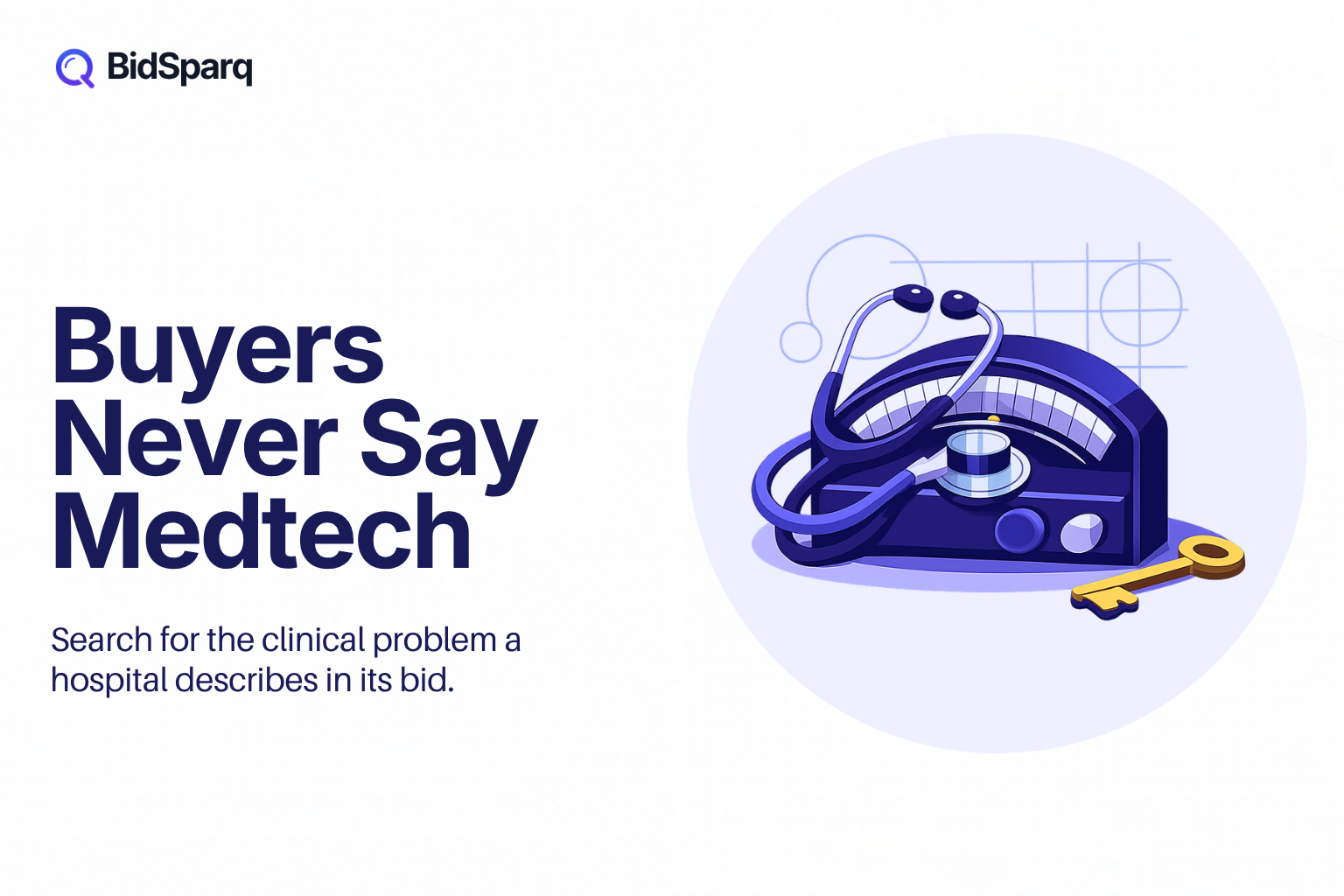
Medtech RFPs are hard to find for a simple reason: buyers rarely call them medtech. A hospital system replacing patient monitors may title the bid after a telemetry upgrade on a cardiac unit. An academic medical center that wants surgical video integration may file it under operating room AV modernization. A keyword alert set to "medical device" misses both. The vendors who do catch them often catch them late, and then have too little time to clear the requirements buried in the scope.
- Clinical language beats catalog language: buyers describe the problem in their own unit's terms, so searches built on your product names miss real fits.
- Compliance gates often decide medtech bids before anyone compares prices.
- Scoring every opportunity before a person reads it keeps a small proposal team off equipment it cannot actually supply.
- Incumbency weighs more in healthcare than in most markets. Installed fleets, service contracts, and trained staff all make switching costly for the buyer.
- Where a bid is posted depends on who is buying: private health systems, public hospital districts, university medical centers, and federal health agencies each publish in different places.
The short answer
To find medtech RFPs, search for the clinical or operational problem the buyer describes, then check each solicitation for regulatory, security, and service requirements before you commit a proposal team. These bids come from supplier portals, public board agendas, university procurement pages, and federal listings, and many of them never use the word "device" in the title. Tools that read the full scope by meaning and pull out disqualifying requirements automatically will find more relevant bids, and find them sooner, than keyword alerts. They also tell you which ones are worth the hours.
Why medtech RFPs slip past keyword alerts
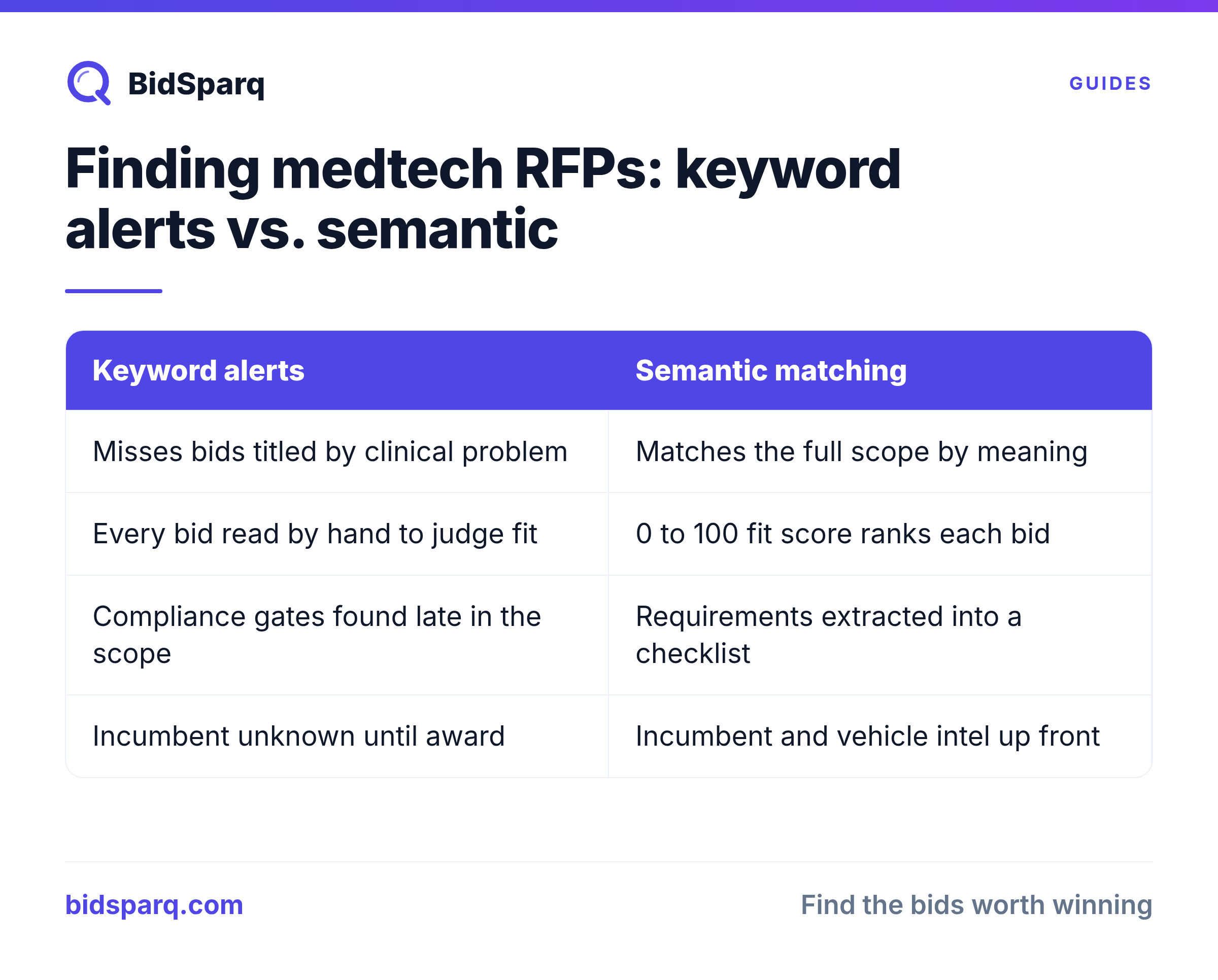
Stop searching for what you sell and start searching for what buyers say. A procurement office writes the solicitation from the floor's point of view. Infusion pumps turn up in a bid about a medication safety initiative. Instrument tracking is described as a sterile processing workflow project. Real-time location systems are listed as asset visibility for biomedical engineering. If your keyword list looks like your price book, it will miss most of these.
Semantic matching takes the opposite approach. It compares the meaning of the whole solicitation, including scope narratives and specification tables, against what your company actually provides. A bid can match your infusion line without containing the word "pump" anywhere in its title. Fixing this with a manual keyword list means adding synonyms forever and still getting surprised.
The manual hunt does not scale
Count the sources before you decide to check them by hand. As of November 2026, 52,983 solicitations are open right now across the 30,000+ sources BidSparq tracks. Medtech is a slice of that total, and the slice is scattered. A private health system posts on its own supplier portal. A public hospital district puts capital purchases on a board agenda, often hosted on BoardDocs. A state university medical center lists bids on the university's procurement page. Federal health buyers post on SAM.gov. Any one of these is easy to check. Covering them all every few days and reading every scope closely enough to spot a fit is what wears down an inside sales team or a proposal coordinator.
Start a 14-day free trial of semantic RFP matching and see which open medtech solicitations fit your product line. No credit card needed.
Read the compliance gates before the scope
Pull out the disqualifiers first, then decide whether to bid. Medtech solicitations stack requirements that can rule out a vendor no matter how good the product is. Common ones include proof of FDA clearance for the indication the buyer specifies, a completed MDS2 (Manufacturer Disclosure Statement for Medical Device Security), a HIPAA business associate agreement for anything that touches patient data, guaranteed service response times, and clinical or biomedical training commitments. Confirm your cleared indications in the FDA's public 510(k) premarket notification database before you assume a match.
Finding these by hand means reading every page of every document. Automated compliance extraction turns the requirements into a checklist as soon as the bid is ingested. A 0 to 100 fit score then ranks each opportunity against your capabilities, so a 40 with a hard cybersecurity requirement you can't meet gets set aside before anyone opens the specifications.
Use incumbent intel to pick your fights
Find out who owns the installed base before you price. Healthcare buyers often standardize on one platform because changing it means retraining nurses, replacing consumables, and rewriting service agreements. A bid that looks open may really be a renewal. A bid that looks routine may be the first real opening in years. Knowing who holds the incumbent contract, and whether the buyer usually purchases through a group purchasing agreement or a vehicle such as the VA Federal Supply Schedule, tells you whether you are competing or just filling out a field.
Doing this research by hand means digging through old award notices and board minutes. Incumbent and contract vehicle intel puts it next to the opportunity, so you can decide whether to go after it on the merits. The same approach works outside healthcare: education, construction, IT, and commercial buyers also bury fits under their own vocabulary, and the vendors who score and screen first win more of the bids they choose.
FAQ
Where do hospitals post medtech RFPs?
It depends on the buyer. Private health systems usually use their own supplier portals or buy through group purchasing agreements. Public hospital districts often post capital purchases in board agendas. University medical centers use the university procurement site, and federal health agencies post on SAM.gov.
How do I find medical device RFPs that don't say "medical device" in the title?
Search for the clinical or operational problem rather than the product name, or use semantic matching that compares the full scope against your capabilities. Terms such as patient safety, sterile processing, telemetry, or asset tracking often hide device purchases.
What compliance documents do medtech RFPs usually require?
Expect proof of FDA clearance for the specified indication, an MDS2 security disclosure, a HIPAA business associate agreement when patient data is involved, and service and training commitments. Check the full requirement list before investing in a response.
Try fit-scored medtech RFP matching free for 14 days, with no credit card required, and spend your proposal hours on the bids you can win.
Find RFPs that match your business
BidSparq monitors 30,000+ procurement sources and uses AI to score every opportunity against your capabilities. Try it free for 14 days.
Start Free Trial →