DoD Per Diem Rates: What Bidders Get Wrong
DoD per diem rates cap what a contractor can recover for travel. Learn which rate applies, where to check it, and how to price travel in a bid.
Travel is one of the easiest lines to get wrong in a bid, and DoD per diem rates are where it usually goes wrong. Price it from memory and you either leave money on the table or hand the contracting officer a cost line that has to be disallowed. The rates are public, they change, and they differ by location, so the real question is never what the per diem is. It is which rate applies to this work, on these dates, in this place.
- DoD per diem rates are a ceiling, not a quote. Contractor travel is allowable up to the published rate, never automatically at it.
- Three bodies publish the rates: GSA for the continental US, the Defense Travel Management Office for Alaska, Hawaii and US territories, and the State Department for foreign locations.
- The word "diem" cuts two ways in solicitations. It can mean travel reimbursement or per diem shift staffing, and only the surrounding meaning tells you which.
- Lodging and meals are separate numbers, and the first and last day of travel pay a reduced meals rate.
- As of October 2026, 61 of the open solicitations BidSparq tracks mention "diem", and 15 of them close within the next 14 days.
The short answer
DoD per diem rates are the maximum daily lodging and meals-and-incidentals amounts a traveler can be reimbursed for at a specific location, and for contractors they cap allowable travel costs under FAR 31.205-46. The Defense Travel Management Office hosts one lookup that returns the correct rate for any location, but the number itself comes from GSA for the continental US, from DoD for non-foreign overseas areas, and from the State Department for foreign countries. In a proposal, you use the current published rate for the place and dates of performance to build a not-to-exceed travel estimate, then follow the reimbursement terms the solicitation sets. Anything above the published rate needs a documented justification, and many contracts will not accept it at all.
Sort the location before you price a single night
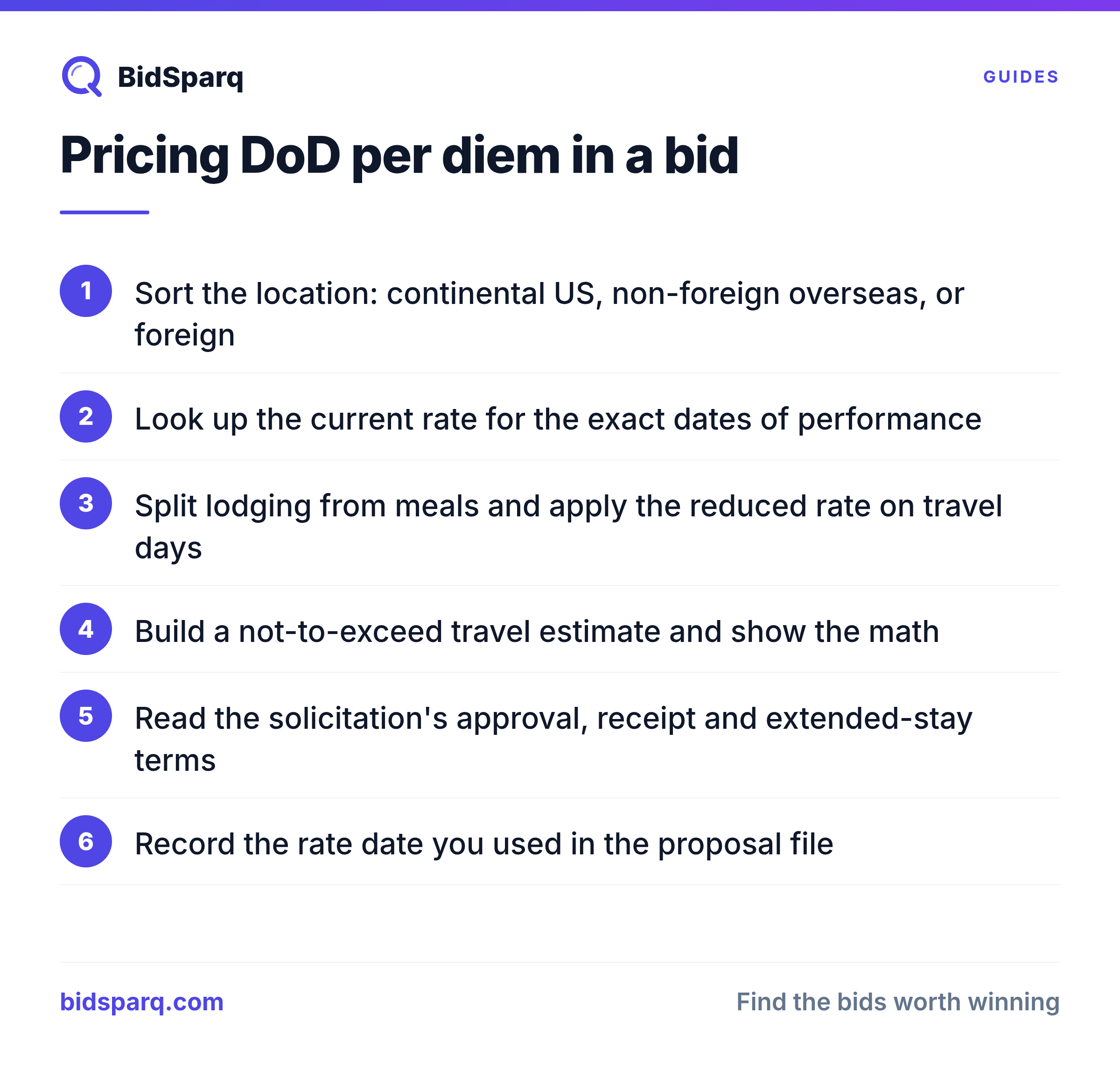
Put every travel destination into one of three buckets first, because the bucket decides who sets the rate and how often it moves. Continental US rates come from GSA and reset each fiscal year on October 1. Non-foreign overseas rates, covering Alaska, Hawaii, Puerto Rico, Guam and the other US territories, come from DoD through the Defense Travel Management Office. Foreign rates come from the State Department's Office of Allowances and can change during the year. Every rate has two parts: a lodging amount and a meals-and-incidentals amount. Under the Joint Travel Regulations, the first and last day of travel pay 75 percent of the meals-and-incidentals rate. In the continental US, lodging taxes are reimbursed on top of the lodging rate; in foreign areas they are built into it.
The bucket matters more than most bidders expect. A construction contractor pricing a roofing repair at an installation in a US territory needs the DoD rate, not the mainland GSA rate, and the lodging component can differ substantially. An IT services firm staffing on-site help desk support at a mainland base uses the GSA lodging figure for that county, then applies the 75 percent rule to travel days for each rotation.
Check the published source for the exact dates of performance
Look the rate up fresh for every proposal rather than reusing the figure from your last bid. The Defense Travel Management Office per diem rate lookup at travel.dod.mil returns rates for all three buckets in one place. GSA's per diem rates page at gsa.gov is the authoritative source for continental US rates and lets you search by city, state or ZIP code. The State Department's Office of Allowances publishes the foreign rates. For the rules behind the numbers, the Joint Travel Regulations cover DoD travel policy, and FAR 31.205-46 sets what a contractor may recover. If a solicitation cites a rate table by name, follow that citation even when it differs from your habit.
The habit pays off well beyond federal work. Many state agencies, school districts and hospital systems write GSA rates into their own travel reimbursement clauses, so the same lookup discipline applies to a facilities bid for a university or a consulting engagement with a county.
Price per diem as a not-to-exceed estimate, not a profit line
Build the travel line from trips, days and the published rate, and show the math in the cost volume. Many solicitations place travel in a cost-reimbursable line with a not-to-exceed amount, which means you estimate it, document the basis, and bill actuals up to the cap. Others fold travel into a fixed price, which shifts the risk of a rate increase onto you, so record the rate date you used and watch for a fiscal year boundary inside the period of performance. Do not apply fee or markup to per diem unless the solicitation explicitly allows it. Read the fine print for pre-approval requirements, receipt thresholds, a local travel radius that pays nothing, and reduced rates for extended stays at one location.
Watch the vocabulary too. A medical staffing firm bidding clinician coverage at a military treatment facility may see "per diem" used twice in one document: once for travel reimbursement, once for on-call shift arrangements. The pricing volume has to keep those apart, and so does the search that found the solicitation in the first place.
The scale problem: finding travel-heavy work before you price it
Treat travel terms as a screening criterion, not something you discover after the pricing volume is half built. Solicitations that require on-site presence are scattered across hundreds of portals, and the travel clause is usually buried in a statement of work or a pricing instruction, never in the title. As of October 2026, 53,364 solicitations are open across the 30,000+ sources we track, and 61 of them mention "diem", with 53 new ones posted in the last 30 days. Reviewing that by hand means searching each portal for a keyword that returns per diem nursing contracts alongside per diem travel clauses, opening every document, locating the clause, and recomputing the estimate for each location.
Automated matching changes the economics. BidSparq's semantic matching reads whether "per diem" refers to travel reimbursement or shift staffing, so the results match your business instead of your keyword. Compliance extraction pulls the travel not-to-exceed amount, the rate table cited and the pre-approval rules into a checklist, and the 0 to 100 fit score weighs the on-site burden against your footprint. Incumbent and contract-vehicle intel adds the last piece: if the incumbent operates near the site, a travel-heavy price has to be sharper to compete.
See which open solicitations match your work with a 14-day free trial, no credit card needed.
FAQ
Are DoD per diem rates the same as GSA per diem rates?
Not always. GSA sets rates for the continental US, DoD sets rates for Alaska, Hawaii and US territories, and the State Department sets rates for foreign countries. The Defense Travel Management Office lookup returns all three, which is why many people assume DoD publishes them all.
Can a contractor bill more than the DoD per diem rate?
Only with justification the contract allows. FAR 31.205-46 makes contractor travel allowable up to the published federal rates, and anything above them needs documented special circumstances and approval. Price to the rate and treat exceptions as the rare case.
How often do DoD per diem rates change?
Continental US rates reset each fiscal year on October 1. Non-foreign overseas and foreign rates can change during the year, sometimes monthly, so check the published rate for the actual dates of performance before you finalize a travel estimate.
Travel is a small share of most bids and a large share of the disallowed costs. Start a 14-day free trial and let matching surface the travel-heavy work before you price it.
Find RFPs that match your business
BidSparq monitors 30,000+ procurement sources and uses AI to score every opportunity against your capabilities. Try it free for 14 days.
Start Free Trial →