DLA Procurement: How to Find the Quotes You Can Win
Where DLA posts RFQs, how to check approved-source and packaging rules, how to become an approved source, and how to price NSNs using DIBBS award history.
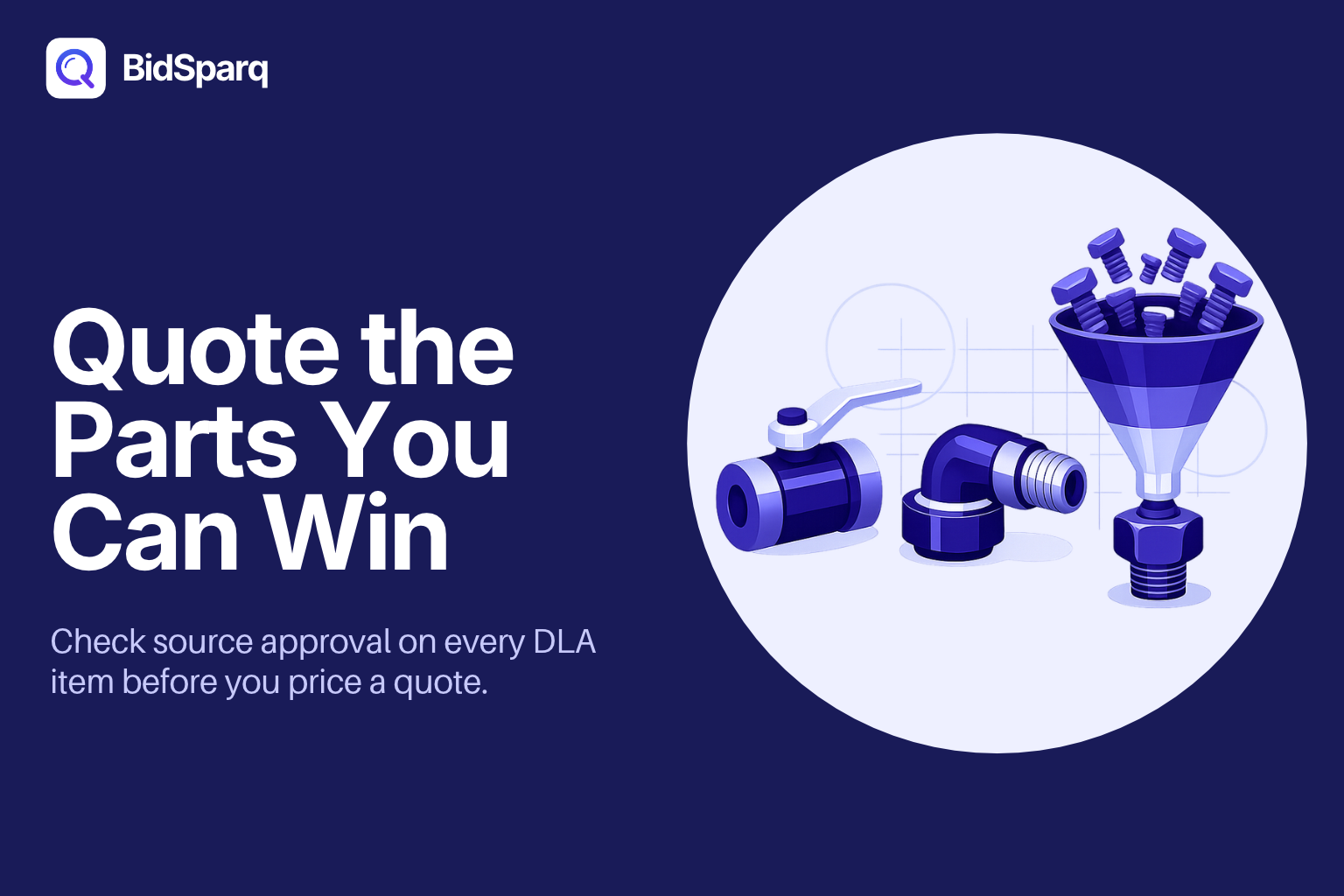
Most vendors lose DLA procurement work before they submit a price. They quote parts they are not approved to supply. They miss a packaging clause that wipes out the margin. Or they find the right NSN after the RFQ has closed. The Defense Logistics Agency buys fittings, filters, rations, uniforms, medical supplies, fuel and construction equipment, and it posts requests quickly and in volume. Finding opportunities is not the hard part. The hard part is finding the few lines you are eligible for, can deliver on time and can still price at a profit.
- Check three places. Search DIBBS daily by NSN and supply class. Check SAM.gov and the DLA Procurement Gateway for larger RFPs and IFBs.
- Read the approved-source note first. If your CAGE is not on the list and you have no traceable approved part number, skip the line unless it allows alternate offers.
- Price packaging into every line. MIL-STD-2073 preservation and MIL-STD-129 marking can cost more than a small part.
- Test delivery days against your real lead time. Count supplier lead time, packaging and transit. Automated evaluation rarely forgives a late date.
- Pull procurement history before you set a price. Prior awardees, unit prices and quantities tell you what wins.
- File Source Approval Requests only for NSNs that recur. Qualification takes months, so spend that effort where demand repeats.
The short answer
DLA procurement is how the Defense Logistics Agency buys the supplies the U.S. military runs on, from repair parts and fuel to food, clothing and medical items. To sell to DLA, register your business in SAM.gov, which gives you a CAGE code, then create a DIBBS vendor account so you can submit quotes. A local APEX Accelerator (formerly the Procurement Technical Assistance Program) will help you with registration and your first quotes at no cost. After that, your win rate depends less on price than on how well you filter for eligibility, packaging cost, delivery days and incumbent history.
Where DLA posts RFQs: DIBBS vs. SAM.gov
Look on DIBBS first for spare parts and routine supply buys, and check SAM.gov and the DLA Procurement Gateway for the larger work. The DLA Internet Bid Board System (DIBBS) posts requests for quotation. Each one is tied to a specific National Stock Number (NSN) and lists a quantity, a required delivery, and notes on sourcing and packaging. Larger negotiated buys, long-term contracts and many service requirements are announced on SAM.gov. Their full solicitation packages are often hosted on the DLA Procurement Gateway.
DLA buys through supply chains that include Land and Maritime, Aviation, Troop Support and DLA Energy. Troop Support alone covers clothing and textiles, medical, subsistence, and construction and equipment. That means a machine shop quoting hydraulic fittings, a medical distributor and a building-products supplier can all find lines that fit.
The real obstacles are volume and vocabulary. DLA writes item names in reverse order, so a part reads "valve, ball" rather than "ball valve," and keyword or NSN alerts only catch the terms you thought to save. Parts you could supply slip past because the government description uses words your catalog never does. Semantic matching closes that gap because it reads what an item is, not which exact words describe it. DLA is also one buyer among thousands. As of November 2026, 53,741 solicitations are open right now across the 33,000+ sources BidSparq tracks, which is far more than any team can review line by line.
See DLA lines ranked by fit for your catalog with a 14-day free trial, no credit card required.
DIBBS solicitation types and automated vs. manual awards
Before you write a quote, find out what kind of solicitation it is, because that decides whether a system or a person evaluates it. Most DIBBS activity is requests for quotation (RFQs) for smaller, repeat buys. Larger requirements come as requests for proposal (RFPs) or invitations for bid (IFBs). DLA publishes those through the DLA Procurement Gateway with their attachments and amendments. Long-term contracts and indefinite delivery contracts commit DLA to one supplier for an NSN or a family of items over several years. While those contracts run, the parts they cover stay off the open market.
The difference between automated and manual evaluation matters more than most new vendors expect. Many smaller DIBBS RFQs are evaluated and awarded automatically against the solicitation terms. On those buys, a quote with an unapproved part number, a packaging exception or a delivery date outside the requirement can lose without a buyer ever reading your explanation. Manually evaluated buys go to a contracting officer, who can consider alternate offers and supporting data. If you plan to offer an alternate part or a longer lead time, put that effort into manual buys, where it has a real chance.
How to check approved-source, technical data and packaging requirements
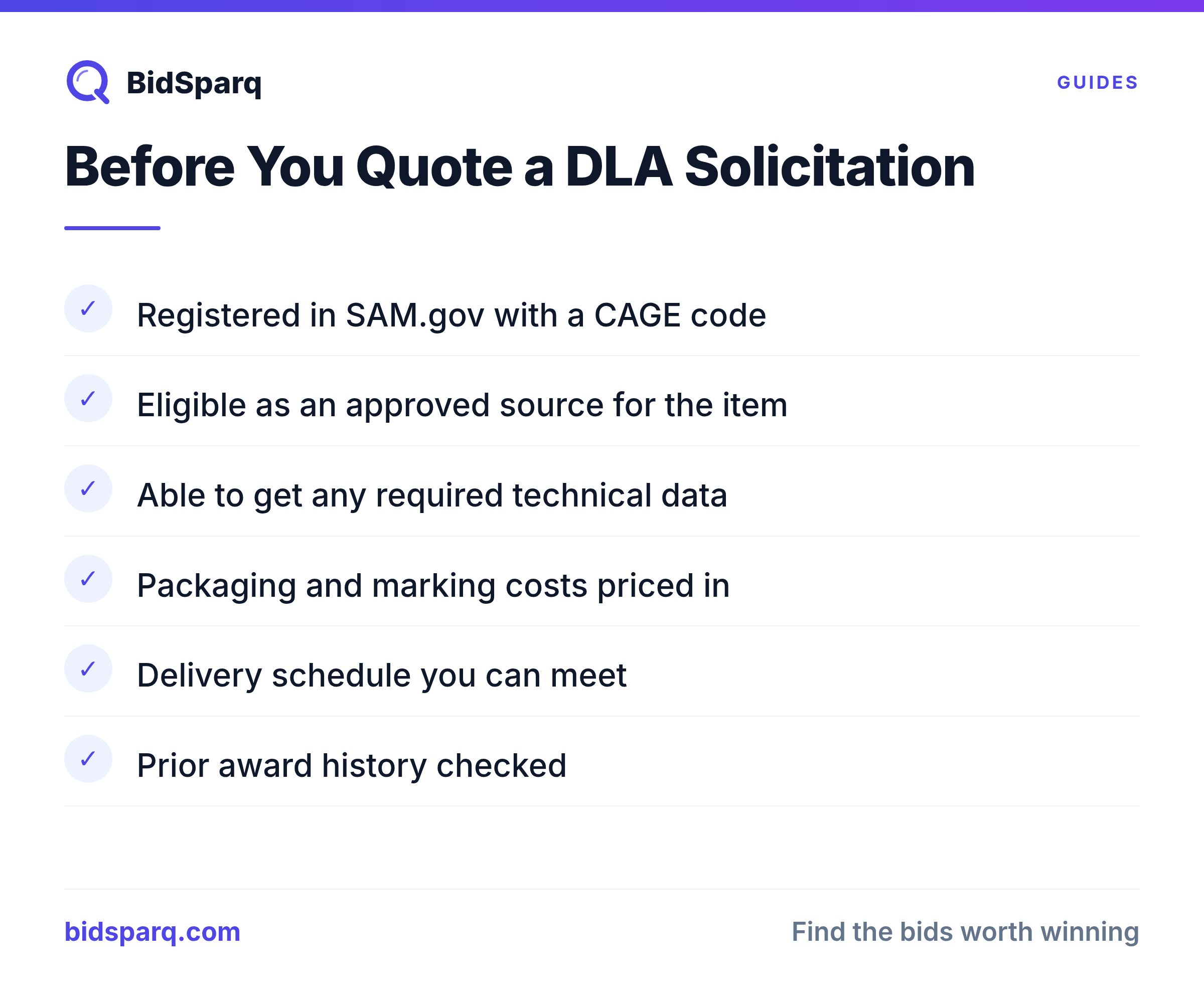
Before you look at quantity or price, confirm that you are allowed to win the line at all. Many DLA items are restricted to approved sources, which means DLA will only buy from manufacturers or dealers it has already qualified for that exact part. Others require a technical data package you must be able to obtain, or traceability back to the original manufacturer. Take a hypothetical DIBBS line for an NSN described as "valve, ball" and run four checks:
- Approved-source note. Look in the procurement item description for the list of approved CAGE codes and part numbers. If your CAGE is not listed and you do not carry a named part number with traceable documentation, you are not eligible, unless the solicitation accepts alternate offers with supporting data.
- Technical data. If the line references drawings, check whether they are available in cFolders, DLA's document collaboration area, or in JEDMICS, the DoD engineering drawing repository. Export-controlled drawings generally require Joint Certification Program (JCP) certification, so get certified well before you need it.
- Packaging and marking. Note whether the line calls for military packaging under MIL-STD-2073 and marking under MIL-STD-129. Price the materials, labor and labels for both.
- Delivery days. Compare the required delivery with your supplier's real lead time plus packaging and transit. If you cannot meet it, skip the line, or quote an honest alternate delivery and expect it to count against you.
Doing these checks by hand means opening every solicitation and every attachment. Here is the same "valve, ball" line with the work automated in BidSparq. Compliance extraction pulls the approved-CAGE list and the MIL-STD-2073 packaging clause out of the item description and puts them at the top of the record. You know who is approved and what preservation costs before you open a single attachment. Next, the 0 to 100 fit score compares the line with your catalog and capabilities. If your CAGE or a traceable approved part number is on the list, the line scores high. If not, it scores low and drops below the parts you can actually ship. Finally, the incumbent view shows that another supplier holds this NSN under a long-term contract. That tells you the part is unlikely to come back open soon, and that a Source Approval Request for it should wait. A keyword alert would have shown you the same line with none of that context.
How to become a DLA approved source (SAR and QPL)
If your CAGE keeps missing from the approved list on parts you know you can make, stop quoting around the problem and get qualified. For items restricted to named sources, DLA accepts Source Approval Requests (SARs). An alternate manufacturer submits technical evidence that its part is equivalent, such as drawings, test data, or proof that it has produced the item for the original equipment maker. The responsible engineering activity reviews the package, and approval can take months.
Other items are governed by a Qualified Products List (QPL). Here, the qualifying activity must test your product against the governing military specification before you can offer it. You can check whether a specification has a QPL in the Qualified Products Database within ASSIST, the DoD specifications system.
Both routes cost time and engineering effort, so be selective about where you spend it. The best SAR candidates are NSNs that DLA buys repeatedly, that are not locked under a long-term contract, and that have only one or two approved sources. Your own production capability should already cover them. Procurement history, covered next, tells you which NSNs meet those tests.
How to use DIBBS award history to price NSNs
Pricing an NSN without its procurement history is guesswork, and the history costs nothing to check. Many DIBBS RFQs include procurement history for the NSN, showing prior awardee CAGE codes, quantities, unit prices and award dates. The DIBBS award search lets you look up past awards by NSN. For larger contracts, Federal Procurement Data System (FPDS) records and SAM.gov contract data show who holds an award, its value and when it ends.
Read the history for patterns, not a single number. Compare unit prices at similar quantities, because a price paid on a large buy does not carry over to a small one. Watch the trend across awards to see whether prices are drifting up or being driven down. Check whether one CAGE has won every buy for years, which suggests either a cost advantage you cannot match or a source restriction you have not met yet. Note how often the NSN is bought. A part DLA orders several times a year deserves a sharp, repeatable price. A one-off may not be worth your time.
Then apply the same four triage questions every time. Are you an eligible source? Can you meet the delivery? Does the margin hold after packaging and freight? Have you shipped this item, or a close cousin, before? Answering them the same way on every line ends the case-by-case debate. The habit works well beyond defense, too. Education, healthcare, construction and commercial buyers reward the same discipline: quote fewer opportunities that fit better, and learn from every award.
FAQ
What is DIBBS used for in DLA contracting?
DIBBS, the DLA Internet Bid Board System, is the web portal where DLA posts many of its requests for quotation. Vendors use it to submit quotes, search by NSN and review award history. Larger RFPs and IFBs are usually published through the DLA Procurement Gateway and announced on SAM.gov.
Does DLA award quotes automatically?
Many smaller DIBBS RFQs are evaluated and awarded automatically against the solicitation terms, so exceptions on part number, packaging or delivery can disqualify a quote without human review. Larger or more complex buys are evaluated manually by a contracting officer, who can consider alternate offers and supporting data.
Can small businesses win DLA contracts?
Yes. DLA buys many items in quantities and dollar ranges that suit small suppliers, and some solicitations are set aside for small businesses. Small vendors do best when they focus on a defined set of NSNs they can source reliably, confirm approved-source requirements first and respond quickly.
Stop reading every RFQ to find the few you can win. Start your free 14-day trial and get every open solicitation, from DLA and beyond, ranked by how well it fits your business.
Find RFPs that match your business
BidSparq monitors 33,000+ procurement sources and uses AI to score every opportunity against your capabilities. Try it free for 14 days.
Start Free Trial →