Civic Federation Alternatives: From Budgets to Bids
Compare civic federation alternatives: Illinois and Chicago fiscal watchdogs, primary data sources, and the procurement portals and tools that turn budget signals into bids.
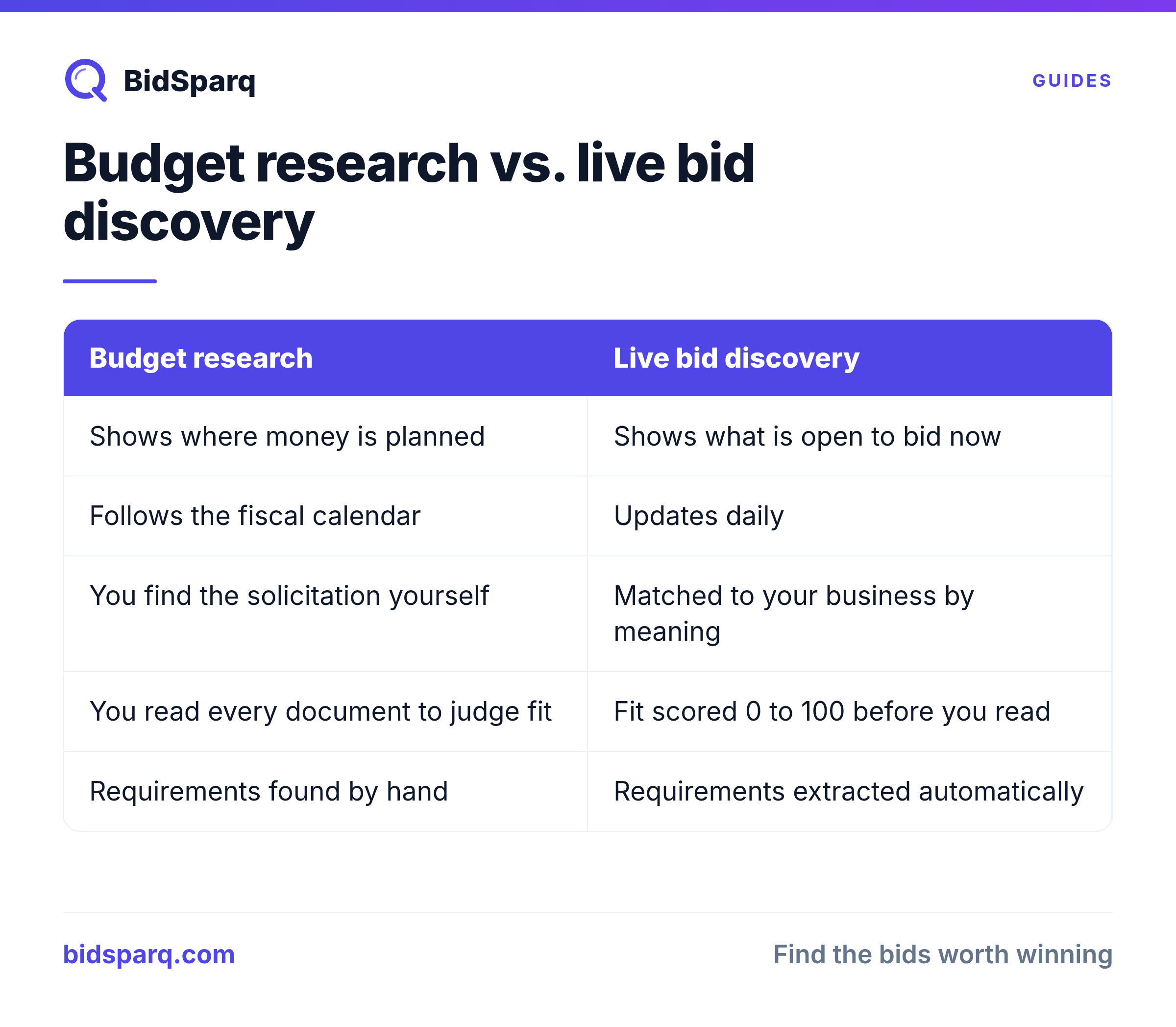
If you are searching for civic federation alternatives, you probably do not need another budget report. You need to know which spending plans in those reports will become a solicitation you can win, and how much warning you will get before it closes.
This guide names the Illinois, Chicago, and national sources worth using, shows what to read inside each one, and marks the point where checking them by hand stops working.
- The Civic Federation analyzes governments and buys nothing. Binding posting and due dates appear only on the procurement portal of the agency doing the buying.
- Four public filings carry timing clues. Bond official statements show funded projects, consent agendas show incumbents and contract terms, federal contract records show end dates, and procurement forecasts show estimated bid timing.
- Chicago-area bids are spread across separate portals. The City of Chicago, Cook County, and the State of Illinois each post solicitations in their own system, and sister agencies run their own pages.
- Keyword alerts stumble on ambiguous words. As of November 2026, 92 open solicitations mention civic, and the states posting the most are California (17), Virginia (9), and Washington (8).
- Scoring comes before reading. A 0 to 100 fit score lets a small team spend its hours on the few pursuits that deserve a proposal.
The short answer
The closest civic federation alternatives for Illinois and Chicago fiscal analysis are the Better Government Association, the Center for Tax and Budget Accountability, and Truth in Accounting, with COGFA and the Illinois Comptroller for official figures. For comparable research outside Illinois, use the Citizens Budget Commission for New York, and the Volcker Alliance or The Pew Charitable Trusts for cross-state work. For raw data, go to the City of Chicago and Cook County budget portals, EMMA, and USAspending.gov. To find the bids themselves, use the City of Chicago, Cook County, and Illinois procurement portals, or a bid discovery platform that watches all of them daily.
What the Civic Federation is, and the alternatives by use case
Choose a replacement by the job you used the Civic Federation for. The Civic Federation is a Chicago-based nonpartisan research organization that analyzes the finances of the State of Illinois, Cook County, and Chicago-area governments. Some readers want independent analysis of how public bodies raise and spend money. Others sell something and treat that analysis as early warning of demand. The table groups the alternatives by those jobs, with one line on what each is best for.
| Your goal | Alternative | Best for |
|---|---|---|
| Independent fiscal analysis | Better Government Association | Chicago-based watchdog reporting and policy work on how Illinois and Chicago governments operate and spend |
| Center for Tax and Budget Accountability | Chicago-based think tank analysis of Illinois tax, budget, and school funding policy | |
| Truth in Accounting | Chicago-based nonprofit that reviews government financial reports and compares the fiscal condition of states and cities | |
| Illinois COGFA | The Commission on Government Forecasting and Accountability, the Illinois legislature's bipartisan source for revenue forecasts and reports on pensions and debt | |
| Illinois Comptroller | The state's chief fiscal officer, publishing state financial reports and local government financial data | |
| Citizens Budget Commission | Nonpartisan research on New York City and New York State finances and services | |
| Volcker Alliance | Research on state budgeting practices and public sector performance | |
| The Pew Charitable Trusts | Comparative research on state fiscal health across all 50 states | |
| Raw budget and spending data | City of Chicago and Cook County budget portals | The adopted budgets and capital plans themselves, straight from the governments that wrote them |
| EMMA | Municipal bond disclosures and official statements from issuers nationwide, on the free site operated by the Municipal Securities Rulemaking Board (MSRB) | |
| USAspending.gov | Federal award history, including recipients and contract periods | |
| BoardDocs agendas | Meeting agendas and contract approvals for the school boards and local bodies that use the platform | |
| Procurement forecasts and capital improvement plans | An agency's own list of the purchases and projects it expects to bid | |
| Finding the bids themselves | City of Chicago Department of Procurement Services | Open City of Chicago bids, RFPs, and contract records |
| Cook County Office of the Chief Procurement Officer | Open Cook County solicitations and awarded contracts | |
| Illinois Procurement Bulletin | State agency solicitations, published through the state's BidBuy eProcurement system | |
| SAM.gov and other state eProcurement portals | Official federal and state postings, one portal at a time | |
| A bid discovery platform | Open solicitations aggregated across sources and matched to your business |
Take a school district capital plan. A budget analysis can tell you the district intends to modernize buildings over the coming years. It will not tell you when the roofing package posts, which contract vehicle the district plans to use, or who holds the current maintenance agreement. The same holds for a public hospital district planning an equipment refresh, a university expanding its network, or a city replacing a permitting system. If you sell to any of them, analysis alone leaves you one step short of the opportunity.
What to look for in the public sources
Read each primary filing for the timing clue it carries. The sources below are open to anyone, and each answers a specific question about a future bid:
- EMMA official statements. When a public issuer sells bonds, the official statement filed on the MSRB's EMMA site describes what the proceeds will pay for. Look for the project description and the sources and uses of funds. Borrowed money for a named capital project is a strong sign that construction, equipment, and professional services bids will follow.
- BoardDocs consent agendas. Routine contract approvals, renewals, and extensions are often bundled into the consent agenda and passed without discussion. The attached items typically name the vendor, the amount, and the term, which tells you who the incumbent is and when the agreement comes up again. Each board runs its own BoardDocs site, so there is no search across boards, and many public bodies use a different agenda system altogether. You have to know which board you are watching before you start.
- USAspending.gov contract end dates. Federal contract records list a period of performance with a current end date and, where options exist, a potential end date. An end date approaching on work like yours suggests a recompete may be coming, and the record names the incumbent. Treat the date as provisional, because agencies can modify contracts to exercise options or extend the period.
- Agency procurement forecasts and capital improvement plans. Many federal agencies publish forecasts of planned purchases, and many cities, counties, and districts publish multi-year capital improvement plans, including the City of Chicago and Cook County. Both list anticipated projects with estimated timing, and those estimates often slip.
- The procurement portals. SAM.gov, the Illinois Procurement Bulletin, and the city and county procurement sites hold the actual postings, with the binding due date and the full solicitation documents.
Read together, these sources tell you who has funding, who holds the work now, and roughly when the buyer will go to market. Nothing puts all of that in one place for you.
Why does the manual route break down at scale?
Expect volume and vocabulary to defeat manual checking long before effort does. Every source above has its own search, its own format, and its own posting rhythm. A vendor that sells across education, healthcare, construction, and local government is checking dozens of sites on a rolling basis, then opening each document to learn whether the work fits.
As of November 2026, 52,342 solicitations are open right now across the 33,000+ sources BidSparq tracks. No team reads that by hand, so most fall back on keyword alerts, and that is where the second problem starts.
The word civic makes a useful illustration. As of November 2026, 92 of the open solicitations mention it. Read that figure as a measure of ambiguity: the same word can describe a building, a software category, or a community program, so a single alert returns work from unrelated industries while missing relevant bids that never use the term.
Geography compounds the problem. The states posting the most civic solicitations right now are California (17), Virginia (9), and Washington (8). A vendor who watches only the Chicago and Illinois portals never sees those postings, even if the work is a perfect fit and the buyer accepts out-of-state bidders.
Deadlines add a third pressure. 25 of the civic solicitations close within the next 14 days. Anyone who checks sources once a week can first see one of those bids with only days left to respond, which is rarely enough time to qualify the opportunity and write a credible proposal.
See which open solicitations match the capital plans you already track.
How automated matching closes the budget-to-bid gap
Let software match by meaning where a keyword list falls short. Semantic matching reads what a solicitation is asking for and compares it with what your business does. A facilities contractor sees the building renovation and a software firm sees the resident engagement platform, even when neither posting uses the vendor's vocabulary.
Go back to the school district. The budget analysis left three questions open, and automated analysis of the solicitation and award records answers each one:
- Who holds the maintenance agreement? Incumbent intel shows who has the work now, the same answer you would otherwise dig out of board agendas and award records one site at a time.
- How will the district buy? Contract-vehicle intel shows whether the purchase runs through an open bid, a cooperative contract, or another vehicle, which decides whether you can compete at all.
- What is mandatory? Compliance and requirement extraction pulls the required items out of the documents before the go or no-go decision, so nobody discovers a disqualifying requirement a week into the proposal.
A fit score from 0 to 100 then ranks each opportunity against your profile, so the go or no-go conversation starts with a number and a short list of reasons. With a keyword tool, a person does the sorting, scoring, and extraction after the alert arrives. With automated matching, that work is finished before anyone opens the document.
How to pair budget research with a live bid feed
Turn every funding signal into a standing watch. Keep reading budget analysis, whichever source you choose. It tells you which sectors and regions are funding the kind of work you sell, and that shapes where you build relationships and capacity.
Then make each signal operational:
- Log the signal. Note the bond issue, the capital plan line, or the contract end date, along with the buyer and the estimated timing.
- Set up matching for that work. Describe what you would bid on so the solicitation reaches you the day it posts, whatever words the buyer uses.
- Review scored matches on a fixed rhythm. Pursue the high scorers and let the low ones go.
- Check the mandatory items first. Confirm you can meet the extracted requirements before anyone starts writing.
The same routine works in commercial and healthcare procurement, where there is often no public budget document to read at all. A private hospital system sourcing a new nurse call system, for example, publishes no capital plan, yet its RFP can still be matched, scored, and checked for mandatory requirements the same way.
The goal is a short, scored list of live bids tied to the bond issues and capital plans you have already logged, with incumbents and mandatory requirements pulled out before you commit a writer. Start a 14-day free trial and match your first budget signal to open bids, with no credit card required. After the trial, BidSparq Pro Max is $249 per month, or $199 per month billed annually.
FAQ
Is the Civic Federation a government agency?
No. The Civic Federation is an independent, nonpartisan research organization based in Chicago. It analyzes the budgets and finances of the State of Illinois, Cook County, and Chicago-area governments, and it has no role in issuing solicitations or awarding contracts. For official figures, go to government sources such as COGFA, the Illinois Comptroller, and the City of Chicago and Cook County budget offices.
Where does Chicago or Cook County post bids?
The City of Chicago posts bids and RFPs through its Department of Procurement Services, and Cook County posts through its Office of the Chief Procurement Officer. State agency solicitations appear in the Illinois Procurement Bulletin, published through the BidBuy eProcurement system. Sister agencies such as Chicago Public Schools, the Chicago Transit Authority, and the Chicago Park District run their own procurement pages, so full coverage of the Chicago market means watching several portals or using a platform that aggregates them.
How early do bond filings signal a bid?
It varies by project. An official statement appears on EMMA when the bonds are sold, and it confirms that a named project has funding. Bids for a project that is already designed can follow within months, while a multi-phase capital program can release solicitations over several years. Pair the bond filing with the issuer's capital improvement plan or procurement forecast for estimated timing, then rely on the procurement portal for the binding posting and due dates.
Find RFPs that match your business
BidSparq monitors 33,000+ procurement sources and uses AI to score every opportunity against your capabilities. Try it free for 14 days.
Start Free Trial →