How to Price a Federal Bid Without Guessing
A practical guide on how to price a federal bid: build from true cost, extract every requirement, and clear federal reasonableness checks without guessing.
Pricing is where most bids are won or lost, and it is the step teams rush. Bid too high and you never reach the shortlist. Bid too low and you win a year of work that quietly loses money. On a federal bid the pressure climbs further, because the government does not only compare your number to competitors, it tests whether your price is realistic on its own terms.
The hard part is not the arithmetic. It is knowing your true cost basis, reading every requirement that actually drives cost, and pricing against competition you can see instead of imagine. Get those three right and the final number nearly sets itself.
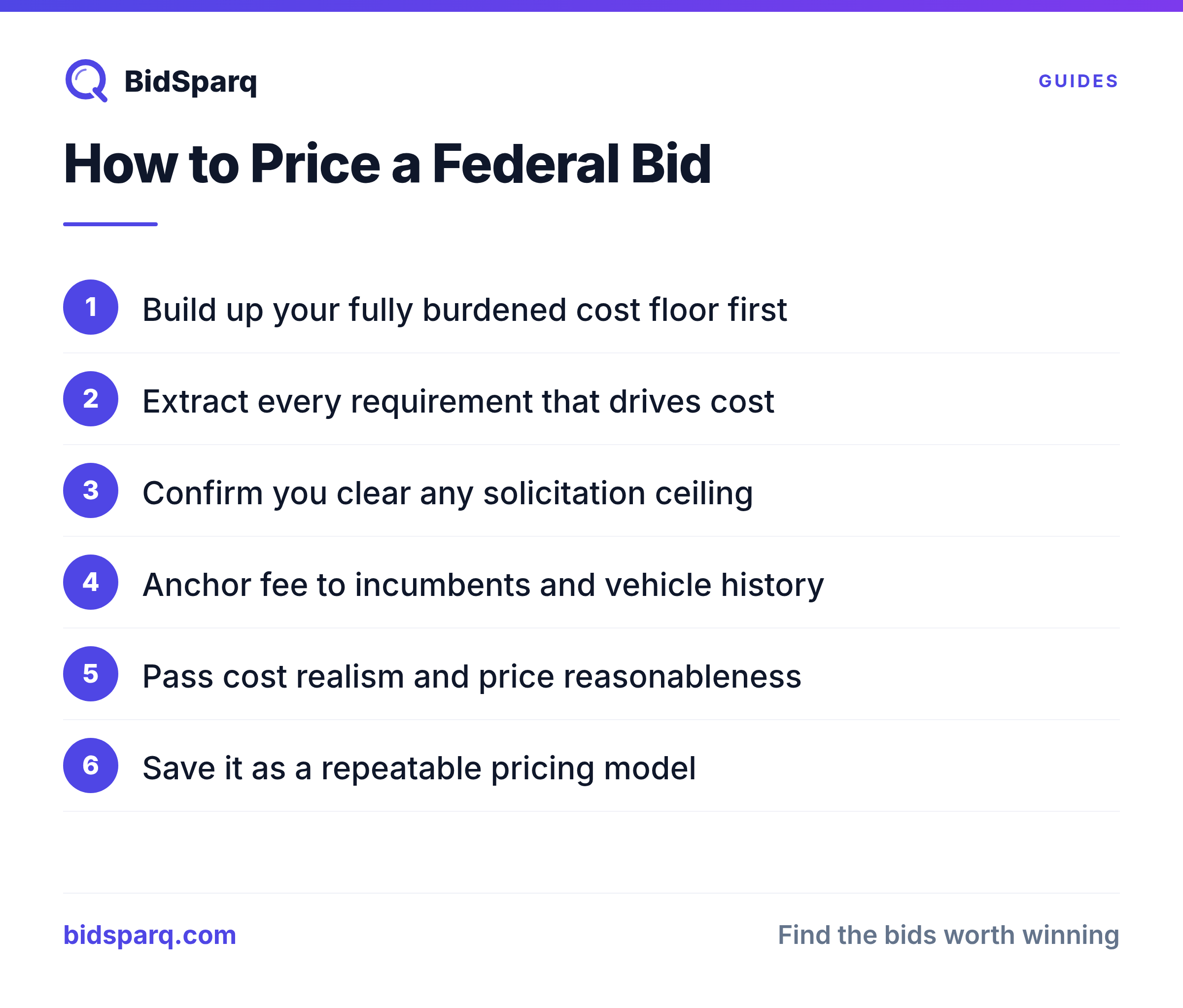
- Start with cost, not price: a competitive number built up from fully burdened cost beats a number reverse engineered from what you hope to win.
- Read the requirements first: the scope you miss in an appendix is the margin you lose after award.
- Price against real competition: incumbents and contract-vehicle history tell you where the number likely lands.
- Federal adds reasonableness gates: cost realism and price reasonableness are pass or fail, not afterthoughts.
- Make pricing repeatable: a model beats a fresh guess on every solicitation.
Start with your true cost, not the price you hope to win
Build your price up from fully burdened cost before you look at any target number. That means direct labor, fringe, overhead, general and administrative expense, materials, subcontractors, and a defensible fee on top. Teams that skip this step tend to anchor on a competitor rumor or last year's award and back into a margin that does not exist. When you know your real cost floor, you can decide how aggressive to be with open eyes instead of hoping the spreadsheet forgives you later.
Cost also tells you which opportunities to walk away from. If your fully burdened rate cannot clear the ceiling implied by the solicitation, no clever pricing rescues it, and the fastest path to profit is often declining to bid.
Read every requirement before you touch a number
Extract the cost drivers from the solicitation first, because the clause you skim is the loss you book. A construction bid can bury a bonding threshold or prevailing-wage schedule deep in an appendix. A healthcare or education RFP can hide staffing ratios, insurance minimums, or service-level penalties that reshape your labor plan entirely. Every one of those lines carries a cost, and manual keyword reading misses the ones that are not phrased the way you searched for them.
This is where automated requirement extraction earns its keep. Instead of one estimator combing a 120 page document, BidSparq reads the solicitation semantically, by meaning rather than exact wording, and surfaces the compliance and requirement language that drives price. Semantic matching also flags obligations a keyword filter would step right over, so your cost model reflects the real scope on the first pass rather than the third.
Price against the competition you can actually see
Anchor your number to who is likely bidding and what they have won before, not to a gut feel. The incumbent almost always has a cost advantage from ramp already paid down, so pricing to unseat one looks nothing like pricing to defend one. Knowing which contract vehicles an opportunity flows through tells you the field of eligible competitors and the pricing norms that field tends to accept.
Keyword tools cannot give you this. They return listings, not context. Incumbent and contract-vehicle intelligence turns a blind guess into a bounded range: you learn who currently holds the work, which vehicles they use, and how similar awards have priced, so your fee decision is a judgment call rather than a coin flip.
Respect the federal rules keyword tools ignore
Treat price reasonableness and cost realism as gates you must pass, not boxes to check at the end. Federal buyers assess whether your price is fair relative to the market and, on cost-type work, whether it is realistic enough to actually perform the scope. A number that looks sharp against competitors can still be rejected as unrealistically low if it cannot cover the labor the work demands. Understand up front whether the acquisition leans toward lowest price technically acceptable or best value, because that single distinction changes how much margin discipline the evaluation will tolerate.
Federal pricing also carries structure that commercial bids rarely do: burdened labor categories, schedule pricing where a vehicle sets rate ceilings, and documentation that has to justify every buildup. Pricing to win here is pricing that survives scrutiny, so keep the trail that shows how you arrived at each number.
Turn pricing into a repeatable model
Template your pricing so every bid starts from the same disciplined baseline. A reusable model with locked cost buildups, standard wrap rates, and a documented fee logic means each new solicitation begins at hour one instead of hour ten. It also makes your pricing defensible, because you can show exactly how the number was built when an evaluator or your own leadership asks.
The compounding benefit is speed. When discovery, requirement extraction, and fit scoring are automated, your team spends its hours on the pricing judgment that machines cannot make, and skips the manual reading that machines do better anyway. That is the difference between chasing every notice and pricing the few you can genuinely win.
FAQ
How do you price a federal bid competitively?
Build the price up from fully burdened cost, confirm it clears any ceiling implied by the solicitation, then set fee based on who is likely bidding and how similar awards have priced. Competitive means the lowest number you can defend without losing money, not the lowest number you can type.
What is cost realism in federal bidding?
Cost realism is the government's assessment of whether your proposed price is realistic enough to actually perform the work as scoped. A bid that undercuts the field can still be rejected if evaluators decide it cannot cover the required labor, so price low with evidence, not optimism.
How much should you mark up a government bid?
There is no fixed markup, because fee depends on risk, competition, contract type, and any vehicle ceilings that apply. Start from your true cost, decide how aggressive the specific opportunity warrants, and document the logic so the number holds up under review.
You cannot price well on opportunities you never see clearly. See your matched bids and fit scores free, no credit card needed, and start every pricing decision from full context.
Find RFPs that match your business
BidSparq monitors 23,000+ procurement sources and uses AI to score every opportunity against your capabilities. Try it free for 14 days.
Start Free Trial →