Best RFP Search Engines Compared (2026): Free and Paid
The best RFP search engines for 2026, free and paid, compared on coverage, matching, price and trial. Vendor facts re-checked October 23, 2026.
Disclosure: BidSparq publishes this guide and sells one of the tools it compares. Every competitor fact below was read on that vendor's own website on October 23, 2026. Where a vendor does not publish a figure, we say so instead of guessing.
The short answer
The best RFP search engine depends on which buyers you sell to. For federal work, start with SAM.gov: it is free, and it is the single place where federal opportunities over $25,000 are posted. For state, local, education and healthcare bids, you need an aggregator, and the right one comes down to budget and how much help you want: InstantMarkets and HigherGov publish low self-serve prices, BidPrime sells broad state and local coverage with a dedicated account manager, GovWin IQ adds analyst-led intelligence at quoted enterprise prices, and BidSparq scores every bid from 30,000+ sources against your profile for $249 a month.
- Free covers federal well and covers state and local only one portal at a time.
- Published prices are the exception: four of the seven tools below quote rather than list a price.
- Matching is the real difference between tools that cover similar sources: keyword alerts, analyst curation, or a fit score.
- Most paid tools here offer a trial or a demo, so test the same week of bids in each before you buy.
How we compared these RFP search engines
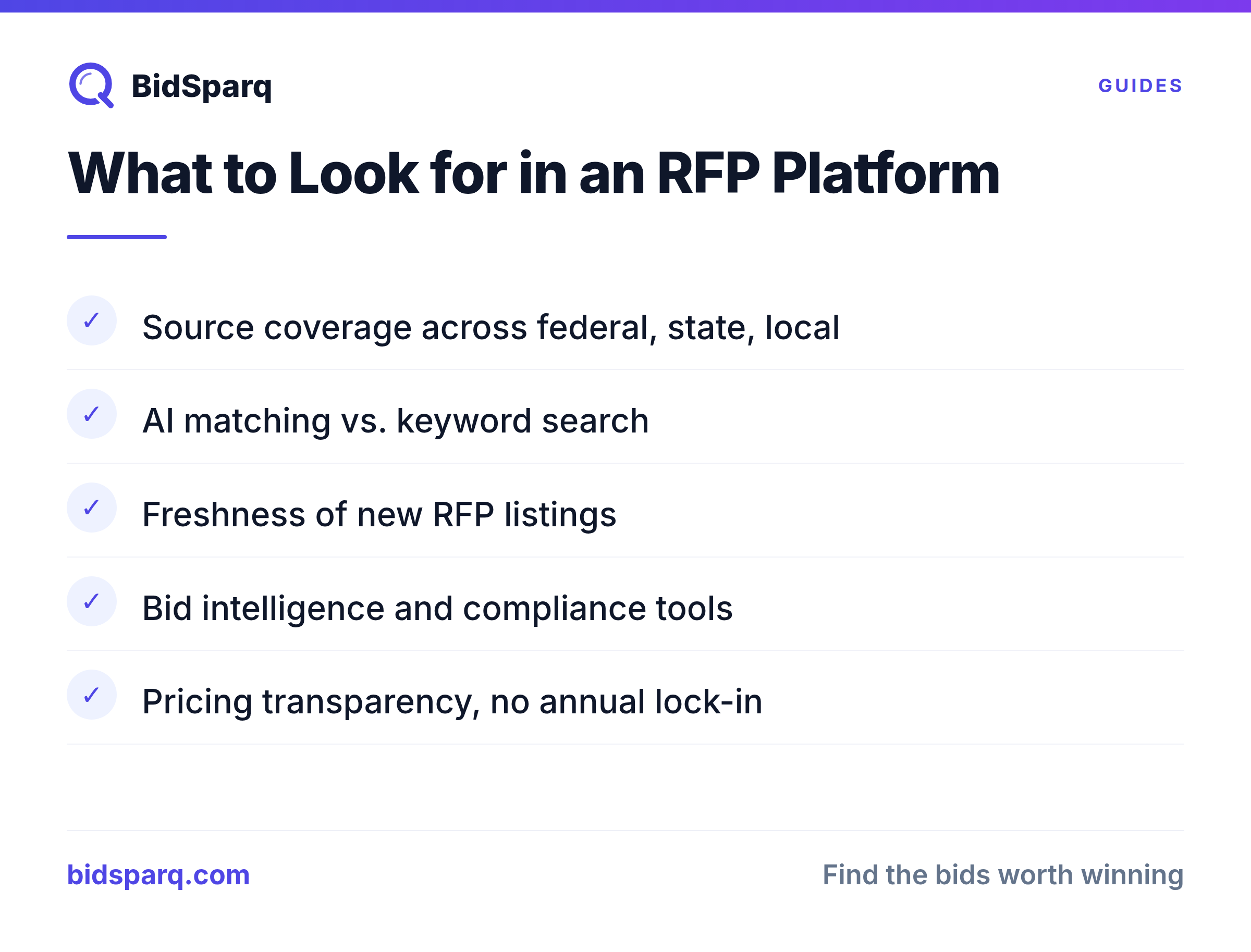
We judged each tool on five things a buyer can check for themselves. Coverage (federal, state and local, education, Canada), how bids reach you (keyword alerts, saved searches, curated or scored matches), whether the price is published, the trial on offer, and what comes beyond discovery (documents, contract history, intelligence). We read each vendor's own pricing and product pages on October 23, 2026. No vendor paid to be listed, and we did not test competitors' paid accounts, so this compares what vendors publish, not hands-on performance. GovTribe, GovSpend and FindRFP are left out of the table because their pricing pages could not be read that day (a bot check, an outage and a blank page); our GovTribe pricing and GovSpend pricing pages carry the figures we verified in September 2026.
Start with the free sources
Use the free official sources before you pay for anything. They are authoritative, and every paid tool draws on them.
SAM.gov: federal opportunities
SAM.gov is the federal government's official point of entry for contract opportunities. Federal agencies synopsize proposed contract actions expected to exceed $25,000 there, so for federal work it is the source of record. You can filter by keyword, NAICS code, set-aside, product or service code and location, and save searches with email notifications. Its limits: it covers federal buyers only, and a keyword search finds the words you typed, so work an agency describes in different words can slip past a saved search.
Federal award history, now in SAM.gov
The Federal Procurement Data System records federal contract awards. Its public search has moved into SAM.gov, and the old ezSearch tool was retired on February 24, 2026. Use it, together with USAspending, to see who already holds the work you want and when it comes up for recompete. Neither shows open bids.
State and local portals
Every state runs its own eProcurement portal, such as eVA, Virginia's eProcurement marketplace, and many counties, cities, school districts and hospital systems post on their own sites or on shared platforms. Each is free to search and each has its own registration and alert rules, which is why monitoring more than a handful by hand gets hard quickly. Our state procurement portals guide lists them by state.
RFP search engines compared
Here is what each paid tool publishes about itself, side by side. "Not published" means the vendor quotes the price through sales.
| Tool | Coverage (as published) | How you find bids | Price (as published) | Trial |
|---|---|---|---|---|
| BidSparq | Federal, state, local, education and healthcare; 30,000+ sources | Every bid scored 0 to 100 against your profile; matching by meaning, not just keywords | $249 a month, or $199 a month billed annually; no annual contract | 14 days, no credit card |
| GovWin IQ (Deltek) | Federal; state and local ("more than 100,000 state and local governments"); Canada | Opportunity tracking, including federal opportunities before public release | Not published | Offered through sales ("Try GovWin IQ Risk Free") |
| HigherGov | Federal opportunities and forecasts; state and local opportunities | Search, alerts, market intelligence, AI tools | $500 a year (1 user); $2,500 a year (up to 10 users); Enterprise custom | Free trial |
| InstantMarkets | Federal and state and local, US and Canada | Unlimited searches and email alerts; AI summaries of key clauses and dates | $60 a month billed annually, or $75 a month | 14 days |
| BidPrime | State, local and education across the US and Canada, plus federal; 120k+ sources | Matched and keyword email alerts; search inside documents; AI assistant on most plans | Not published; billed annually and quoted by geography | 30 days, no credit card |
| BidNet Direct (SOVRA) | Regional purchasing groups, such as the Rocky Mountain E-Purchasing System | Email alerts matched by category and location | Not published on its public pages | Not stated |
| GovSignals | Federal, focused on defense | Signals ranked by fit, plus CRM and AI-drafted proposals | Not published; demo-led | Proof-of-value trial |
Tool by tool
BidSparq
BidSparq monitors 30,000+ federal, state, local, education and healthcare sources and scores every new bid from 0 to 100 against your company profile, so the strongest fits reach you first instead of every keyword hit. It also extracts requirements from solicitation documents and shows incumbent and contract vehicle history. Best for: small and mid-size teams that bid across several levels of government and want ranked matches without a sales process. See BidSparq pricing.
GovWin IQ (Deltek)
GovWin IQ is the long-standing enterprise choice. Deltek says it surfaces DoD and civilian opportunities "years before public release", monitors "more than 100,000 state and local governments", and covers Canada's federal, provincial and MASH markets. Price is by quote. Best for: larger capture teams that want analyst-led pre-RFP intelligence and can run a sales cycle. Compare: BidSparq vs GovWin, GovWin alternatives, GovWin pricing.
HigherGov
HigherGov publishes its prices: $500 a year for one user and $2,500 a year for up to ten, with a custom Enterprise plan. Every plan includes federal opportunities and forecasts and state and local opportunities, and record exports scale by plan. Best for: budget-conscious teams that want market research and opportunity search together. Compare: BidSparq vs HigherGov, HigherGov pricing.
InstantMarkets
InstantMarkets sells one plan: $60 a month billed annually, or $75 a month, with a 14-day free trial. It covers federal and state and local opportunities in the US and Canada, includes unlimited searches and alerts, five or more years of award history, and AI summaries of documents. Best for: a single user who wants the lowest published price for broad search. Compare: BidSparq vs InstantMarkets, InstantMarkets alternatives.
BidPrime
BidPrime monitors 120k+ sources, including newspaper classifieds that small agencies still use, and covers state, local and education bids across the US and Canada with federal included. Plans are billed annually and quoted by geography, with a 30-day free trial and no credit card. Its Core Bidding plan and above include onboarding, training and a dedicated account manager, plus document retrieval through Docs on Demand, and e-bidding through its own Beacon Bid network. Best for: teams that want a done-for-you setup and the widest local coverage. Compare: BidSparq vs BidPrime, BidPrime alternatives.
BidNet Direct
BidNet Direct, run by SOVRA, connects vendors to regional purchasing groups such as the Rocky Mountain E-Purchasing System and sends email alerts matched by category and location. Its public pages do not list prices. Best for: vendors focused on the regions where its purchasing groups operate. Compare: BidSparq vs BidNet, BidNet alternatives.
GovSignals
GovSignals now positions itself as an acquisition platform for the defense market: industry gets signals ranked by fit, a CRM and AI agents that draft proposals, while government buyers use it to run acquisitions. It lists FedRAMP High authorization and Impact Level 5, and pricing is demo-led. Best for: defense contractors who want discovery and proposal drafting in one cleared platform. Compare: BidSparq vs GovSignals.
Where competitors beat BidSparq
No single tool is best at everything, including ours. Choose another tool when one of these matters more to you than ranked matching across every level of government:
- Lowest published price: InstantMarkets ($60 a month billed annually) and HigherGov ($500 a year for one user) both cost less than BidSparq.
- Analyst-led pre-RFP intelligence and Canada: GovWin IQ is built around early federal intelligence and covers Canada; BidSparq does neither in the same way.
- Hands-on service: BidPrime includes onboarding, a person to set up your alerts and a dedicated account manager on its Core Bidding plan and above, plus document retrieval and its own e-bidding network.
- Multi-user value: HigherGov's $2,500 a year covers up to ten users.
- Defense proposals: GovSignals drafts full proposal documents inside a FedRAMP High, IL5 platform.
How to choose by situation
Match the tool to the buyers you actually sell to.
- Federal only, tight budget: SAM.gov saved searches, plus HigherGov if you want market research.
- One user, lowest cost, broad search: InstantMarkets.
- Several levels of government, and you want the best fits ranked first: BidSparq.
- Enterprise capture with pre-RFP intelligence: GovWin IQ.
- Local and education bids with a done-for-you setup: BidPrime.
- Defense pursuits with proposal drafting: GovSignals.
Whichever you shortlist, run the trials in the same week against the same bids you already know about. The tool that finds those, and fewer irrelevant ones, is your answer.
Search engines are one of four kinds of government contracting software
Make sure you are buying the right category. Opportunity discovery tools, the subject of this guide, find and filter open bids. Competitive intelligence tools analyze award history, incumbents and agency spending. Proposal management tools handle writing, compliance matrices and review. Contract management tools track deliverables and modifications after award. Some products span two categories; few do all four well. For proposal tools, see our RFP and proposal management software guide.
When free sources are enough, and when to pay
Free sources are enough while your market is narrow. If you bid only federal work, or follow one or two agencies closely, SAM.gov and those agencies' own pages may be all you need while you learn the market. Paying makes sense when you are missing bids because you cannot watch enough portals, when opportunity research takes hours every week, or when you want to move into state, local and education work, which is spread across too many sites to watch by hand.
How to find RFP opportunities
To find RFP opportunities, search where your buyers post, then automate the watching. Federal opportunities over $25,000 are on SAM.gov. State agencies post on their state's eProcurement portal, and local governments, school districts and hospitals post on their own sites or on shared platforms. Register as a vendor where you plan to bid, save searches using both keywords and NAICS codes, and set email alerts. Once you are watching more portals than you can check daily, an RFP search engine pulls them into one feed. You can also browse open RFPs by state to see what is posted right now.
Is there a search engine for government contracts?
There is no single official search engine for every government contract. SAM.gov is the official search for federal opportunities, but state, local and education bids are spread across separate portals and agency sites. Aggregators, the RFP search engines compared above, come closest to one search box by monitoring many of those sources for you. They differ in how many sources they watch, how they decide what is relevant to you, and what they charge.
FAQ
Is there a free RFP search engine?
Yes, for federal work: SAM.gov is free and is where federal opportunities over $25,000 are posted. State and local portals are free too, but each covers one state or agency. Most paid tools offer a free trial, so you can compare them on real bids before paying.
Can I search government contracts by NAICS code?
Yes. SAM.gov lets you filter contract opportunities by NAICS code, and most paid tools support NAICS search as well. Searching by NAICS code and keywords together catches more than keywords alone, because agencies describe the same work in different words. Our NAICS code lookup helps you find yours.
Do I need more than one RFP search tool?
Usually not. Pair SAM.gov with one paid tool that covers the levels of government you sell to, and avoid paying twice for the same coverage. Teams that also need deep award analytics or proposal software often add a tool from that category rather than a second search engine.
Want to see how scored matching works on your own market? See your RFP matches free for 14 days, no credit card needed.
Find RFPs that match your business
BidSparq monitors 30,000+ procurement sources and uses AI to score every opportunity against your capabilities. Try it free for 14 days.
Start Free Trial →