How Do Contractors Find Upcoming Recompetes? Start Early
How do contractors find upcoming recompetes? Use agency forecasts, USAspending end dates, and board agendas to engage long before the RFP posts.
Most contractors first see a recompete on the day its solicitation posts, and by then they're already late. The incumbent has spent months shaping the requirements and has a buyer who already trusts them. The challenger gets a few weeks to write against a scope it never had a hand in. Yet a recompete is the most predictable opportunity in procurement, because the contract already exists and it has an end date. The problem is that almost nobody tracks that date until it is close.
- Every recompete has a known expiration date, which makes it the easiest bid in the market to see coming.
- Federal acquisition forecasts and USAspending exports show expiring work well before any notice appears on SAM.gov.
- Board agendas and short-term extensions often reveal a rebid long before a solicitation exists.
- Option years, bridge contracts, and set-aside changes can move the date or change who is eligible to bid.
- Keyword alerts go quiet when a buyer renames the service between contract cycles.
The short answer
Contractors find upcoming recompetes by tracking when existing contracts expire and watching the public signals buyers leave before they rebid. Federal work is the most transparent: agency acquisition forecasts and USAspending.gov award data show what is ending and roughly when. For school districts, public hospitals, universities, and local agencies, the trail runs through board minutes, extension approvals, and public records requests. Aim to engage 12 to 18 months before the end date, while the buyer is still writing requirements and still willing to talk.
Start with contract end dates and federal forecasts
Your pipeline should be built from contracts that are ending, not solicitations that are open. A food service contract at a large school district or an environmental services agreement at a public hospital system carries a base term plus option periods, and those dates are usually public. Boards approve multi-year contracts in open session, and the approval typically states the term. Many universities and municipalities also publish contract registers on their procurement or transparency pages.
When a date isn't published, ask for it. Most states and localities have public records laws that let you request a copy of a current contract, including its term and often its pricing. It's slow, but it turns a guess into a fact.
Federal: read the agency forecasts first
Federal agencies publish acquisition forecasts that list planned procurements for the coming fiscal year, typically with an estimated value, a NAICS code, and an anticipated solicitation date. Some also flag whether a requirement is a follow-on to an existing contract and name the incumbent, which is exactly the recompete signal you want. Rather than visiting each agency's small business office page, start with the Forecast of Contracting Opportunities tool on GSA's Acquisition Gateway, which pulls forecasts from participating agencies into one searchable place you can filter by NAICS code and agency. Agencies that don't feed the tool still post forecasts on their own sites, so check those for your top buyers.
Federal: a USAspending recipe for expiring contracts
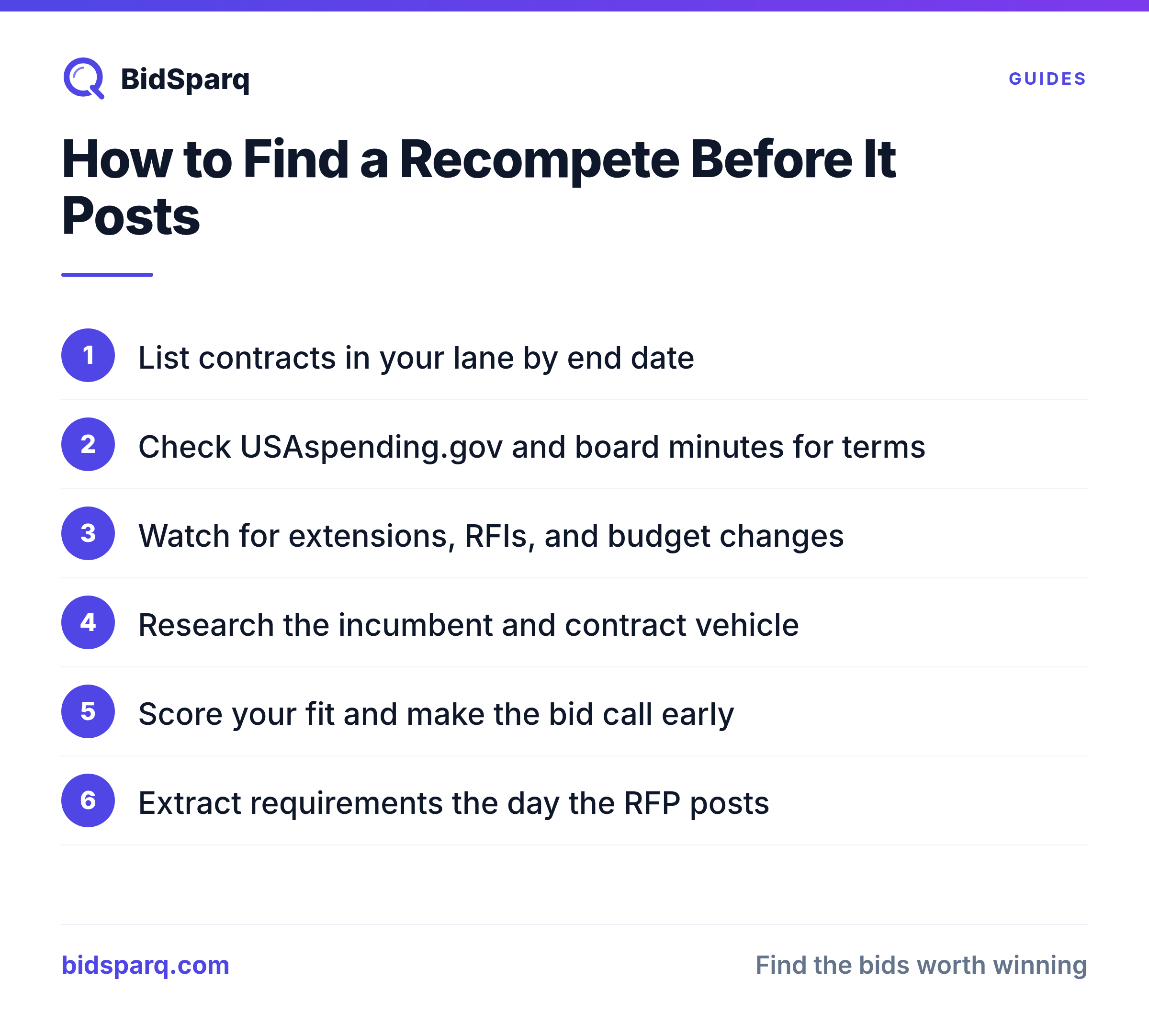
- Open Advanced Search on USAspending.gov and select Contracts under Award Type.
- Add your NAICS codes and Product and Service Codes (PSC) so results match the work you actually do.
- Under Time Period, filter on period of performance end date and set a window roughly 12 to 36 months out.
- Download the award-level results as a CSV.
- Sort by the period of performance current end date column, then compare it with the potential end date column. A large gap between the two means unexercised options remain and the real end date may be later.
- Note the awarding office and incumbent for each row, then check SAM.gov for related sources sought or presolicitation notices.
Read the signals buyers leave before the rebid
Before a rebid posts, look for the paper trail the buyer leaves behind. Buyers rarely go straight from a signed contract to a new RFP. In between, they leave clues:
- Extension approvals. A short-term extension of an existing contract on a board agenda often means a rebid is being prepared.
- Sources sought notices and RFIs. Requests for information are market research, and they're your best chance to shape the scope.
- Budget documents. A new line item or a shift in a department's budget can signal a scope change at renewal.
- Performance concerns in the minutes. Recorded complaints about a current vendor suggest the buyer may be open to a change.
BoardDocs hosts agendas and minutes for many school boards and local governments, and it's searchable. When the RFI or pre-bid notice finally posts, it may land on a state eProcurement portal or only on the buyer's own procurement page.
Watch for name changes. A county's "job order contracting" agreement can come back as "on-call construction services," and an IT "help desk support" contract can return as "end user services." The work is the same, but an alert built on last cycle's title never fires. BidSparq matches solicitations by meaning rather than keywords, so a renamed rebid still lands in your feed instead of slipping past.
Why manual recompete tracking breaks down
Don't expect a spreadsheet of end dates to scale past a short watch list. The method above works for a few dozen contracts. It falls apart across hundreds of buyers, each with its own board calendar and its own portal. As of November 2026, 51,201 solicitations are open across the 30,000+ sources we track, and 5,071 new solicitations mentioning "contractors" were posted in the last 30 days alone. Nobody can read that volume by hand and still notice which postings are rebids of contracts they've been watching.
Keyword alerts don't solve it, because of the renaming problem above. A hospital's "biomedical equipment maintenance" can return as "clinical engineering services," and the old alert stays silent. Timing makes it worse. As of November 2026, 2,103 open "contractors" solicitations close within the next 14 days. That count covers all postings, not recompetes specifically, but it shows how short the window usually is once work goes public, and two weeks is nowhere near enough to start capture from zero.
Automation fixes the triage as well as the discovery. Every match gets a fit score from 0 to 100 against your capabilities, so the few rebids worth pursuing rise to the top instead of sitting buried in a daily list.
Get rebids of contracts you're watching flagged even when the buyer renames them, free for 14 days, no credit card needed.
Turn recompete intel into a bid or no-bid call
Decide whether to pursue a recompete months before it posts, and let the incumbent's position drive that decision. An incumbent with a clean record and a buyer that keeps extending them is a hard target. One with recorded performance problems, or a contract bought through a cooperative purchasing vehicle you already hold, is a different opportunity entirely. Incumbent and contract-vehicle intelligence shows who held the work and how it was procured, so you can spot a locked-up rebid before you spend a week on it.
Federal recompetes add three traps to check before you commit:
- Bridge contracts. When a rebid slips, agencies often keep the incumbent working, either through the option to extend services clause at FAR 52.217-8, which allows up to six more months, or through a short sole-source bridge with its justification posted on SAM.gov. A bridge pushes the date out and tells you the agency's timeline is slipping, so recheck the forecast before you replan.
- Option-year traps. The current end date assumes the next option won't be exercised. If it is, the recompete moves out a year. If the agency declines an option, the rebid can arrive early. Track the potential end date and watch for option exercise modifications.
- Set-aside changes. A recompete isn't guaranteed to keep its prior set-aside. The contracting officer redoes market research, so a full and open contract can become a small business set-aside or the reverse, and an incumbent that has outgrown its size standard may no longer qualify. Answering the sources sought notice is how you influence that decision.
Once the solicitation posts, speed matters more than discovery. Automatic compliance and requirement extraction pulls mandatory forms and certifications into a checklist, so your team spends its short window on win themes instead of rereading the scope.
Recompetes reward the teams that show up first. The contracts are already on the calendar; your job is to read it.
FAQ
How far in advance should you start tracking a recompete?
Start a year or more before the current contract expires. Buyers often begin market research and scope drafting well ahead of the solicitation, and that window is when you can talk with them and influence the requirements. If you wait until the RFP posts, you usually get only a few weeks to respond.
Where can I find when a federal contract expires?
Start with agency acquisition forecasts and the forecast tool on GSA's Acquisition Gateway, then confirm dates in USAspending.gov. In a USAspending download, compare the current end date with the potential end date: the difference tells you whether option years remain that could push the recompete out. SAM.gov carries the sources sought and presolicitation notices as the rebid approaches.
How do you find recompetes for school districts and public hospitals?
Read board meeting agendas and minutes, where multi-year contracts and extensions are approved in public. If the term isn't listed, file a public records request for the current contract. A tool that tracks incumbents and matches by meaning can then surface the rebid when it posts, even if the service has been renamed.
Start your 14-day free trial of BidSparq and see upcoming recompetes, scored for fit, before the RFP drops. No credit card required.
Find RFPs that match your business
BidSparq monitors 30,000+ procurement sources and uses AI to score every opportunity against your capabilities. Try it free for 14 days.
Start Free Trial →