Capture Management: Win Bids Before the RFP Drops
Capture management is how teams win bids before the RFP is published. Here is how to build an early, repeatable capture process across any procurement market.
Most bids are decided before the RFP is ever published. By the time a solicitation lands in your inbox, the requirements often reflect whoever was talking to the buyer months earlier, shaping the scope and quietly tilting the evaluation criteria. That is the hard truth behind capture management: the work that wins deals happens in the quiet window before the clock starts, not in the frantic weeks after. If your team only reacts to posted opportunities, you are competing for scraps that someone else already framed.
Capture management is the discipline of finding the right opportunities early, qualifying them honestly, and positioning your team before the formal process begins. It applies everywhere procurement happens, and getting it right is the difference between a pipeline you can forecast and a scramble you can only survive.
- Capture starts early: the highest-leverage work happens before the RFP is posted, not after.
- Qualification beats volume: chasing every notice burns your team; scoring fit first protects it.
- Keyword search misses deals: opportunities reworded or filed under an odd category slip past manual searches.
- Compliance is a capture signal: reading requirements early tells you whether you can actually win.
- Incumbent intel changes the call: knowing who holds the contract and how it was bought reshapes your bid decision.
- Capture is a rhythm: a repeatable weekly process beats heroics from one person.
Capture management is a pipeline, not a scramble
Treat capture as an always-on pipeline, not a fire drill triggered by a posted RFP. Consider a commercial construction firm that wants a steady book of hospital renovation work. If it waits for each project to hit a bid portal, it is already behind the competitors who tracked the facility's capital plans, spoke with the owner's representatives, and understood the budget before the design was final. Capture management reframes the job from "respond fast" to "see it coming." That shift is what turns a lumpy, unpredictable win rate into a pipeline you can actually plan staffing and cash around.
The same pattern holds for a medical device supplier tracking group purchasing renewals, an IT services vendor watching a health system's ERP roadmap, or a facilities contractor following a university's deferred maintenance backlog. The market is different in each case. The mechanic is identical: get in early, or accept a lower probability of winning.
Qualify opportunities before you commit resources
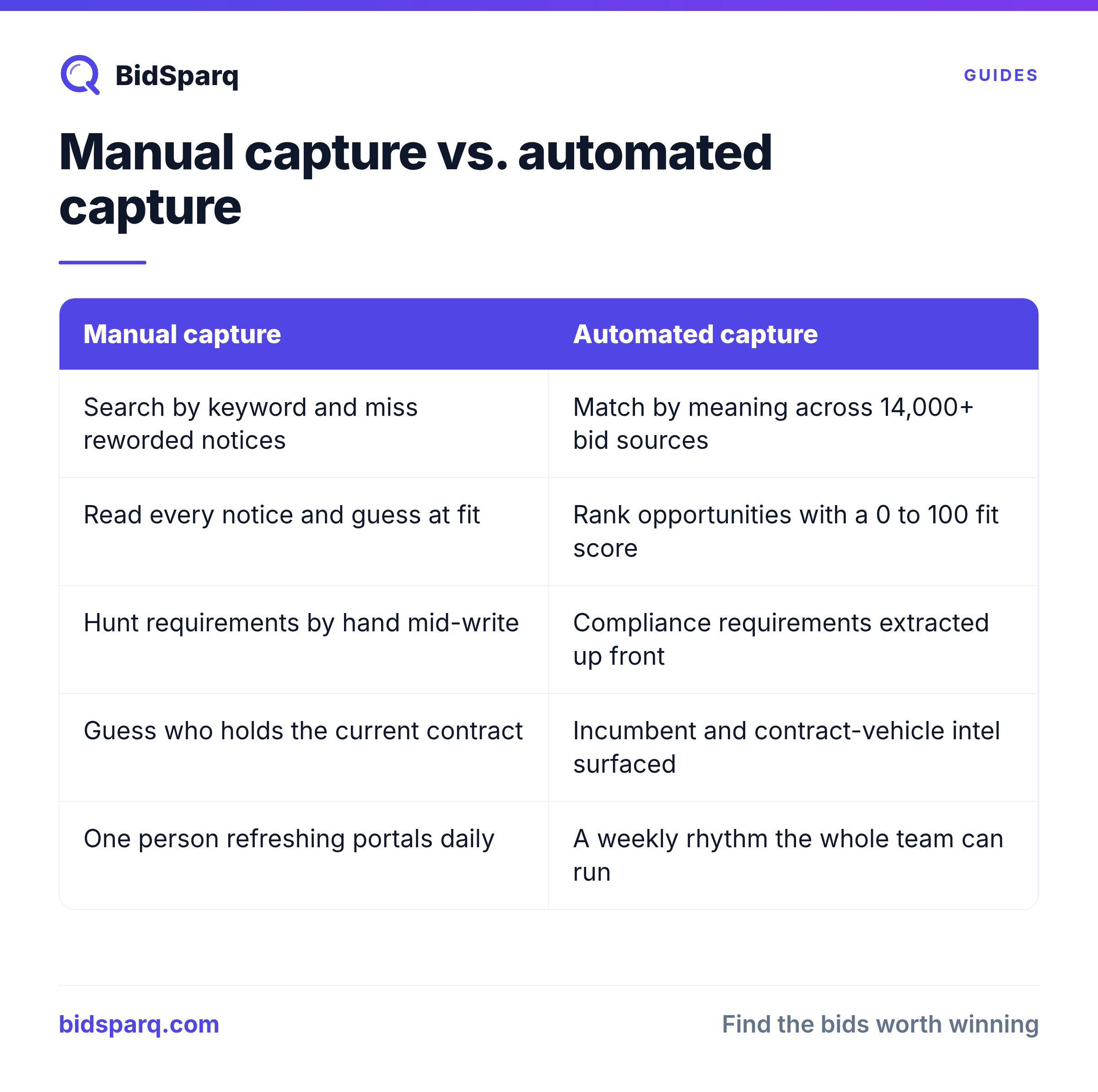
Score fit before your team writes a single word. The most expensive mistake in capture is pouring senior time into a bid you were never going to win. Manual qualification is slow and biased: people chase the opportunity they find exciting, not the one they can actually take. This is where automated fit-scoring earns its keep. Instead of reading every notice and guessing, semantic matching finds opportunities by meaning rather than exact keywords, and a 0 to 100 fit score ranks them against your real capabilities. A weak match at 34 gets a fast pass. A strong match at 88 gets your best people. Your capacity goes to the deals that deserve it.
Good qualification is also honest qualification. The score is a starting point for a conversation, not a verdict. But having a consistent, automated baseline means the whole team is arguing from the same facts instead of the loudest opinion in the room.
The manual capture trap
Stop trying to out-search a market that never sits still. Buyers post opportunities across thousands of portals, agency sites, and category systems, and they rarely use the words you would search for. A keyword hunt for "cybersecurity" misses the notice filed as "information assurance services," and a manual sweep of a handful of portals misses the ones you never thought to check. That is how good-fit deals go dark until a competitor announces the win. Aggregating 23,000+ distinct bid sources daily and matching them semantically closes that gap, which is the practical reason teams lean on a platform like purpose-built bid discovery software instead of a folder of saved searches.
The manual trap has a second cost: burnout. When capture depends on one person refreshing portals every morning, the pipeline is one resignation away from going dark. Automating discovery and scoring makes capture a process the whole team owns rather than a single point of failure.
Build a capture rhythm your whole team can run
Turn capture into a weekly rhythm anyone on the team can execute. The best capture programs are boring in the best way: they run the same loop every week. New matches surface and get fit-scored. High scores get a quick bid or no-bid decision. For the deals worth pursuing, the team pulls the requirements and the intel that decide the outcome. Automatic compliance extraction lists the mandatory requirements up front, so you learn whether you can meet them in minutes instead of on day nine of writing. Incumbent and contract-vehicle intel tells you who currently holds the work and how it was bought, which often reveals whether an opportunity is genuinely open or effectively wired for the current provider.
Put those pieces together and capture stops being guesswork. You are qualifying on fit, reading requirements early, and reading the competitive picture before you spend a dollar on proposal writing. That is capture management working as intended: fewer bids, better bids, higher win rate.
FAQ
What is capture management in bidding?
Capture management is the pre-RFP work of identifying promising opportunities early, qualifying them for fit, and positioning your team to win before the formal solicitation is published. It covers opportunity discovery, bid or no-bid decisions, requirement analysis, and competitive intelligence. Done well, it raises win rate by focusing effort on the deals you can actually take.
How is capture management different from proposal management?
Capture management happens before the RFP and decides which opportunities you pursue and how you position for them. Proposal management happens after the RFP drops and focuses on producing a compliant, compelling response on deadline. Capture sets you up to win; proposal execution converts that advantage into a submitted bid. Weak capture makes even a flawless proposal a long shot.
When should capture management start?
Capture should start as early as you can see an opportunity forming, often months before a solicitation is posted. The earlier you understand the buyer's needs, budget, and requirements, the more you can shape your positioning and make a clear-eyed bid decision. Waiting until the RFP is published means competing on terms someone else may have already influenced.
Ready to build a real capture pipeline? Start with the opportunities worth your time. See your best-fit bids free with capture-ready bid discovery, no credit card needed.
Find RFPs that match your business
BidSparq monitors 23,000+ procurement sources and uses AI to score every opportunity against your capabilities. Try it free for 14 days.
Start Free Trial →