HVAC Bids: Finding the Work That Never Says HVAC
Many HVAC bids never use the word HVAC. Learn where to find mechanical work across healthcare, education, commercial, and public buyers, and how to qualify it before estimating.
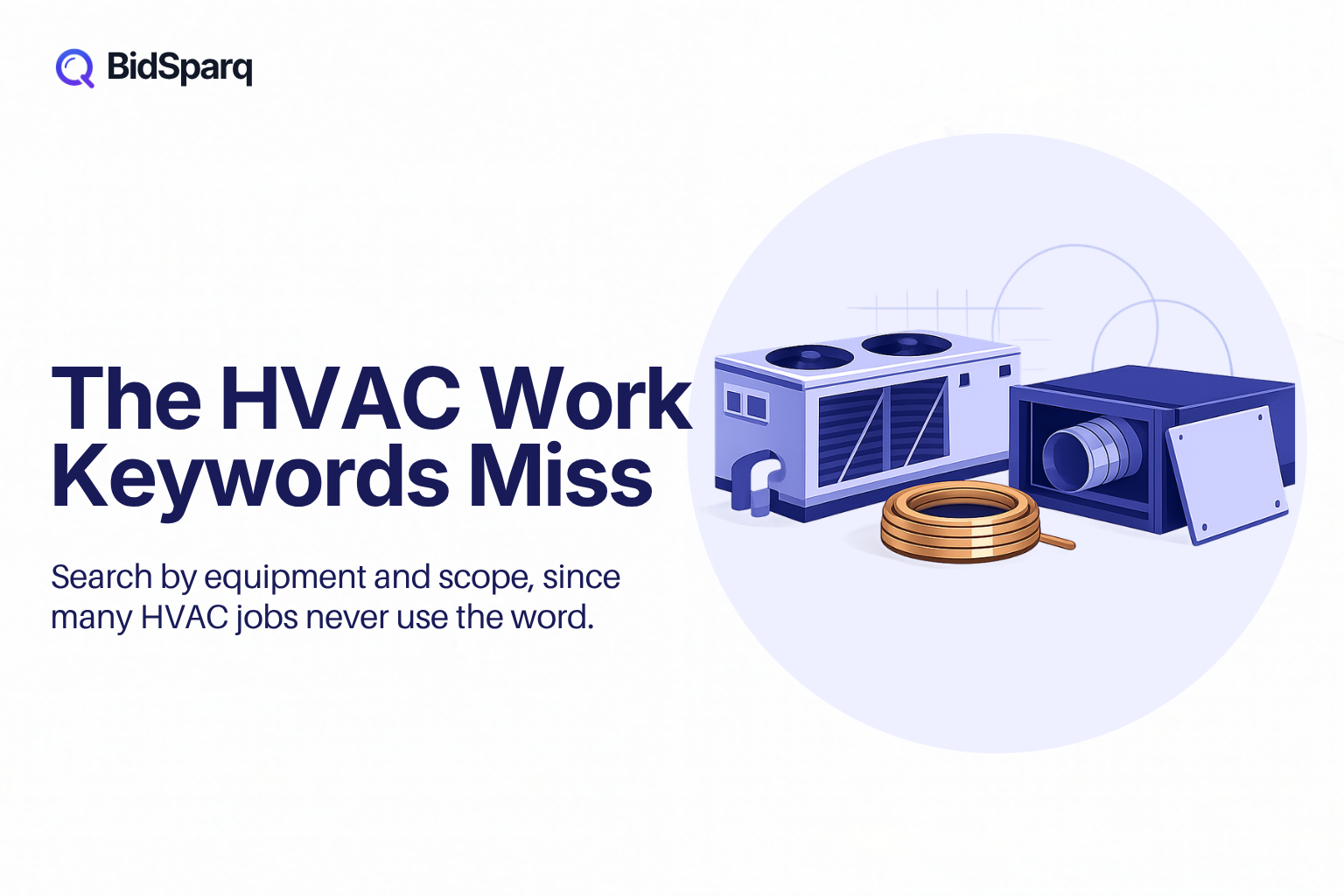
The hardest part of winning HVAC work is often finding it. A hospital may ask for air handler replacement, a private college may call its project a chiller retrofit, and a property manager may fold the work into a facilities maintenance package. If your search depends on the word "HVAC," good jobs can pass you by without ever appearing on your list.
- The acronym is a weak filter: buyers often describe the equipment or the outcome instead.
- Late discovery can end a pursuit outright when a mandatory pre-bid walkthrough has already passed.
- Licensing and bonding rules can disqualify a strong price before anyone reads it.
- Incumbent research belongs before the takeoff, since it shows what your number has to beat.
- Replacement, service, and new construction each reward a different kind of proposal.
The short answer
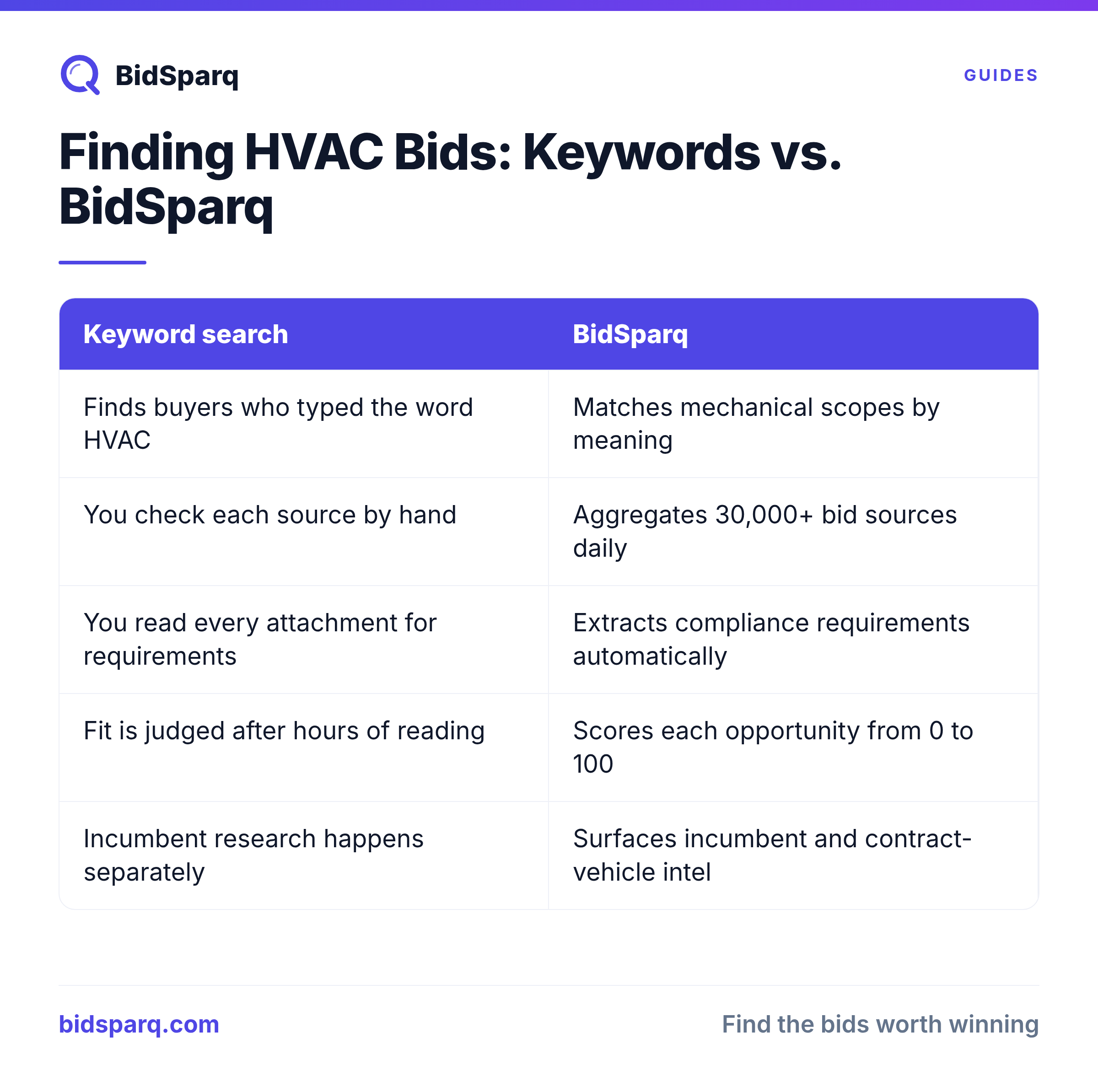
The best way to find HVAC bids is to monitor several bid sources with searches built around equipment, building type, and scope, then screen each opportunity for fit before estimating. Hospitals, schools, commercial owners, general contractors, and public agencies all buy this work, and they post it in different places under different names. As of November 2026, 1,061 open solicitations across the 30,000+ sources we track mention "hvac," and that count only includes buyers who used that exact term. Put your estimating hours into the jobs your crews can perform, staff, and bond.
Search the way buyers write their scopes
Build your search list around the words buyers actually use. Start with equipment: rooftop units, chillers, boilers, cooling towers, air handlers, ductwork, and building automation controls. Then add the language of the project itself, such as mechanical replacement, ventilation upgrade, indoor air quality, or planned maintenance.
Building type changes the vocabulary as well. Healthcare scopes may focus on infection control and room pressure. A school project may center on ventilation and a tight installation window during summer break. Commercial owners may tuck mechanical work inside a tenant improvement or a wider building retrofit. Keep a running list of terms from the jobs you have won, because your past scopes are the best guide to how your next buyer will write.
Check every channel where this work appears
Cover more than one source, because no single portal holds this market. For public work, check SAM.gov for federal opportunities, your state's official eProcurement portal, and DemandStar for participating local agencies. For schools, BoardDocs agendas can surface planned capital projects at districts that use it, sometimes before a solicitation is posted. For private work, stay on the invitation lists of the general contractors you trust, and watch the supplier pages of healthcare systems and universities in your service area.
The volume makes this hard to sustain by hand. As of November 2026, 1,190 new "hvac" solicitations were posted in the last 30 days, and that figure still leaves out jobs written in other terms. California (97), New York (88), and Texas (78) currently post the most, yet a national ranking matters less than your own radius. Multiply a dozen search terms by every portal and plan room you cover, and the daily check becomes a part-time job that still depends on keywords.
See your HVAC matches free for 14 days, no credit card needed.
Screen each opportunity before the takeoff
Make the bid or no-bid call before an estimator opens the drawings. Timing comes first: as of November 2026, 453 "hvac" solicitations close within the next 14 days, so a job found late may leave too little time for equipment quotes or a required site visit. Next, confirm the disqualifiers: state mechanical licensing, EPA Section 608 certification for technicians handling refrigerants, bonding capacity, prevailing wage terms, and service response times. Finally, look at the specification. A named equipment brand with no "or equal" language can decide your price before you start.
Doing this by hand means reading every attachment. BidSparq reads the documents for you, extracts compliance requirements automatically, and scores each opportunity from 0 to 100 against your company profile, so your team can start with the strongest fits. Its semantic matching works by meaning, which also helps a chiller retrofit surface for an HVAC contractor even when the acronym never appears.
Find out who you are up against
Identify the incumbent and the contract vehicle before you price. On a maintenance renewal, the current provider knows the equipment, the building staff, and where the problems hide. You can still win that job, though your proposal needs a specific reason to switch, such as better response coverage or a stronger plan for aging units. Previous award records and public meeting minutes can often tell you who holds the work and when it last changed hands.
Also check how the buyer can purchase. Many schools and public agencies can use cooperative contracts such as Sourcewell or OMNIA Partners, which may give them a route around an open bid. If those vehicles keep showing up in your target accounts, joining one may be worth more than another round of searching. BidSparq surfaces incumbent and contract-vehicle intel alongside each match, which replaces much of the record hunting that usually comes before this decision.
Match the pursuit to how your shop makes money
Treat replacement, service, and new construction as separate pipelines. Replacement work rewards careful site knowledge, shutdown planning, and a clear phasing schedule. Service contracts depend on coverage, response times, and technician availability, with margin that arrives over the life of the agreement. New construction usually runs through a general contractor, where your schedule, your submittals, and your relationship can matter as much as the number.
Set a separate go or no-go standard for each pipeline. Record the wins and losses by type, then let those results decide which jobs get an estimator next quarter.
FAQ
Where can I find HVAC bids?
Check SAM.gov for federal work, your state's official eProcurement portal, DemandStar for participating local agencies, and BoardDocs agendas for early signals from school districts that use it. Add general contractor invitation lists and the supplier pages of hospitals and universities for private and institutional jobs.
How do I win HVAC maintenance contracts?
Start by learning who holds the current contract and what the equipment looks like, ideally through a site visit. Then give the buyer a specific reason to switch, backed by response commitments your technicians can truly meet, a clear preventive maintenance schedule, and relevant references from similar buildings.
What do I need to bid on commercial HVAC jobs?
Requirements vary by location and buyer, but expect to show a valid mechanical contractor license, insurance, bonding capacity for larger projects, and EPA Section 608 certification for technicians handling refrigerants. Read each solicitation closely for mandatory walkthroughs, wage requirements, and submittal rules.
Start your 14-day free trial and score your next HVAC pipeline before your team estimates a single job.
Find RFPs that match your business
BidSparq monitors 30,000+ procurement sources and uses AI to score every opportunity against your capabilities. Try it free for 14 days.
Start Free Trial →