Sources Sought Notice: The Quiet Pre-RFP You Shouldn't Skip
A sources sought notice is your earliest signal that an RFP is forming. Here is what one is, why it shapes the requirements, and how to respond so the buyer builds the solicitation around you.

Requirements get shaped before the RFP is ever published, and they get shaped by the vendors who answer the quiet notice that lands first. That notice is the sources sought, and skimming past it is how you end up bidding on a solicitation that was quietly written around a competitor.
Picture an ops lead at a midsize supplier opening what looks like a routine market research request on a Tuesday afternoon. She files it under "later" and moves on. Two weeks later a near-identical notice from a different buyer lands in the same inbox, this time labeled a sources sought notice. Same buyer behavior, different paperwork. By the time the formal RFP publishes, the requirements have already hardened around the competitors who answered the pre-RFP memo first. This pattern runs across every procurement market, from healthcare and construction to education, IT, and commercial buying, and government is only one vertical where it shows up.
Key Takeaways
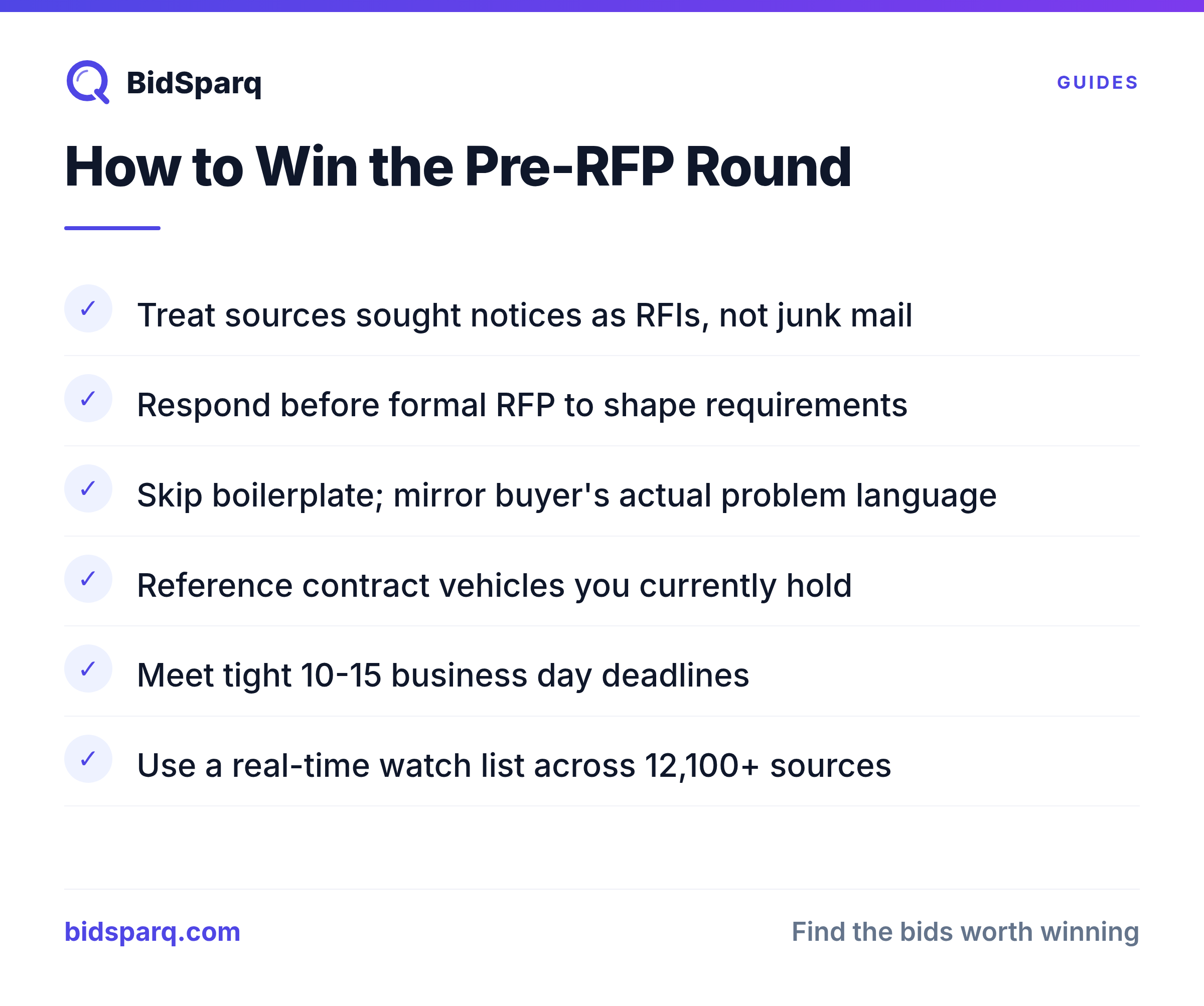
- A sources sought notice is the procurement world's RFI, a pre-RFP signal where you can shape requirements before they harden into a solicitation.
- Responding well puts your name and capabilities in front of the buyer weeks before competitors ever see the formal RFP.
- Boilerplate capability statements get ignored. Strong responses mirror the buyer's exact problem language and name the contract vehicles you hold.
- Deadlines are tight, usually 10 to 15 business days, so a real-time watch list matters more than a heroic writing sprint.
- The same pre-RFP round exists under different names across healthcare, construction, education, and commercial buying: RFI, market sounding, capability survey, prequalification.
- Most of these notices never use the words your team searches for, which is why keyword alerts miss them and semantic matching finds them.
What a sources sought notice actually is
Treat a sources sought notice as the buyer asking the market to teach them how to write the RFP. A contracting officer or category manager publishes one when they need to confirm that qualified vendors exist for a planned purchase, gauge interest from specific business types, justify a set-aside or sole-source path, or collect the pricing structure the eventual solicitation will use. It is not a request for a bid. It is a request for evidence that you can do the work, and quietly, a chance to influence how that work gets defined. Responses are non-binding, and the buyer is under no obligation to follow up. They almost always do, just not in writing. The vendors who understand this stop reading the notice as a survey and start reading it as the first round of the competition.
Why early responders treat it as the real bid
Every requirement in the final RFP started as a sentence somewhere, and that somewhere is often a sources sought response. When you describe your capability in specific language backed by measurable past performance, you hand the contracting officer ready-made evaluation criteria. The suppliers who win the formal RFP are frequently the ones whose pre-RFP language got copied into the statement of work, sometimes close to verbatim. The reverse is just as reliable: skip the notice and your competitors define what good looks like, or respond with generic boilerplate and they define it anyway, only with slightly better manners. The decisive round happens in silence, usually before most of the field even knows a contract is coming. That is why the gap between responders and non-responders is far wider than it looks from the outside, and why the shaping work is worth more than the proposal-writing work that follows it.
How to write a response buyers actually read
Mirror the notice paragraph by paragraph, then attach proof. Open with a short company overview tailored to the NAICS code or industry the notice cites, and answer every question in the exact order it was asked. List specific past performance with dollar values, customer names where allowed, and dates. Name the contract vehicles you hold, whether that is a GSA schedule, OASIS, CIO-SP4, a state cooperative, or a GPO agreement, because the buyer is usually hunting for the easiest compliant path to purchase. Flag any place the planned scope looks unrealistic and propose a workable alternative, since a useful correction reads as expertise. Close with size status and any socioeconomic certifications. Keep the whole thing to five to ten pages and front-load the value, because reviewers rarely read past the first few. The hard part is not the writing. It is knowing who holds the work today and how the buyer prefers to buy, which is the intelligence that turns a generic capability statement into a response aimed squarely at the real purchase path.
The private-sector equivalents you are probably ignoring
The same buyer behavior shows up across every market, just under different labels. A hospital system runs a capability survey before the RFP for an EMR migration. A university posts a request for information for campus food services ahead of the formal bid. A general contractor sends a prequalification questionnaire before a design-build solicitation. A Fortune 500 procurement team runs an RFI to find a managed services partner. None of these carry the phrase sources sought, because that is a federal acquisition term, but the dynamic is identical: the vendor who answers first and answers specifically shapes the requirements everyone else will later compete against. The trap is that these notices rarely use the words your team would think to search for, which is exactly why suppliers who lean on manual keyword alerts miss most of them and never learn what they lost.
How to catch these notices before the deadline closes
Automated discovery beats manual searching every time, because the notices that matter most are the ones your keywords were never built to catch. Crawling SAM.gov, state portals, hospital procurement pages, and university vendor sites by hand is a full-time job, and keyword alerts fail because a notice almost never uses the exact phrase your team uses internally. This is the gap BidSparq closes across 23,000+ bid sources rather than SAM.gov alone. Semantic matching reads the meaning of a notice instead of its keywords, so a sources sought for "patient transport modernization" reaches an ambulance service that never set an alert for that phrase. Incumbent and vehicle intelligence on each notice shows who holds the work today and how the buyer prefers to purchase, so you mirror the right contract path instead of guessing at it. A 0 to 100 fit score ranks the day's opportunities so you answer the right two notices instead of skimming forty. Automatic requirement extraction pulls the questions, deadlines, and set-aside status into one place, so your team spends its hours writing rather than transcribing. That is the shift from treating sources sought notices as a guessing game to running them as a repeatable pipeline.
FAQ
Is a sources sought notice the same as an RFP?
No. A sources sought notice is a pre-solicitation market research request that usually arrives weeks or months before the actual RFP, and it is not a binding opportunity to bid. Your response is information, not a proposal. It carries weight anyway, because it often shapes the requirements in the RFP that follows.
Do I have to respond to a sources sought notice to bid on the eventual RFP?
No, responding is not a prerequisite, and you can still bid on the formal RFP without it. In practice, though, vendors who skip the sources sought stage are bidding against requirements that other vendors helped define, which is a steep and avoidable handicap.
How long should a sources sought response be?
Most notices cap responses at five to ten pages. Treat that range as a hard ceiling and stay near the low end, then aim for a tight, mirrored structure: a short overview, a direct answer to every question, specific past performance, and your contract vehicles. Anything longer reads as filler the reviewer will not reach.
If your pipeline is missing the pre-RFP round, you are answering RFPs that were written for someone else. Start tracking sources sought notices free on BidSparq, no credit card required.
Find RFPs that match your business
BidSparq monitors 23,000+ procurement sources and uses AI to score every opportunity against your capabilities. Try it free for 14 days.
Start Free Trial →