Building Tenders: How to Find the Ones Worth Bidding
Find building tenders worth bidding: where to look in the US, UK, Australia, Canada and the EU, a go/no-go rubric, and the right order to read a package.

Most contractors see only part of the building tenders they could win, and they spend estimating hours on jobs they were never going to get. The work is posted on thousands of separate owner sites, and many of those notices never use the word "building." Checking portals one at a time leaves gaps, while a keyword alert fills your inbox with capacity building programs. Fix the coverage first, then fix the fit.
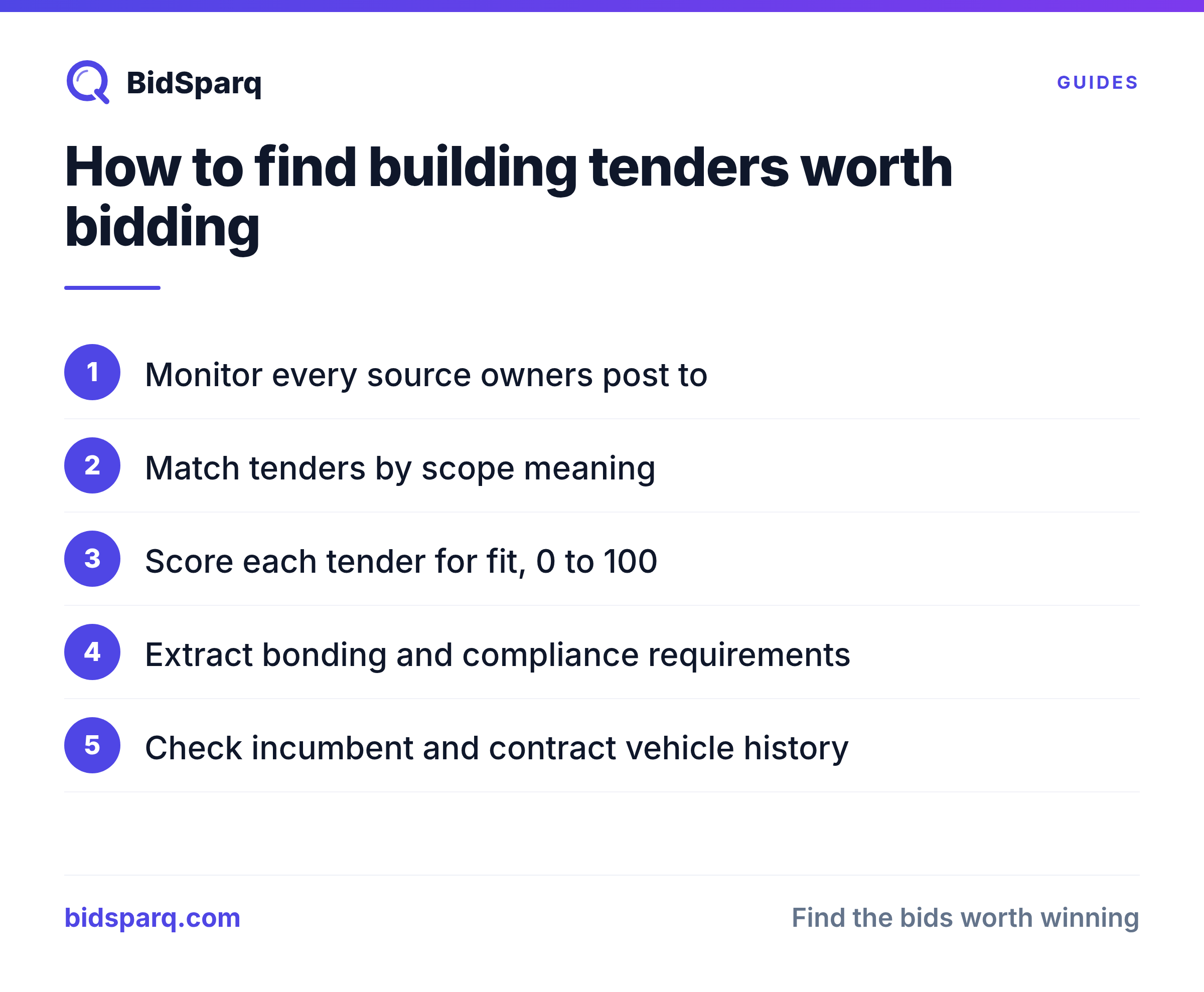
- Score every tender before anyone estimates it. Clear the hard disqualifiers first, then weigh scope, size, location, time left and incumbent.
- The word "building" is a weak filter because it catches "capacity building" and misses a facility envelope tender that never uses the word.
- Board agendas can reveal a project before it is advertised, often at the point when an owner hires an architect or approves a capital plan.
- Check for addenda before you read anything else, because they can change the rest of the package and an unacknowledged one can sink a low bid.
- The instructions to bidders hold most of the quick disqualifiers, so read them before the drawings.
- Outside the US, start with the official portal for your market: Find a Tender, AusTender, CanadaBuys or TED.
The short answer
Bid the building tenders where you clear every hard requirement, the scope matches your trades, and enough time remains to price the job properly. To find them, search public portals, cooperatives and private bid lists by what the work involves rather than by one keyword. As of October 2026, 3,774 of the open solicitations across the sources we track mention "building," and 1,599 of those close within the next 14 days. Those counts are neither a floor nor a ceiling, because they include false positives such as "capacity building" and miss work worded differently.
Where building tenders actually get posted
List every channel your target owners use, then decide how you will monitor each one. A school district replacing roofs and a hospital expanding an outpatient wing may publish on entirely different systems. Each portal has its own registration, its own alerts and its own way of describing scope, so monitoring by hand gets harder with every owner you add.
As of October 2026, 54,398 solicitations are open across the 30,000+ sources BidSparq tracks. The states posting the most "building" solicitations right now are New York (363), California (297) and Massachusetts (224), but those figures count only notices containing that one word. Use them as a sign of scale, not as your market estimate.
See the tenders that match your trades, free for 14 days, no credit card, and compare them with what your current portal checks turned up.
In the US, these sources are worth knowing directly:
- SAM.gov for federal construction work.
- Your state's eProcurement portal for state agency projects.
- State DOT and public works portals, which often run separately from the main state system and may have their own contractor prequalification.
- Cooperatives such as Sourcewell and OMNIA Partners, which run their own solicitations and let public members buy from contract holders.
- Plan rooms, including those run by builders exchanges and general contractors, for drawings and subcontract packages.
- Dodge Construction Network for private and public project leads.
- Bid lists at private owners, developers and general contractors, since invited work may never reach a public portal. Complete their prequalification forms and keep your trade and capacity details current.
If you searched for "tenders" because you work outside the US, start here:
| Market | Start with | Also check |
|---|---|---|
| UK | Find a Tender for higher-value public contracts | Contracts Finder for lower-value work in England, Public Contracts Scotland, Sell2Wales |
| Australia | AusTender for federal work | State portals such as VicTenders and QTenders, plus state contractor prequalification schemes |
| Canada | CanadaBuys for federal work | Provincial and municipal channels such as BC Bid, SEAO in Quebec, and MERX |
| EU | Tenders Electronic Daily (TED) for above-threshold notices | National and regional portals for work below the thresholds |
How to find what a "building" search misses
Search for the work itself, because owners rarely describe it the way your alert does. One owner might post "facility improvements, Phase 2" for a roof and masonry job, while another calls similar work "exterior masonry repair and waterproofing." Keyword lists need constant tuning, and they still fail whenever an owner picks a phrase you did not anticipate.
Automated semantic matching compares what a tender means with what your firm does, so a mechanical contractor can see a chiller replacement even when the notice never says "HVAC." BidSparq applies that matching across its sources, then gives each tender a fit score from 0 to 100 based on scope, location, size signals and stated requirements. A manual alert list gives every notice equal weight. A ranked list lets a K-12 renovation contractor start with the strongest matches and drop the rest quickly. The same approach holds across the broader procurement market, from healthcare services to IT and commercial supply, but building work feels it sharply because preconstruction effort is so expensive.
Some projects can be found before any notice exists. When a board votes to hire an architect, put that project on your watch list. School boards often discuss capital work in public long before a tender appears, which gives you time to line up subs and bonding capacity. A short routine covers most of it:
- Find where each target owner publishes agendas and minutes. Many school districts use BoardDocs, and others post PDFs on their own sites.
- Search recent agendas for "capital improvement plan," "bond program," "architect selection," "construction manager" and "authorization to advertise."
- Read facilities committee minutes too, since projects are often debated there before they reach the full board.
- Log the project, the named architect or construction manager, and the expected next vote, then ask the design firm how the work will be procured.
The same habit works for city councils and housing authorities. An early signal is only a lead, because projects can be delayed or cut, so spend a phone call on it and save the estimating time for the actual tender.
How to decide whether a tender is worth bidding
Run every tender through the same six checks before an estimator opens the drawings. Stop at the first hard failure, and judge the remaining checks together.
- Hard disqualifiers. Can you meet the license, bonding, prequalification, mandatory pre-bid and submission requirements? One firm no ends the review.
- Scope. Does most of the work sit in trades you self-perform or can reliably sub out?
- Size. Is the job within your usual range and your remaining surety capacity?
- Location. Can you supervise it at a sensible cost, and do you have subs nearby?
- Time left. Is there room for a site walk, written questions and sub quotes?
- Incumbent. Who did the last phase, and how did they win it?
Take a hypothetical roofing and masonry contractor looking at a school district's "facility improvements, Phase 2" tender. The license and bonding requirements are met, and the pre-bid meeting is still ahead. The scope fits, the size suits the firm's surety line, and the district is within its working area, though local subs would need lining up. Time is tight but workable. On those five checks, it is a go.
The sixth check can change that answer. Incumbent and contract vehicle intelligence, which a keyword tool cannot supply, might show that another firm finished Phase 1 and that the district bought it through a cooperative contract. If Phase 2 looks written around that firm's earlier work, the contractor should send a written question about how the award will be evaluated, and pass if the answer points to the incumbent. If Phase 1 drew several competing bids and went to the lowest responsive bidder, the field is genuinely open, and the bid stays a go. Where the owner keeps buying through one cooperative, the better long-term move may be to pursue a place on that vehicle or team with a firm that holds it.
Reading a tender package before you price it
Read the package in a fixed order, so any deal-breaker turns up before pricing starts. This order puts the documents most likely to end the review first:
- Addenda. Check for these first, since they can move the bid date, answer questions or rewrite the scope you are about to read. Assign one person to watch for new ones until the deadline and to confirm that each is acknowledged on the bid form. A missed acknowledgment can make even the low bid nonresponsive.
- Instructions to bidders. They set the deadline, submission format, bid security, required forms and any mandatory pre-bid meeting. They also state the cutoff for written questions, which is easy to miss. If you cannot meet one of these terms, stop here.
- General conditions. Often based on a standard form such as AIA A201, and changed by supplementary conditions, they govern payment, retainage, insurance, change orders and liquidated damages. These terms belong in your price, and a harsh damages clause on a tight schedule can make an attractive job a poor one.
- Specifications and drawings. Open these last, once you know the job is worth the estimating time.
Doing this by hand means re-reading long documents for every tender you consider. Automated compliance extraction pulls bonding, licensing, prevailing wage, participation goal and pre-bid requirements into one checklist as soon as a tender is matched. Someone should still confirm them against the source documents, but the first go/no-go check takes far less of your team's time.
FAQ
Where can I find building tenders?
In the US, check owner portals, state eProcurement and DOT sites, SAM.gov, plan rooms, cooperatives and lead services such as Dodge Construction Network. Outside the US, start with official sites such as Find a Tender in the UK, AusTender in Australia, CanadaBuys in Canada or TED in the EU. Since no single source is complete, many contractors also use an aggregator that monitors many sources and sends only matching tenders.
What is the difference between a building tender and an RFP?
A building tender, often called an invitation to bid in the US, usually asks for a firm price against complete drawings and is typically awarded to the lowest responsive, responsible bidder. An RFP is evaluated on qualifications, approach and price together, which is common for design-build and construction manager at risk projects.
What bonds do I need to bid on a building tender?
Many public tenders require a bid bond or other bid security, and the winner usually must then provide performance and payment bonds. On US federal work, the Miller Act sets those requirements above a contract value threshold, and states have their own rules. Ask your surety early, because your available capacity may decide whether you can bid at all.
Your estimators' first hour should go to the tender most likely to pay off. Start your 14-day free trial to get a ranked list with requirements already extracted before anyone opens the drawings. No credit card is required, and Pro Max is $249/mo, or $199/mo billed annually, after the trial.
Find RFPs that match your business
BidSparq monitors 30,000+ procurement sources and uses AI to score every opportunity against your capabilities. Try it free for 14 days.
Start Free Trial →