Best Pre-RFP Tools for Small B2G Companies: Get In Early
Compare the best pre-RFP tools for small B2G companies: SAM.gov, USAspending, GovWin IQ, HigherGov, GovSpend, GovTribe and BidSparq on early signals, SLED coverage, fit scoring, and price.
Most small B2G companies lose a contract before the RFP is ever posted. By the time a solicitation goes public, the buyer has usually shaped the requirements through sources sought notices, RFIs, budget discussions, and conversations with vendors it already knows. If you first see an opportunity on the day it drops, you are bidding against firms that helped write it.
You do not need a business development department to get in early. You need the free public sources buyers are required to publish, plus one tool that does the sorting for you. Here is how the main options compare and how to build a stack a small team can actually run.
- The RFP is the finish line, not the start. Requirements, evaluation criteria, and often the shortlist are set during the pre-solicitation phase.
- Free federal sources are mandatory, not optional: SAM.gov and USAspending.gov cover sources sought notices and recompete timing at no cost.
- Public meeting agendas are an underused early signal for state and local work, because boards discuss projects long before a bid posts.
- Keyword alerts miss any opportunity written in the buyer's language instead of yours.
- Enterprise intelligence platforms are powerful but priced for capture teams, so most small firms get more value from automated matching and scoring.
The short answer
Start with SAM.gov and USAspending.gov, then add one automated discovery platform before you consider an enterprise intelligence suite. The free federal sources should come first because they cost nothing and contain the sources sought notices and expiring contracts that define the pre-RFP window. Second, add an automated platform that covers federal and state and local buyers together and scores fit for you; BidSparq does this at $249/mo ($199/mo billed annually). GovWin IQ comes third, and it makes sense only once you have a dedicated capture person and a budget to match.
Pre-RFP tools compared
Compare tools on what they surface early and what they automate, not on how many listings they advertise. The table below shows where each option fits for a small company. Paid vendors other than BidSparq change their packaging often, so confirm current pricing directly with them.
| Tool | Early-signal coverage | SLED coverage | Fit scoring | Incumbent data | Price tier |
|---|---|---|---|---|---|
| SAM.gov | Federal sources sought, RFIs, presolicitation notices | No | No, manual search and saved filters | Limited, award notices only | Free |
| USAspending.gov | Recompete timing from period of performance end dates | No | No | Yes, federal award history | Free |
| Agency procurement forecasts | Planned federal buys, often months ahead | Rarely | No | Sometimes lists the current vehicle | Free |
| GovWin IQ | Deep pre-RFP intelligence and analyst tracking | Yes | Filters and saved searches | Yes | Enterprise, quote-based |
| HigherGov | Federal forecasts, notices, and awards in one search | Yes | Filters and saved searches | Yes | Paid subscription, tiered |
| GovSpend | State and local spend and purchase history | Yes, its core focus | Filters and saved searches | Yes, from purchase data | Quote-based |
| GovTribe | Federal notices, forecasts, and pipeline tracking | Partial | Filters and saved searches | Yes | Paid subscription |
| BidSparq | New postings across 30,000+ sources, matched as they publish | Yes | Automated 0 to 100 fit score on every opportunity | Yes | Pro Max at $249/mo, or $199/mo billed annually; 14-day free trial, no credit card |
The pattern is clear. The free federal tools are essential but leave you doing every search by hand. The enterprise platforms add depth, but most still depend on filters you build and maintain. Automated matching shifts that work off your team, which matters most when your team is two people.
Mine the free public signals first
Build your early-warning list from the sources buyers are required to publish. Federal agencies post sources sought notices and requests for information on SAM.gov, and responding to one is the cheapest way to get on a contracting officer's radar. A thoughtful RFI response can shape how the requirement gets written, which is the whole point of working pre-RFP. Many agencies also publish annual procurement forecasts, and Acquisition.gov links to them.
USAspending.gov deserves more attention than it gets. It shows who won prior awards, how much they were worth, and when the period of performance ends. Sort by end date and you have the closest thing to a calendar of upcoming recompetes, along with the name of the firm you would be displacing.
State and local buyers are less centralized, and that is where small firms often find the least competition. A school district planning an HVAC replacement or a new student information system usually discusses it in board meetings first, and many districts publish agendas through BoardDocs or a similar portal. County capital improvement plans and your state's official eProcurement portal fill in more of the picture. If you need help interpreting any of it, APEX Accelerators (formerly PTACs) offer free counseling to small businesses.
Recognize where manual tracking breaks
Count your sources before you commit to checking them by hand. One federal portal is manageable. Then you add a state portal, dozens of county and city sites, school district agendas, university purchasing pages, and housing authority postings, and the list outgrows a bookmark folder within weeks. As of October 2026, 52,825 solicitations are open right now across the 30,000+ sources BidSparq tracks, spread across sites that each use their own layout, categories, and vocabulary.
Timing compounds the problem. Manual search finds opportunities in whatever order you happen to check your sites, so a strong fit on a portal you visit monthly may surface with only days left on the clock. At that point you can rarely produce a compliant response, and you have no chance to influence the requirements. Small companies lose most often not because they are outmatched but because they start late, and starting late is mostly a discovery problem.
See which open solicitations fit your company today with a 14-day free trial of automated bid matching, no credit card needed.
Demand four capabilities from a paid tool
Judge any pre-RFP or bid discovery tool by what it automates for you. These four capabilities separate a useful platform from a glorified keyword alert.
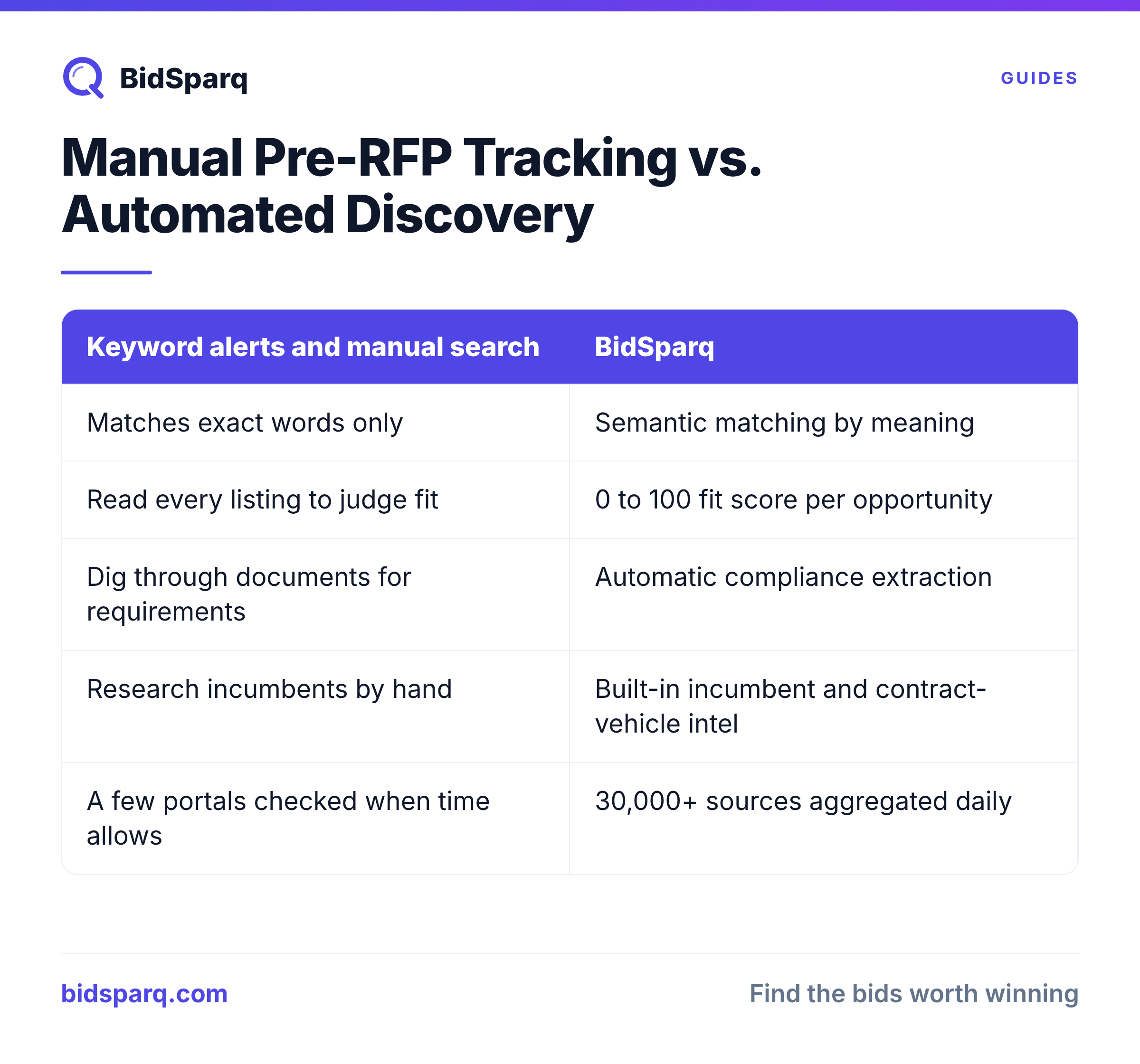
Matching by meaning, not keywords. A county IT office might post "network modernization services" while your capability statement says "managed infrastructure." A keyword alert misses that pair entirely. Semantic matching catches it, which means you stop losing opportunities to vocabulary.
A fit score you can sort by. Filters tell you what matches; a score tells you what matters. When every opportunity is rated from 0 to 100 against your profile, a small team can work from the top of the list and ignore the long tail instead of reading everything.
Automatic compliance extraction. Bonding, certifications, insurance minimums, and submission rules are often buried deep in attachments. A tool that pulls them out up front lets you disqualify a bid in minutes rather than after a day of reading.
Incumbent and contract-vehicle intelligence. If the current holder has years of strong performance, or the work runs through a vehicle you are not on, you need to know before you write a single page. That knowledge tells you whether to compete, team with a partner, or walk away.
Then give the output a fixed routine. Review new matches, sources sought notices, and upcoming recompetes on a set day each week, and make a quick call on each: respond to the RFI, request a capability briefing, find a teaming partner, or pass. Write down why you passed, because those notes will show you which markets to stop chasing. The same discipline works well beyond government, since education, healthcare, construction, and commercial buyers also signal intent before they issue an RFP, and the vendors watching for those signals get to help shape the work.
FAQ
What is a pre-RFP tool for government contractors?
It is any resource that shows you an opportunity before the formal solicitation is released. Examples include sources sought notices, RFIs, procurement forecasts, award history for recompetes, public meeting agendas, and discovery platforms that automatically match and score new postings against your capabilities.
How much do pre-RFP tools cost?
The core federal sources, SAM.gov, USAspending.gov, and agency forecasts, are free. Enterprise intelligence platforms such as GovWin IQ and GovSpend are typically quote-based and priced for organizations with dedicated capture staff. BidSparq is Pro Max at $249/mo, or $199/mo billed annually, with a 14-day free trial and no credit card required.
Is GovWin worth it for a small business?
It can be, if you pursue large federal programs and have someone whose job is to work the intelligence it provides. For most small businesses, the cost is hard to justify early on. Free federal sources plus an automated discovery platform usually cover the pre-RFP window well, and you can revisit GovWin IQ once your pipeline and capture team grow.
Is SAM.gov enough for small government contractors?
SAM.gov is essential for federal work, but it does not cover most state, local, and education buying. Those agencies post on their own portals, board agendas, and purchasing pages, so a small company selling to the public sector needs coverage well beyond the one federal site.
How early should a small business engage before an RFP?
Engage as soon as a buyer signals a need, which usually means a sources sought notice, an RFI, a forecast entry, or a board discussion. For recompetes, track when the incumbent's period of performance ends on USAspending.gov and plan your outreach well before that date.
Start matching your best-fit bids free for 14 days, no credit card required, and put your hours into the pursuits worth winning.
Find RFPs that match your business
BidSparq monitors 30,000+ procurement sources and uses AI to score every opportunity against your capabilities. Try it free for 14 days.
Start Free Trial →