Full-Service RFP Management Solutions: What They Fix
Full-service RFP management solutions promise to handle the whole bid lifecycle. Here is what the term should cover, where the manual cost hides, and how to tell real automation from a keyword feed.
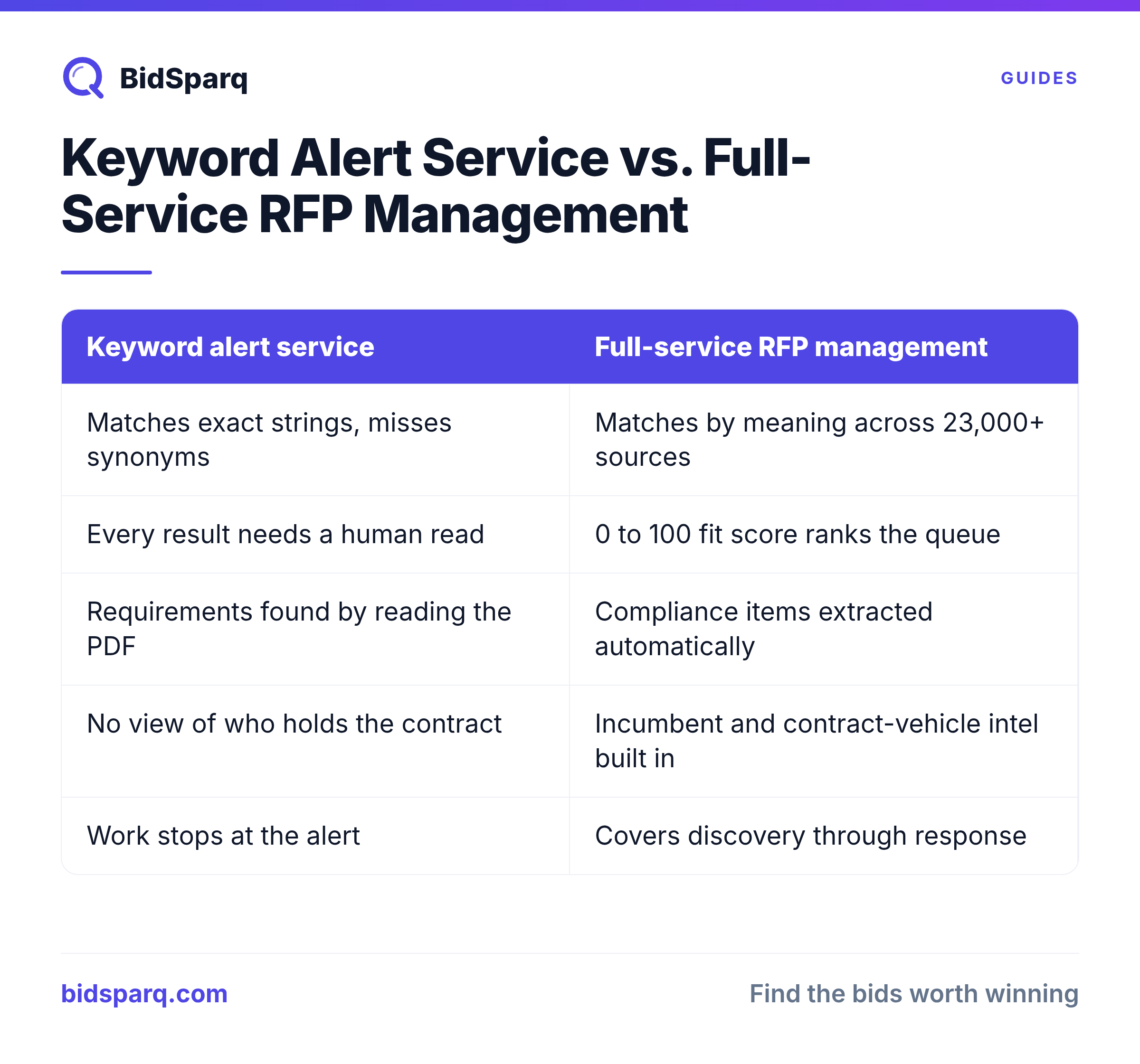
Your team is spending its best hours reading solicitations it will never bid. Portals multiply, alerts arrive by the dozen, and someone still has to open each PDF to learn whether the buyer wants a full-service janitorial contractor or a one-time deep clean. Full-service RFP management solutions exist to take that reading off your plate, but the label gets applied to everything from a daily email digest to a staffed proposal shop. This guide explains what the term should mean, where the real cost hides, and how to tell an automated pipeline from a keyword feed with a nicer name. Put any vendor that claims the label through the five questions below before you believe the brochure.
- Does it find by meaning? "Custodial services," "building maintenance," and "janitorial" should land in the same queue without you maintaining a synonym list.
- Does it score fit from 0 to 100 on every match, so one person can triage the queue without opening each document?
- Does it extract bond and certificate of insurance limits automatically, or does someone on your team still read the attachments to find the disqualifier?
- Does it tell you who holds the contract today and which purchasing vehicle the buyer is likely to use before you commit writing hours?
- Does it treat education, healthcare, construction, and commercial buyers as fully as government, and does it publish its price?
The short answer
Full-service RFP management solutions handle the whole bid lifecycle for you, from finding solicitations across every portal to matching them against what you sell, extracting the requirements, and supporting the response, so your team only touches bids worth winning. The practical difference from a bid alert service is the work after the alert. A true full-service platform scores fit and extracts compliance items automatically, and it tells you who holds the contract today and which purchasing vehicle the buyer is likely to use before you invest hours. For most teams the right choice is software that automates those stages, with people reserved for pricing, strategy, and the writing itself.
What "full-service" should actually cover
Define the service by the stages it removes from your week, not by the number of portals it claims. Every RFP has a lifecycle. It is posted, it has to be found, it has to be judged for fit, its requirements have to be pulled out and checked, and a response has to be assembled and submitted. A full-service solution covers all of those stages. Picture a regional food service company deciding whether to chase a hospital system's full-service cafeteria management contract. Discovery is the easy part. The hard questions are whether the scope matches what the company actually does, whether a required certification is held, who holds the contract today, and how many hours the response will take. A solution that answers only the first question is an alert service, whatever its marketing says.
The same test applies across the market. A commercial landscaping firm looking at a university's grounds contract, an IT reseller weighing a managed print RFP from a community college, and a general contractor sizing up a school district's design-build project all need the same answers after discovery. Those buyers differ in nearly every way except the questions they force a vendor to answer before writing a word, and a service that cannot answer them for a college or a hospital as readily as for a city hall is not full-service in any useful sense.
Where the manual effort piles up
Count the hours before you count the fees. Volume alone explains why outsourcing feels tempting. As of October 2026, 52,390 solicitations are open across the 23,000+ sources BidSparq tracks, and 815 new solicitations mentioning "full-service" were posted in the last 30 days. Even a narrow niche produces more documents than one person can read, and that is before the real work: cross-checking scope, due dates, bonding and insurance requirements, mandatory site visits, and submission formats that differ from one buyer to the next. Manual review scales linearly with volume, so every new portal becomes another login, another saved search, and another set of PDFs that someone has to open and skim.
Keyword tools do not fix this. They move the bottleneck. A saved search for "janitorial" misses the solicitation titled "custodial and building services," and a search for "managed print" misses "output device fleet." The team ends up reading the misses anyway, or it ends up missing them entirely, and either way the cost lands on people. That is why so many teams end up paying a human service to do the reading, when what they needed was software that reads for meaning.
See which open solicitations score above 80 for your firm, free
The layers that separate full-service from a search tool
Judge any solution on what it automates after discovery. Three kinds of vendor use the full-service label: bid-alert digests (portal email alerts and aggregator newsletters), staffed proposal services (proposal consultancies and bid-writing shops), and automated platforms (software that reads, scores, and extracts). The table shows what each one actually does at every stage of the lifecycle.
| Stage | Bid-alert digest | Staffed proposal service | Automated platform |
|---|---|---|---|
| Discovery | Keyword alerts from the portals it covers; new phrasings are missed | Consultants search on your behalf, limited by the hours you buy | Semantic matching across every source, by meaning rather than string |
| Fit triage | None; your team reads every alert | Done by hand for the pursuits you pay them to review | Fit score from 0 to 100 on every match, automatically |
| Requirement extraction | None; you open the attachments | Thorough, but billed per proposal and started only after you commit | Bonds, COI limits, certifications, and deadlines pulled from attachments before you commit |
| Incumbent and vehicle intel | Not included | Available as paid research | Surfaced alongside the match |
| Response support | Not included | The core offer: writers and designers who draft and assemble | Structured requirements and a compliance checklist that feed your writers |
Four capabilities do most of the work in the right-hand column, and each one replaces a task your team currently does by hand or trusts a keyword filter to do badly.
Semantic matching comes first. It reads each solicitation for meaning rather than for strings, so a janitorial contractor surfaces the right contract whether the buyer wrote "custodial services," "building maintenance," or "full-service facility cleaning," and the irrelevant results a keyword feed would have pulled in never arrive. The manual alternative is a person maintaining synonym searches on every portal and still guessing at the phrasing a new buyer will use.
A pile of matches is still a pile until something ranks it, which is what fit scoring from 0 to 100 does. Take the commercial landscaping firm. Its bid manager sorts by score and starts at the top, where the university grounds contract covering mowing, irrigation, and tree care sits well above a one-time stump removal job that happened to share a few words. Nobody opened the stump removal document to rule it out, and that is the entire point. Low-scoring matches are still there if someone wants them, but they stop consuming attention by default.
Then come the requirements. Compliance extraction pulls the mandatory items out of the attachments automatically: bid, performance, and payment bond requirements, certifications, certificate of insurance limits for general liability and workers' compensation, page limits, mandatory pre-bid meetings, and submission method. Public construction work in particular routinely requires a performance bond and a payment bond at a percentage of contract value, and a vendor without bonding capacity learns that deep in an attachment, not in the summary. This is the stage where manual processes fail quietly, because the disqualifying line is almost never where a skimmer looks. Automated extraction puts it in front of you before you commit hours to a response.
Who holds the contract today, and how does the buyer actually purchase? Incumbent and contract-vehicle intel answers both. Return to the IT reseller weighing the community college's managed print RFP. If the college has been buying its print fleet through a cooperative contract such as Sourcewell or OMNIA Partners, the open solicitation may be a formality on the way to a renewal, and the reseller should know that on day one rather than after a week of writing. A rebid with an entrenched incumbent and a cooperative vehicle already in place is a very different pursuit from an open competition, and that knowledge changes which bids you chase and how you price the ones you do.
A staffed service can do all of this, at a staffed price and a staffed pace. Software does it on every solicitation, every day, which is the only way to keep up with the volume described above.
How to evaluate full-service RFP management solutions
Run a short trial against your real pipeline before you sign anything. Pick a few pursuits you already know well, one you won, one you lost, one you declined, and check whether the solution would have surfaced them, scored them sensibly, and flagged the requirement that mattered. Then check coverage breadth against sources you can verify yourself. Federal opportunities post to SAM.gov, where your firm also needs an active registration and Unique Entity ID before it can be awarded anything. State work lives on portals such as Cal eProcure in California or MyFloridaMarketPlace in Florida, and a great deal of education and local government buying runs through cooperative vehicles like Sourcewell rather than through an open RFP at all. Pull a handful of live solicitations from those sources and confirm the platform already has them. Ask whether it treats education, healthcare, construction, and commercial buyers as first-class, or whether government is the default and everything else an afterthought. Ask about timing, because 321 "full-service" solicitations close within the next 14 days as of October 2026, and a weekly digest arrives too late for many of them. Finally, insist on transparent pricing. BidSparq publishes a Free plan and Pro Max at $249 per month, or $199 per month billed annually, and any vendor should be able to state its price that plainly.
The teams that get the most from full-service tooling are not the ones with the biggest proposal departments. They are the ones that stopped reading everything and started reading what scored well, and then spent the recovered hours on pricing and strategy where a human still outperforms any tool. Start on the Free tier and get scored matches today, with no card and no sales call.
FAQ
What do full-service RFP management solutions include?
At minimum they should include discovery across government, education, healthcare, construction, and commercial sources, matching against what you sell, extraction of mandatory requirements such as bonding and insurance, and support for assembling the response. Stronger solutions add fit scoring and intel on incumbents and contract vehicles so you can decide what to pursue before anyone starts writing.
How much do full-service RFP management solutions cost?
Staffed services are typically priced per proposal or on a retainer, which scales with how much you bid. Automated platforms are priced per month: the platform referenced in this guide offers a Free tier and Pro Max at $249 per month, or $199 per month billed annually, with no other paid plan. Whatever the number, the right comparison is always against the hours your team currently spends reading solicitations it never bids.
Are full-service RFP management solutions worth it for small businesses?
Usually yes, because small teams feel the reading burden most. A platform that matches by meaning and scores fit from 0 to 100 lets one person triage a queue that would otherwise take a department, and automated requirement extraction protects a small firm from investing a week in a bid it was never eligible to win.
Find RFPs that match your business
BidSparq monitors 23,000+ procurement sources and uses AI to score every opportunity against your capabilities. Try it free for 14 days.
Start Free Trial →