Government Purchasing Cooperative Status Lost: Now What?
Government purchasing cooperative status lost? Get a first-week plan, learn how piggyback authority and open POs work, and find where the demand reappears.
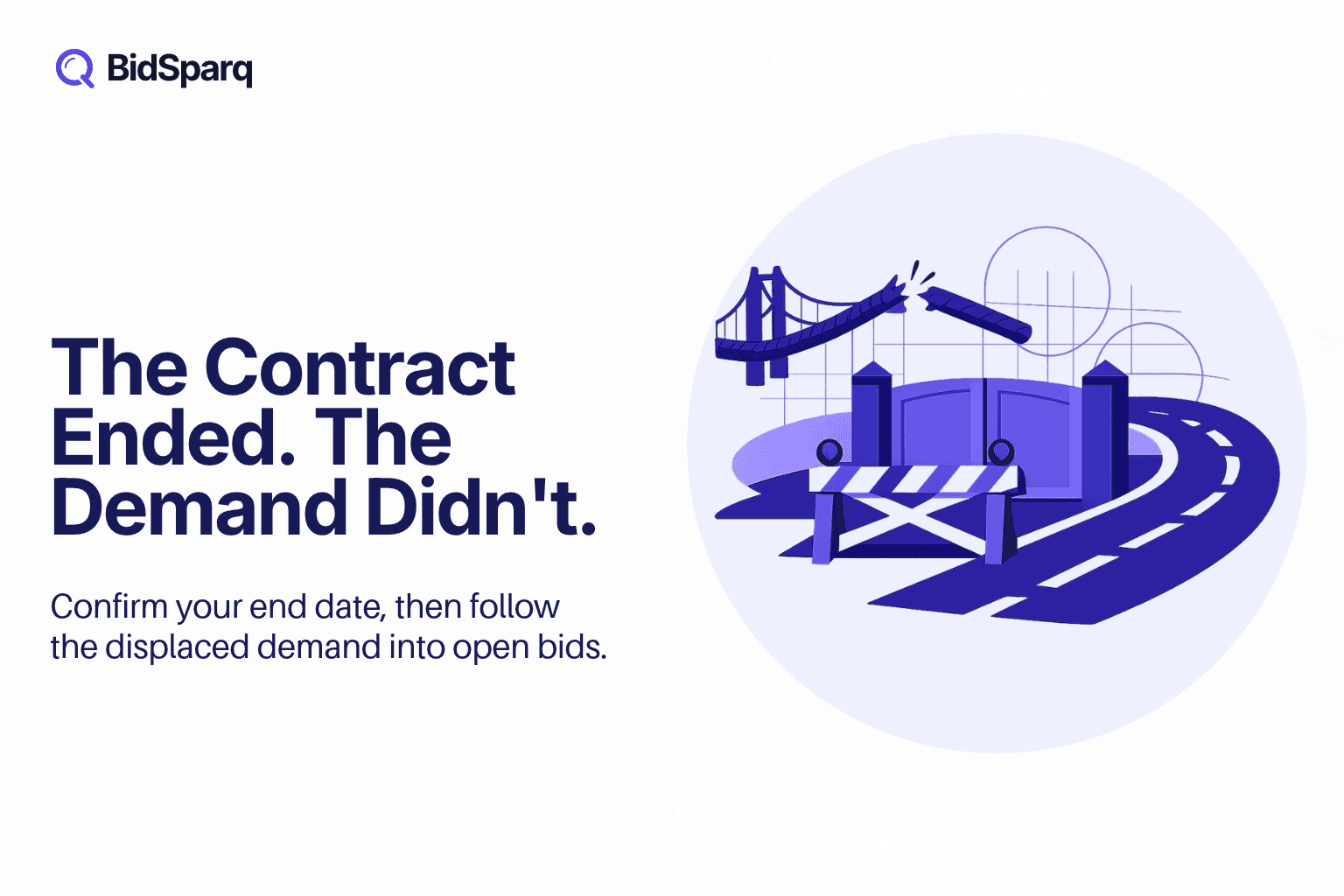
Losing a cooperative contract does not take your public customers' budgets away. It takes away their permission to spend those budgets with you without running a bid. School districts, cities, colleges, and public hospitals that used to issue a purchase order against your contract number now need another lawful route, and the first one they find may lead to a competitor.
The need for what you sell is unchanged. What changed is the paperwork a buyer must complete to reach you, and the place where that purchase gets published.
Key takeaways
- The demand outlives the contract: agencies that bought through the cooperative still need the product or service, and they will buy it some other way.
- How the contract ended matters as much as when. Expiry, termination, and a lost rebid each treat purchase orders already in motion differently.
- A buyer can often move to a competitor's cooperative contract without bidding, which makes the replacement awardee your new incumbent.
- Buyers describe the need, not the contract. Very few open solicitations use cooperative wording at all, so searching for it misses the demand.
- The rebid is public and open to you, and so are the winning proposal and score sheets, but fees, reporting, and coverage duties make it a business decision.
The short answer
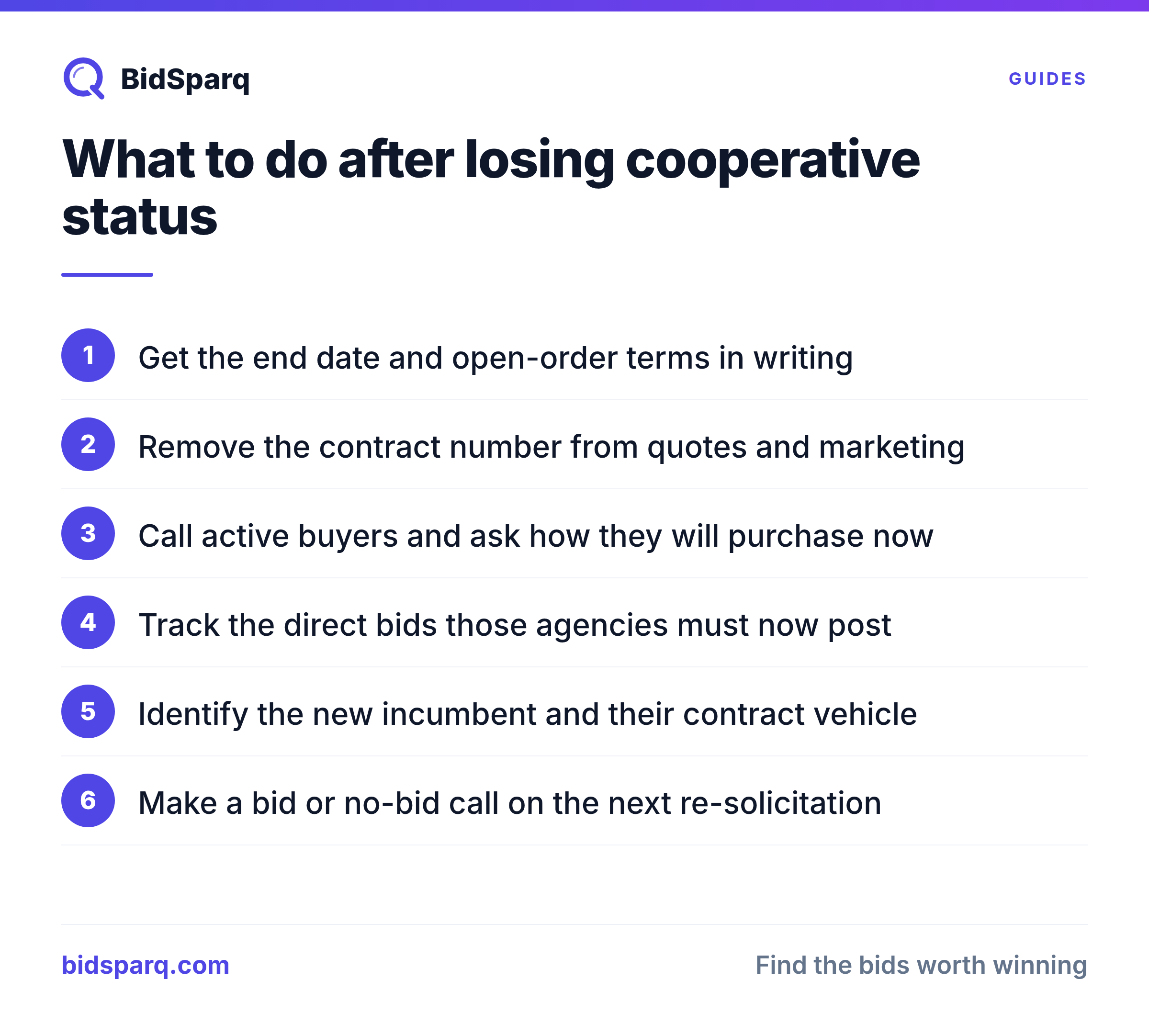
Spend the first week in this order: get the contract's end date confirmed in writing by the cooperative or its lead agency, then get its treatment of open purchase orders and pending quotes in writing as well. Next, call every buyer with a project budgeted against the contract, and scrub the contract number from your quote templates, website, and capability statements so nobody issues an order they cannot defend in an audit. Close the week by setting up tracking on the agencies that bought through the contract, because their next purchase will arrive as a quote request, a formal bid, or an order on someone else's contract. From the end date forward, assume new orders against the old contract are off the table unless the cooperative tells you otherwise in writing.
Understand how cooperative authority works and how yours ended
Identify which kind of ending you are dealing with before you do anything else. The mechanics behind the contract decide what your buyers can still do, and those mechanics rest on piggyback authority: a state statute, often paired with an interlocal or joint powers agreement, that lets a public entity buy from a contract another public agency already awarded competitively.
The statutes are specific and easy to look up. In Texas, the Interlocal Cooperation Act (Government Code Chapter 791) lets local governments contract with one another to perform governmental functions, purchasing included. In Minnesota, the joint powers statute (Minnesota Statutes Section 471.59) lets governmental units jointly exercise powers they hold in common. Other states have their own equivalents, and each sets its own limits. Under any of them, the lead agency runs the solicitation, evaluates the responses, and signs a master agreement, and other agencies then rely on that competitive process in place of their own. Sourcewell acts as its own lead agency, OMNIA Partners contracts are awarded by a lead public agency, and NASPO ValuePoint uses a lead state with other states joining through participating addenda. Membership is also wider than the word "government" suggests: many cooperatives serve K-12 districts, colleges and universities, and nonprofits, so a lost contract can touch education and healthcare customers as much as cities and counties.
Most master agreements run for a base term of several years followed by optional renewal periods. The renewals belong to the lead agency, not to you. A contract can therefore end while you still expected years of runway, simply because an option was not exercised.
The three endings behave differently for orders in motion:
- Expiry or a declined renewal. The contract runs to a known date. Purchase orders issued on or before that date are usually honored through delivery under the contract's terms, but nothing new can be issued afterward. Multi-phase projects and blanket orders are the gray area, so ask about them specifically.
- Termination. The end date is set by the termination notice and can be immediate. A termination for cause may cancel pending orders outright, while a termination for convenience usually includes wind-down language. Read the clause and the notice together.
- A lost rebid. Your existing contract normally continues to its natural end, sometimes with a short transition extension, while the new awardee's contract starts. You have a defined window to fulfill, quote, and prepare buyers for the change.
Can a buyer simply shift to a competitor's cooperative contract without bidding? In most cases, yes. If the buyer's own law permits cooperative purchasing, the buyer is eligible under that cooperative, and the contract's scope covers the need, the same piggyback authority that once favored you now favors whoever holds the replacement award. Many purchasing offices still document that the contract offers best value, and some restrict cooperative use for construction or above certain dollar levels. Everything in this section is the general pattern: your contract's language and each buyer's state law control the actual answer.
Tell your buyers before the requisition bounces
Call every customer with a budgeted project this week, and bring options with you. Consider a school district facilities team that planned a gym flooring replacement around your cooperative pricing. If the first sign of trouble is a purchasing office rejecting the requisition, the project stalls and the district starts looking at whoever holds a usable contract. An early call keeps you in the conversation while the district decides how to proceed.
The options depend on the buyer's rules. A purchase under the small-purchase or informal quote threshold can often proceed on competitive quotes. Anything larger needs a formal bid or a different contract vehicle, which may be one you already hold, such as a state term contract or another cooperative award. Thresholds vary by state and by entity, so ask each purchasing office directly. An IT reseller with a city customer and a contractor doing job-order work for a county face the same conversation.
Clean up your own materials the same week. A contract number left on a quote template or a cooperative logo left on a website can lead a buyer to issue an order they have no authority to issue, and the audit finding lands on the people you most need to trust you.
Follow the demand into open solicitations
Search for the need your buyers have, not the contract they used to buy it through. Orders that once moved quietly through one contract are now scattered across many posting locations. National cooperatives such as Sourcewell and OMNIA Partners publish solicitations and awarded contracts on their own sites, and NASPO ValuePoint does the same for state-led programs. Individual agencies post to the state's official eProcurement portal, to their own purchasing pages, and to board agendas on BoardDocs, where school boards approve cooperative purchases and contract awards. If federal buyers are part of your mix, add SAM.gov.
The cooperative's name will not lead you to those postings. As of November 2026, only 32 of the 54,672 solicitations open across the 33,000+ sources BidSparq tracks mention "purchasing cooperative." Texas accounts for 26 of those, followed by New Jersey with 2 and Florida with 1. Buyers describe the need rather than the contract. A district that needs a gym floor writes a flooring bid, and it has no reason to mention the vehicle it used last time.
That leaves a vendor with two problems at once: too many places to check by hand, and no reliable phrase to search for once there.
Describe what you sell and see today's open bids ranked by fit.
How to find former cooperative buyers' bids without keyword alerts
Judge any bid-finding method by what it does with one real solicitation. Take the school district from earlier. Suppose it posts its project as "resilient athletic surfacing replacement," with no product name and no reference to a cooperative. Here is how that one solicitation moves through an automated pipeline, compared with a keyword alert or a manual portal check:
- Semantic match. A keyword alert for "gym flooring" never fires. Matching by meaning connects the district's wording to a plain description of what you sell, so the bid reaches you instead of sitting unread on a portal.
- A fit score from 0 to 100. The bid arrives ranked against your profile, alongside everything else open that day. A small team reads the top of the list and skips the manual triage.
- Extracted bonding and insurance requirements. Direct bids carry terms the cooperative used to absorb. Compliance extraction pulls the bid bond, performance bond, insurance limits, required forms, and deadlines out of the documents, so you can decide whether you qualify before investing hours in a response.
- Incumbent and vehicle lookup. Contract intelligence shows who holds the district's current flooring work and through which vehicle. That tells you whether this buyer tends to bid openly or piggyback, and which competitor you are pricing against.
BidSparq runs those four steps automatically, where a keyword tool stops at the first and a manual process rarely gets past the second. The benefit reaches beyond government. A hospital system renovating a clinic may issue a private RFP for "heat-welded sheet flooring" with its own infection-control and insurance terms, and the same matching and extraction put that opportunity in the same ranked list as the district's bid. A vendor that loses a cooperative contract may be able to replace part of the volume with healthcare and commercial owners, provided those RFPs are visible at all.
Decide whether winning the status back is worth it
Treat the cooperative's next solicitation as a bid or no-bid decision, and make it on your own numbers. Cooperative contracts usually carry administrative fees on sales, periodic reporting, and an expectation that you can serve a wide territory. Set those costs against what the contract produced, using your order history. If most of the revenue came from a small group of agencies, direct bids to those buyers may return more than a national award would.
Where the contract did carry real volume, find out when the category will be re-solicited and start early. If you lost on a rebid, request a debrief, then go get the record. Because a public lead agency ran the solicitation, the winning proposal and the evaluators' score sheets are generally public records once the award is final. File a public records request with the lead agency itself, under that agency's state public records law, and expect some pricing or trade-secret material to be redacted. Set the score sheets beside the published evaluation criteria and your own response, and you can see where the points were lost instead of guessing.
A second route is also worth checking. Many agencies belong to several cooperatives at once, so an award from a different cooperative with overlapping membership, or a state term contract, can restore a no-bid path to the same customers. Confirm that each buyer is eligible under that vehicle and that its scope covers what they purchase.
FAQ
What happens to open purchase orders and new orders after a cooperative contract ends?
Purchase orders issued on or before the end date are usually honored through delivery under the contract's terms, while new orders need another lawful method: competitive quotes under the agency's small-purchase threshold, a formal bid, or a different contract vehicle the vendor holds. Termination is different and may cancel pending orders, particularly a termination for cause. Ask the cooperative's contract manager to confirm in writing how open orders, blanket orders, and unconverted quotes will be treated.
What should an agency do if its own cooperative membership or interlocal agreement has lapsed?
Pause new orders through that cooperative until the membership or agreement is back in force. The agency's authority to piggyback usually depends on a current membership, interlocal agreement, or governing board resolution, so an order placed during a lapse can be hard to defend in an audit. Reinstate the agreement with the cooperative, confirm the effective date in writing, and use the agency's own quote or bid process for anything that cannot wait.
How does a vendor get back on a purchasing cooperative contract?
Respond to the cooperative's next competitive solicitation for the category. These are published publicly by the lead agency and evaluated against stated criteria. Before writing the next response, request a debrief on the prior loss and file a public records request with the lead agency for the winning proposal and score sheets.
Your former cooperative customers will buy again, and the purchase will be posted somewhere you can find it. After a 14-day free trial, Pro Max is $249/mo, or $199/mo billed annually. Start the free trial with no credit card and get a ranked list of the open bids that fit what you sell.
Find RFPs that match your business
BidSparq monitors 33,000+ procurement sources and uses AI to score every opportunity against your capabilities. Try it free for 14 days.
Start Free Trial →