Cap Statement: What It Is and Why It Wins Bids
A cap statement is the document that gets your company in front of buyers before the RFP is released. Learn what to include, how to tailor it, and how to find the right opportunities across education, healthcare, construction, and government markets.
A capability statement is often the difference between being invited to bid and being overlooked. Most vendors invest in writing the document and almost nothing in the harder problem: getting it in front of the right buyers before the opportunity closes.
- A cap statement is a short structured document that tells buyers exactly what your company does, who you have served, and why you are the right fit before they read your full proposal.
- Capability statements win attention at the sourcing stage, when buyers are deciding whom to invite, shortlist, or call before a solicitation is ever posted.
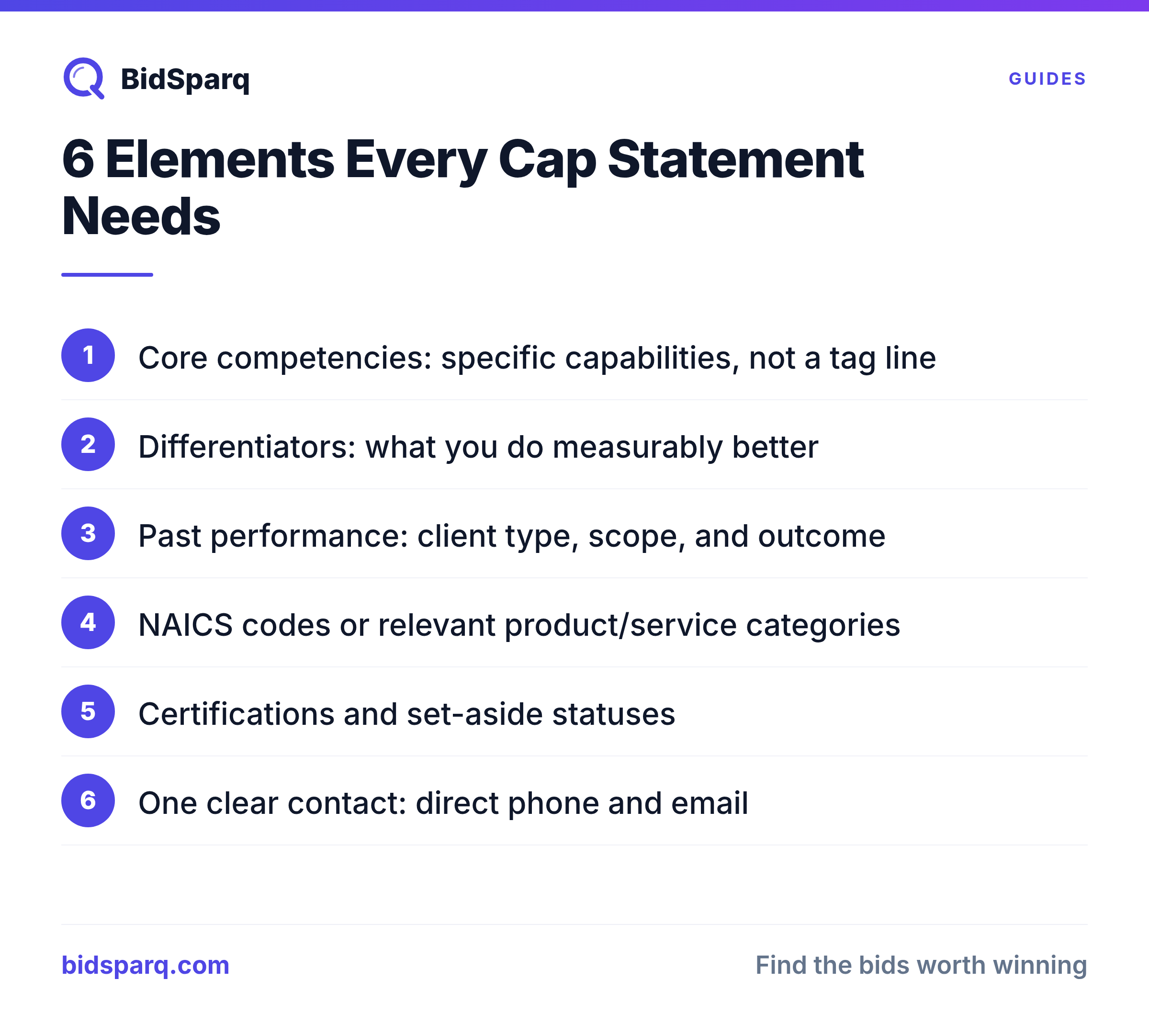
- Six elements belong in every cap statement: core competencies, differentiators, past performance, relevant codes, certifications, and one clear contact.
- Tailoring beats boilerplate because procurement teams across education, healthcare, construction, and government read dozens of generic statements and remember the ones that match their actual need.
- Discovery is the hidden bottleneck: finding the right buyers to send your cap statement to is where most vendors lose pipeline, not in the writing of the document.
The short answer
A capability statement, or cap statement, is a one-to-two-page business profile that summarizes your core competencies, differentiators, past performance, and contact details for a specific buyer or opportunity type. Procurement offices across education, healthcare, construction, IT, and government markets use them to pre-qualify vendors before a solicitation is ever released. A well-crafted cap statement shortens the distance between initial contact and a solicitation invitation. It does not replace a proposal; it earns you a seat at the table before the RFP drops.
What a cap statement actually does for your pipeline
A cap statement is a standing pitch that works while you are pursuing active bids. Buyers circulate capability statements internally when a need arises and share them with prime contractors assembling teaming arrangements. A statement that clearly maps to an upcoming scope can generate an outreach call before a solicitation is ever posted publicly. That early access, before formal competition begins, is the real return on a polished, targeted document.
Six elements every cap statement needs
Leave any of these out and buyers have to chase information they expected to find in under a minute. Each element serves a specific purpose in helping a procurement team decide whether to continue the conversation:
- Core competencies stated as specific capabilities, not a marketing tag line
- Differentiators that explain what you do measurably better than alternatives
- Past performance with the type of client, scope, and outcome (omit names if confidential)
- NAICS codes, product codes, or service categories relevant to the buyer's market
- Certifications and set-aside statuses such as SBE, DBE, HUBZone, or SDVOSB where applicable
- One clear contact with a direct phone number and email address
The differentiator line is where most vendors lose the buyer's attention before the first page is finished. A phrase like "experienced team committed to quality outcomes" signals nothing a procurement officer cannot read in the next twenty statements stacked on their desk. A differentiator earns a second look when it is quantified and tied directly to the buyer's specific risk or priority. Compare:
Generic: "Experienced team committed to quality outcomes."
Buyer-specific: "Delivered 14 school modernization projects on schedule and under budget for districts enrolling 2,000 to 10,000 students, with zero change orders attributable to design errors across all 14 projects."
The revised line is verifiable, scope-specific, and addresses the concern every school district procurement officer carries into an evaluation: will this contractor create budget surprises mid-project? That is the differentiator doing its job.
How to get your cap statement in front of the right buyers
Getting your cap statement seen requires two things done in order: tailoring it to the buyer's actual risk profile, then solving the discovery problem of finding the right buyers to send it to. A generic statement distributed broadly produces weaker results than a tailored statement sent to a targeted list. The tailoring step comes first, and sector lists are not tailoring examples.
Consider a general contractor that renovates occupied buildings. For a school district capital project, that firm leads its core competencies with phased construction sequencing that keeps buildings operational during renovation, familiarity with state education agency approval processes, and a track record sized to district capital budgets. Every word signals that the contractor understands the buyer's primary concern: avoiding disruption to students and staff while spending public funds responsibly.
The same firm responding to a hospital renovation bid leads instead with infection control protocols (ICRA-compliant work practices), direct experience in occupied clinical environments, and familiarity with Joint Commission documentation requirements. Same company, same portfolio, different framing because the buyer's compliance obligations and operational risks are entirely different from a school district's.
Tailoring means reordering and reframing your core competencies so the first thing a procurement officer reads is the specific problem they are trying to solve, not a list of markets you claim to serve.
Then comes discovery. As of October 2026, 57,251 solicitations are open across the 23,000+ sources we track, and 3,450 of those mention "statement" specifically. Of those, 1,417 close within the next 14 days. Monitoring that volume manually across education, healthcare, construction, IT, and government markets means constant tracking that still misses solicitations posted on sources you had no reason to check. The revenue you lose is not from a bad cap statement; it is from opportunities you never saw.
Semantic matching closes that gap automatically. The platform reads what a solicitation is actually asking for, not just whether a keyword appears in the title, then scores each open bid from 0 to 100 on fit, extracts compliance requirements without manual review, and surfaces incumbent and contract-vehicle intelligence so you know the competitive landscape before committing to a response.
Search open bids free, no credit card needed, and see which opportunities match your capabilities today.
When and how to distribute your cap statement
Timing and targeting matter as much as the quality of the document itself. Distribute your cap statement during industry days and when responding to sources-sought notices. SAM.gov is the primary federal source for those notices; your state's official eProcurement portal and the SBA's vendor matching programs cover additional channels worth building into a regular outreach cadence. For solicitations with pre-proposal conferences or vendor fairs, bring printed copies and a digital version ready to send immediately. Update your statement at least once a year and whenever you add a major past performance reference or a new certification that changes your competitive position. The best cap statement is the one the right buyer sees before the deadline.
FAQ
What is a capability statement and why do I need one?
A capability statement is a concise structured document summarizing your company's services, experience, and credentials for procurement buyers. You need one because many buyers pre-qualify vendors before releasing a formal RFP, and a polished cap statement is the standard format they expect during outreach, industry days, and sources-sought responses.
How long should a cap statement be?
One to two pages is the accepted standard across markets. One page works best for brief events or email introductions to a busy procurement officer. Two pages are appropriate when substantial past performance requires space to present clearly. Anything longer is typically skimmed rather than read.
Does a cap statement work outside of government contracting?
Yes. Healthcare systems, school districts, construction owners, and corporate procurement teams all evaluate vendors before issuing formal solicitations. The document may be called a vendor profile, company overview, or qualification summary depending on the market, but the same six core elements apply: lead with what the buyer needs, not with your company history.
Start your free BidSparq account and match your capabilities to live solicitations across every market, no credit card required.
Find RFPs that match your business
BidSparq monitors 23,000+ procurement sources and uses AI to score every opportunity against your capabilities. Try it free for 14 days.
Start Free Trial →