Cooperative Purchasing Contracts: BuyBoard, SourceWell, and TIPS-USA Explained
Cooperative purchasing lets you win one contract and sell to thousands of agencies. Learn how BuyBoard, SourceWell, TIPS-USA, and other cooperatives work, and whether they're right for your business.

What if you could respond to one RFP and gain access to thousands of government agencies as potential customers: without competing again for each individual sale?
That's the promise of cooperative purchasing. Instead of bidding on contracts one agency at a time, you compete for a spot on a cooperative contract. Once awarded, member agencies across the country can purchase from you directly using the pre-negotiated terms.
For many contractors, especially those selling products, IT solutions, or recurring services, cooperative contracts are the most efficient path to government revenue.
How Cooperative Purchasing Works
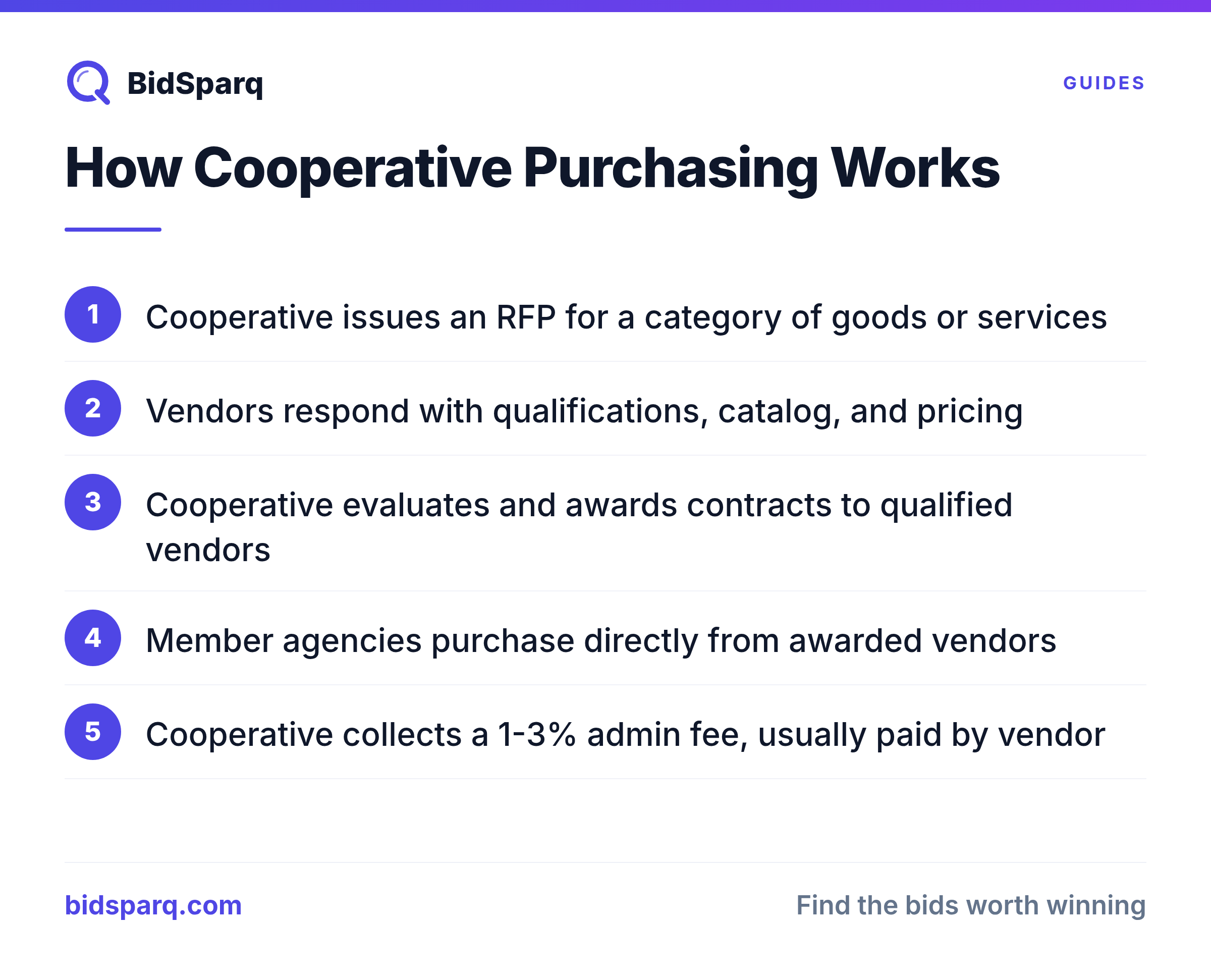
A cooperative purchasing organization (also called a "purchasing cooperative" or "group purchasing organization") runs a competitive procurement process on behalf of its member agencies. Here's the flow:
- The cooperative issues an RFP for a category of goods or services (e.g., "IT Hardware and Solutions" or "Facility Maintenance Services")
- Vendors respond with their qualifications, product/service catalog, and pricing
- The cooperative evaluates and awards contracts to qualified vendors
- Member agencies can now purchase directly from awarded vendors without running their own procurement: the competitive process is already complete
- The cooperative takes a small administrative fee (typically 1-3% of sales), usually paid by the vendor
The key advantage: the cooperative's procurement satisfies the competitive bidding requirements for all member agencies. A school district in Texas, a city in Oregon, and a county in Florida can all buy from you using the same cooperative contract.
The Major Cooperative Purchasing Organizations
BuyBoard (Texas Association of School Boards)
Members: 5,500+ member agencies across Texas and growing nationally
Focus: K-12 education, cities, counties, and special districts
Strengths: Dominant in Texas education procurement. If you sell to schools, BuyBoard is essential.
How to get on: Respond to BuyBoard RFPs posted on their vendor portal. Awards are category-based (technology, facilities, supplies, etc.).
SourceWell (formerly NJPA)
Members: 50,000+ member agencies across all 50 states and Canada
Focus: Broad, equipment, technology, services, facilities
Strengths: Largest cooperative by membership count. National reach. Strong in heavy equipment, fleet, and technology.
How to get on: SourceWell issues solicitations throughout the year for specific categories. Apply through their vendor portal at sourcewell-mn.gov.
TIPS-USA (The Interlocal Purchasing System)
Members: 4,500+ member agencies, primarily in the southern US but growing nationally
Focus: Construction, facilities, technology, and services
Strengths: Strong in construction and JOC (Job Order Contracting). Active in Texas, Oklahoma, and southeastern states.
How to get on: TIPS posts solicitations for specific categories on tips-usa.com. New categories are added regularly.
OMNIA Partners (formerly US Communities / National IPA)
Members: 90,000+ member agencies
Focus: Office supplies, furniture, technology, services
Strengths: Massive membership base. Strong relationships with large national vendors.
How to get on: OMNIA typically works with larger vendors. Category solicitations are issued periodically.
E&I Cooperative Services
Members: Higher education institutions
Focus: University and college procurement
Strengths: If you sell to higher ed, this is the primary cooperative channel.
How to get on: Respond to E&I solicitations for your product/service category.
Is Cooperative Purchasing Right for Your Business?
Good Fit
- You sell products or productized services with catalog pricing: technology, equipment, supplies, software
- You can serve customers nationally: cooperatives have members across multiple states
- You want steady, repeatable revenue: once agencies find you on a cooperative, they reorder
- You sell to education: school districts are the most active cooperative purchasers
- Your margins support the admin fee: typically 1-3% of sales
Not Ideal
- You provide highly customized services: consulting, construction design, or project-specific work that requires individual scoping
- You operate in a single region: the value of cooperatives is national reach
- Your pricing is project-based: cooperatives work best with catalog or rate-card pricing
- You only pursue federal contracts: cooperatives are primarily state, local, and education
How to Win a Cooperative Contract
Cooperative RFPs are evaluated differently than typical government solicitations:
What Cooperatives Value
- Breadth of catalog. Can you serve a wide range of member needs in your category?
- Competitive pricing. Your prices should be at or below what agencies would get through individual procurements.
- National delivery capability. Can you serve agencies across multiple states?
- Customer service infrastructure. Cooperative members expect responsive support: dedicated account managers, quick quotes, and reliable fulfillment.
- Marketing commitment. Cooperatives expect awarded vendors to actively market the contract to member agencies. If you win and don't sell, you're taking up a slot.
Common Mistakes
- Winning the contract and doing nothing. A cooperative award is a hunting license, not a guaranteed revenue stream. You need to market to member agencies.
- Pricing too high. Member agencies use cooperatives for convenience AND value. If your prices aren't competitive, they'll run their own procurement.
- Ignoring the admin fee in your pricing. The 1-3% fee comes from your margins. Build it into your cooperative pricing from the start.
- Not understanding member agency processes. Even with a cooperative contract, individual agencies may have their own PO requirements, insurance minimums, and approval processes.
Cooperative vs. Traditional RFP: A Comparison
| Factor | Cooperative Contract | Individual RFP |
|---|---|---|
| Competition frequency | Once (at award) | Every opportunity |
| Customer base | Thousands of agencies | One agency |
| Revenue model | Ongoing catalog sales | Project-based |
| Admin fee | 1-3% per sale | None |
| Marketing effort | You market to members | Agency finds you via RFP |
| Contract duration | 3-5 years typical | 1-5 years |
| Pricing flexibility | Catalog/rate card | Project-specific |
How BidSparq Tracks Cooperative Opportunities
BidSparq scrapes cooperative purchasing platforms alongside traditional procurement portals:
- BuyBoard, SourceWell, and TIPS-USA solicitations appear in your matched feed alongside state and federal RFPs
- AI scoring evaluates cooperative RFPs against your profile the same way it scores traditional opportunities
- Education RFP coverage includes the school districts and universities that are the most active cooperative purchasers
Next Steps
- Start your free trial: see cooperative and traditional RFPs matched to your business in one dashboard
- Explore state procurement portals for agencies that also use cooperative contracts
- Learn about NAICS codes and how they map to cooperative purchasing categories
- Read our guide on writing winning proposals: cooperative RFPs require the same proposal quality
- Browse active education RFPs: school districts are the most active cooperative purchasers
- Read our guide to SLED government contracting: the full state, local, and education market
Find RFPs that match your business
BidSparq monitors 23,000+ procurement sources and uses AI to score every opportunity against your capabilities. Try it free for 14 days.
Start Free Trial →