Washtenaw County Fire Truck Purchase Cooperative Contracts
A guide for Washtenaw County and Michigan municipalities on using cooperative purchasing contracts to buy fire trucks faster, including which national programs carry active awards and how to locate every available contract vehicle.
Buying a fire truck through a cooperative contract can cut months off a county's procurement timeline, but only if the right contract vehicle is active, competitively awarded, and legally permissible under your state's interlocal purchasing authority. For procurement offices in Washtenaw County and across Michigan, the framework is clear. Finding the right contract to use is the harder part.
- Cooperative purchasing contracts let Washtenaw County and similar Michigan jurisdictions skip a full competitive bid cycle for major apparatus like fire trucks.
- Sourcewell, HGAC Buy, OMNIA Partners, and NASPO ValuePoint are the largest national cooperative programs with active fire apparatus award schedules.
- Michigan's interlocal cooperation statutes explicitly authorize counties to use contracts competitively awarded by another eligible public entity, without rebidding.
- Volume pricing negotiated across thousands of member agencies often delivers a better unit cost than a single-county solicitation alone can achieve.
- Verifying contract scope, expiration dates, and eligible-entity language is its own research step, and keyword searches surface only a fraction of available vehicles.
- The same cooperative framework applies to ambulances, IT infrastructure, and other capital equipment, making it a tool every county procurement office uses across categories.
The short answer
Washtenaw County can purchase fire trucks without conducting a separate competitive bid by piggybacking on a cooperatively awarded contract from Sourcewell, HGAC Buy, OMNIA Partners, or NASPO ValuePoint, provided the contract's eligible-entity language covers Michigan public agencies and the original award was reached through a competitive process. Michigan's interlocal cooperation framework explicitly permits this, and most national cooperative programs are structured to meet that standard. The county's procurement office still performs due diligence: confirming the contract is active, verifying that the awarded manufacturer meets the department's apparatus specification, and documenting that no local purchasing ordinance requires a standalone bid. Done correctly, a cooperative purchase can close in weeks rather than the many months a standalone solicitation typically requires.
Which cooperative programs carry fire apparatus contracts
Four national cooperative programs regularly carry competitively awarded fire apparatus contracts, and each has a different membership structure and pricing approach worth comparing before committing to a purchase order. Sourcewell runs a member-agency model with multi-year contracts covering apparatus from major manufacturers, and its contract database is publicly searchable. HGAC Buy (Houston-Galveston Area Council) posts contract pricing schedules publicly and is widely used by counties for both light and heavy apparatus. OMNIA Partners aggregates contracts from multiple lead agencies across apparatus categories. NASPO ValuePoint, the cooperative arm of the National Association of State Procurement Officials, offers additional options, though fire apparatus coverage varies by participating state. Beyond these four, Michigan's own procurement infrastructure may carry state-level cooperative agreements worth reviewing before looking to national programs. Each cooperative requires member registration before a purchase order can be issued, a step that typically takes only a few business days and carries no cost to the agency.
What Michigan's interlocal purchasing framework requires
Michigan's interlocal cooperation statutes allow Washtenaw County to use a contract awarded by any other eligible public agency, as long as that contract was competitively solicited and awarded in a manner consistent with what Michigan law would require of a local procurement. In practice, this means the procurement file needs to include the cooperative's original solicitation, the award documentation confirming competitive selection, and the contract's eligible-entity language confirming Michigan jurisdictions are covered. Most national cooperatives provide this package on request, and many post it publicly. Local purchasing policy may impose additional requirements: capital purchases at the scale of fire apparatus commonly require governing board approval regardless of how the competitive requirement is satisfied. Confirming both state statute and the county's own purchasing thresholds before issuing a purchase order keeps the procurement defensible at audit.
The real challenge: locating every active contract vehicle
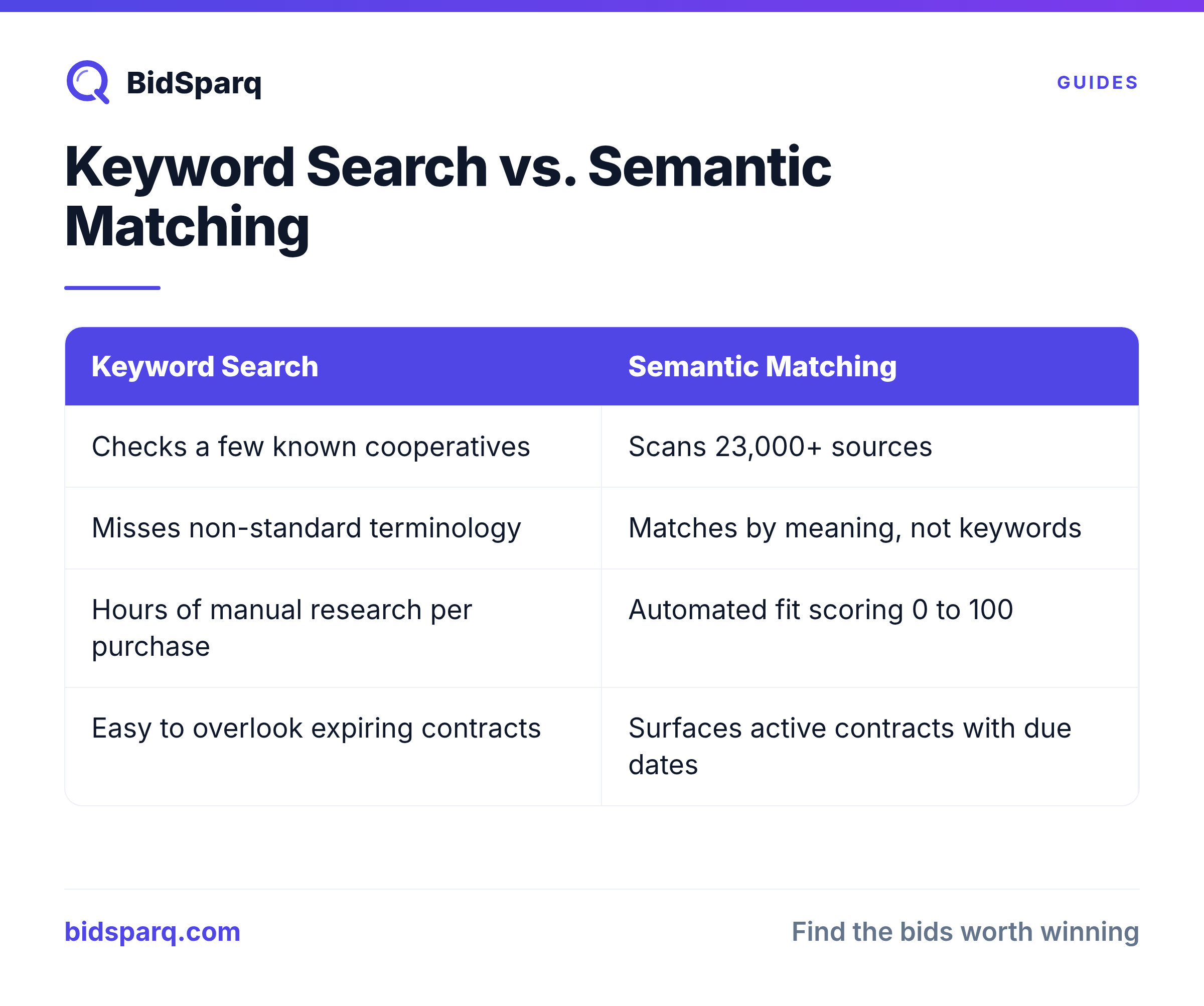
The biggest friction in cooperative fire apparatus purchasing is not legal compliance; it is finding every active contract vehicle that covers the required apparatus type before manufacturer delivery slots close. Most procurement offices check the one or two cooperatives they already use and stop there, missing contracts with better pricing, faster delivery schedules, or stronger manufacturer fit. A complete search means reviewing Sourcewell's contract database, HGAC Buy's pricing schedules, OMNIA's award registry, NASPO ValuePoint, your state's official eProcurement portal, and any regional cooperative programs active in Michigan. Cooperative solicitations also use inconsistent terminology: the same apparatus may appear under "emergency response vehicle," "fire suppression apparatus," or "fire and rescue equipment" rather than "fire truck," so keyword searches reliably miss a share of available contracts. As of October 2026, BidSparq tracks 56,066 open solicitations across 23,000+ sources, using semantic matching to surface relevant cooperative awards by meaning rather than exact keyword, so a procurement team finds contracts even when the terminology does not match their search terms.
Checking every cooperative source manually is the kind of research that falls to one or two people in a county procurement office already managing hundreds of active items. Search cooperative fire apparatus contracts free, no credit card needed.
How to execute a cooperative fire truck purchase
A cooperative fire truck purchase follows a short, documented sequence, and each step leaves a record that satisfies audit requirements. First, identify the cooperative program and register your agency as a member if you are not already. Second, pull the full contract package: the original solicitation, the award decision, the current pricing schedule, and the eligible-entity language. Third, compare the awarded manufacturer's available configurations against the fire department's apparatus specification, and confirm whether the cooperative contract allows spec modifications and at what cost. Fourth, obtain any required governing board approval, documenting that the cooperative contract satisfies the competitive requirement. Fifth, issue the purchase order directly to the awarded manufacturer, referencing the cooperative contract number and the lead agency that holds it. Sixth, retain all documentation in the procurement file for the full audit retention period. Procurement offices that maintain a standing checklist aligned to both their own purchasing policy and the cooperative's requirements move through this sequence consistently, with fewer delays at the compliance review stage.
FAQ
Can Washtenaw County use a cooperative contract for a fire truck purchase without rebidding?
Yes. Michigan's interlocal cooperation statutes allow public agencies to use contracts that another eligible public entity awarded through a competitive process, without conducting a separate bid. Washtenaw County confirms that the cooperative contract was competitively awarded, that fire apparatus is within the contract's scope, and that Michigan public agencies are listed as eligible entities. The county also follows its own purchasing thresholds for board approval and retains the cooperative's award documentation in the procurement file.
Which cooperative contracts cover fire trucks for Michigan counties?
The most widely used programs for fire apparatus in Michigan and across the country are Sourcewell, HGAC Buy, OMNIA Partners, and NASPO ValuePoint. State-level cooperative programs through Michigan's procurement infrastructure may also carry applicable awards. Each program's contract database is searchable online; procurement offices verify that a specific contract is currently active, covers the desired apparatus type and manufacturer, and lists Michigan public agencies as eligible members before issuing a purchase order.
How do I find all open cooperative contracts for fire apparatus in my county?
Start by searching the contract databases at Sourcewell, HGAC Buy, OMNIA Partners, and NASPO ValuePoint directly. Also check your state's official eProcurement portal and any regional cooperative programs active in your area. Board agenda records from nearby counties that recently completed fire apparatus purchases can identify the cooperative contract they used. Explore BidSparq's free cooperative contract search to scan 23,000+ sources using semantic matching, which catches contracts listed under non-standard apparatus terminology that keyword searches miss, with no credit card required.
Find RFPs that match your business
BidSparq monitors 23,000+ procurement sources and uses AI to score every opportunity against your capabilities. Try it free for 14 days.
Start Free Trial →