What Is the OGA? The Procurement Shortcut Vendors Miss
What is the OGA in procurement? Learn how Other Government Agency clauses work and how vendors can turn a single contract win into revenue across dozens of agencies.
Vendors competing for public sector business spend enormous time chasing individual RFPs. Most never realize that a single contract win, if it includes the right clause, can generate ongoing revenue from dozens or hundreds of agencies without another competitive bid. That clause is an OGA provision. Understanding it changes how you approach the entire public sector market.
- An OGA clause allows eligible public agencies to purchase from an existing competitively awarded contract without running their own solicitation.
- School districts, hospital districts, and transit authorities use OGA provisions routinely, making this a multi-sector opportunity that extends well beyond federal contracting.
- A single OGA-eligible contract win can generate revenue across dozens or hundreds of agencies under the same pricing, scope, and terms.
- Incumbent and contract-vehicle intelligence is the key competitive edge: knowing which active contracts carry OGA language lets you act before reprocurement opens.
- Keyword-only search tools miss most OGA opportunities because the enabling language varies by jurisdiction and is often buried deep in contract documents.
The short answer
An OGA, or Other Government Agency clause, is a provision in a competitively awarded public contract that allows any eligible public agency to buy from that contract without running its own bid process. The vendor gains new customers under the same pricing and scope. The purchasing agency avoids a lengthy procurement cycle. The entity that ran the original bid often earns a small administrative fee on resulting sales. OGA provisions appear in contracts across K-12 education, public healthcare, transit, and government at every level, making them one of the most powerful and least understood revenue levers in the public sector market.
How an OGA clause works in practice
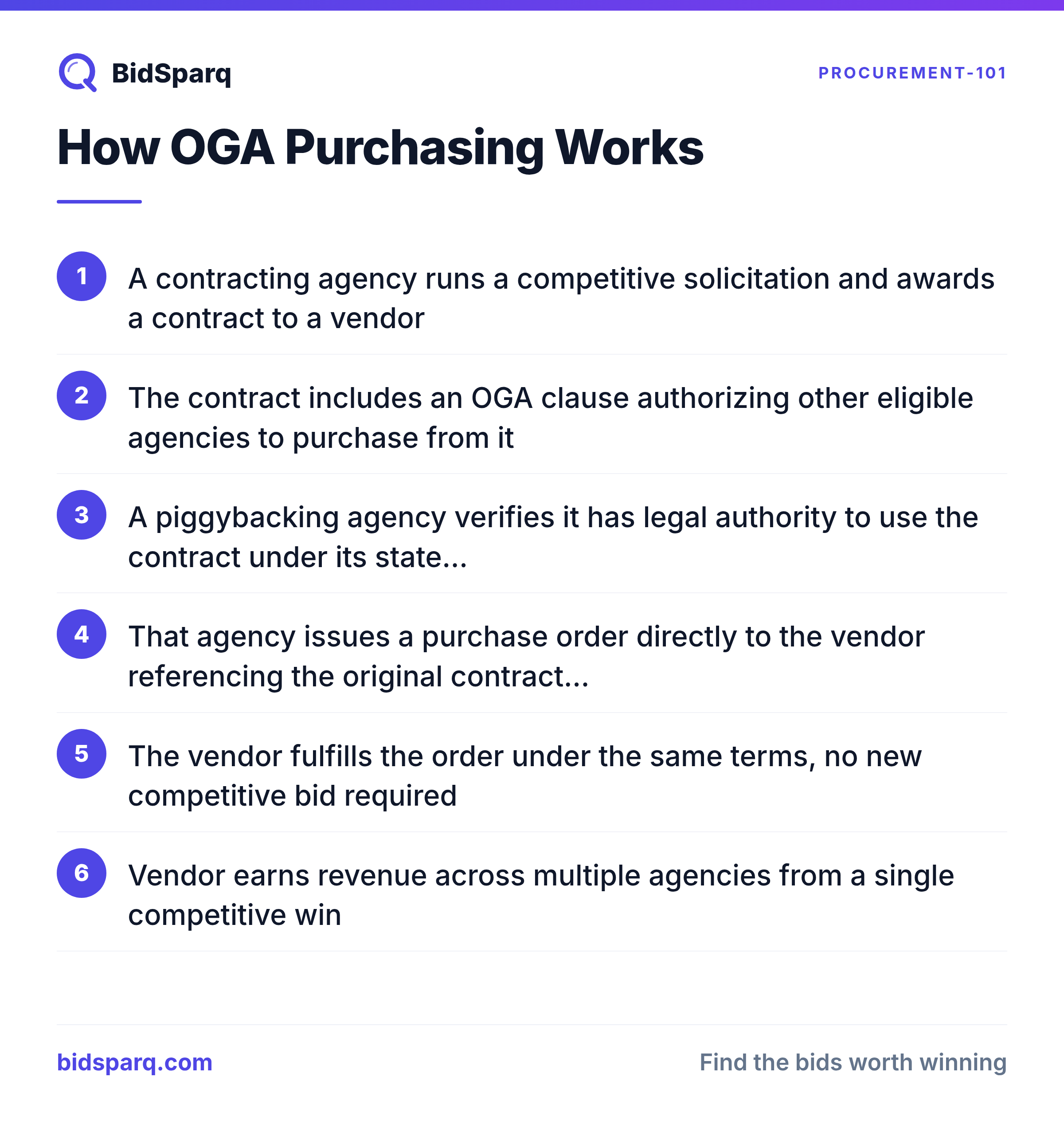
When a contracting agency includes OGA language in an awarded contract, it is effectively authorizing other eligible public entities to issue purchase orders against that award. A piggybacking agency confirms it has legal authority under its state procurement code to use the contract, then issues a purchase order directly to the vendor referencing the original contract number and pricing schedule. No new RFP is required. The vendor fulfills the order under the existing terms, and the transaction can move from approval to purchase order in days rather than months. Software, technology infrastructure, professional services, and standardized materials contracts carry OGA clauses most frequently, because pricing and scope transfer cleanly across agency types.
Who uses OGA provisions and how far the reach extends
OGA purchasing spans every layer of the public sector. A school district taps a state software contract rather than running a district-level RFP. A regional hospital authority uses a county medical supply award to secure pricing it could not negotiate alone. A transit agency leverages a neighboring city's fleet maintenance contract to avoid months of competitive process. National cooperative networks like NASPO ValuePoint and Sourcewell extend this logic further still, running multi-state solicitations explicitly designed for broad agency adoption. In all of these cases, the competitive event happens once. Revenue can flow for years.
Finding OGA-eligible contracts before your competitors do
The practical barrier is not understanding how OGA clauses work, it is locating which active contracts carry them before the reprocurement window closes. Contract language is not standardized. One document says "Other Government Agency," another says "cooperative purchasing," a third buries the provision in a general terms exhibit under a heading like "Intergovernmental Relations." Searching SAM.gov, your state's official eProcurement portal, and the published contract databases of cooperative networks manually is a weeks-long process for a single region, and coverage is never complete. As of October 2026, there are 56,697 open solicitations across the 23,000+ sources BidSparq tracks. Semantic matching reads for meaning rather than exact keywords, surfacing OGA-relevant contracts that keyword-only tools never reach. Automated fit scoring from 0 to 100 ranks results by alignment to your offering, so your team spends time on the right contracts, not every contract.
Start exploring OGA-eligible matches for your business at no cost. See your matches free on BidSparq, no credit card needed.
Cooperative purchasing networks and the broader landscape
National cooperative programs operate on the same principle as a single-agency OGA clause, but with built-in marketing, pre-vetted eligibility, and administrative infrastructure designed for volume. A vendor awarded a Sourcewell or OMNIA Partners contract can reach eligible public agencies across the country under the same pricing and terms. NASPO ValuePoint state master agreements work similarly, with state-negotiated terms that local agencies in participating states can access. The sales motion differs from a single-agency OGA clause: cooperative network awards come with built-in buyer awareness and dedicated contract administrators, while OGA clauses on individual contracts require you to surface and reach eligible agencies yourself. Tracking both categories gives vendors a complete picture of where piggyback revenue exists right now and where it is about to open as contracts approach renewal.
FAQ
What does OGA stand for in government procurement?
OGA stands for Other Government Agency. In public procurement, an OGA clause is a contract provision that allows eligible public agencies beyond the original awarding entity to purchase from that contract under the same terms, pricing, and scope, without running their own competitive solicitation.
Is OGA purchasing legal for school districts and healthcare agencies?
In most U.S. states, yes, but legality depends on state procurement code, the specific agency type, and how the OGA clause is written. Many states explicitly authorize cooperative and piggyback purchasing for K-12 districts, community colleges, hospital districts, and other public entities. Each piggybacking agency must independently confirm its authority before issuing a purchase order, and some require additional board approval before exercising the provision.
How do vendors find contracts with OGA clauses?
Reliable starting points include SAM.gov for federal awards, your state's official eProcurement portal for state and local contracts, and the published contract databases of major cooperative networks including NASPO ValuePoint, Sourcewell, OMNIA Partners, and TIPS. Because the enabling language is not standardized, semantic search tools that analyze contract documents for meaning rather than exact keywords surface far more relevant opportunities than keyword searches alone.
Ready to find OGA-eligible contracts matched to your offering? Explore open solicitations free on BidSparq, no credit card required.
Find RFPs that match your business
BidSparq monitors 23,000+ procurement sources and uses AI to score every opportunity against your capabilities. Try it free for 14 days.
Start Free Trial →