Government Contract Types Explained: Stop Guessing
Government contract types, explained: from fixed-price to IDIQ vehicles, each structure carries different risk and compliance requirements. This guide helps you match your capabilities to the right vehicle before committing proposal resources.
Most vendors lose bids not because their pricing is wrong, but because they misread the contract structure before the proposal starts. Government contract types determine your pricing model, your risk exposure, your teaming requirements, and the compliance documentation the agency will demand from day one. Misidentify the type and your entire proposal architecture can be wrong before a word is written.
As of August 2026, 70,991 solicitations are open across the 23,000+ sources BidSparq tracks. Of those, 1,093 mention contract types directly, and 364 close within the next 14 days. There is no time to learn the landscape mid-proposal.
Key Takeaways
- Fixed-price contracts put 100% of cost risk on the vendor; accurate scoping is what determines whether you make money.
- Cost-reimbursement contracts protect vendors on uncertain scope, but require auditable cost accounting systems the agency can inspect at any time.
- IDIQ vehicles and schedules limit task-order competition to on-ramp holders, making the initial award the real strategic win.
- Semantic bid discovery identifies contract-type nuances that keyword searches miss, so you can qualify a bid before committing proposal resources.
- Incumbent and vehicle intel changes bid strategy: a recompete on an established IDIQ plays differently than a full-and-open competition.
- Auto-extracted compliance requirements surface contract-type-specific clauses that manual review frequently misses under deadline pressure.
Why Contract Type Is the First Thing to Check
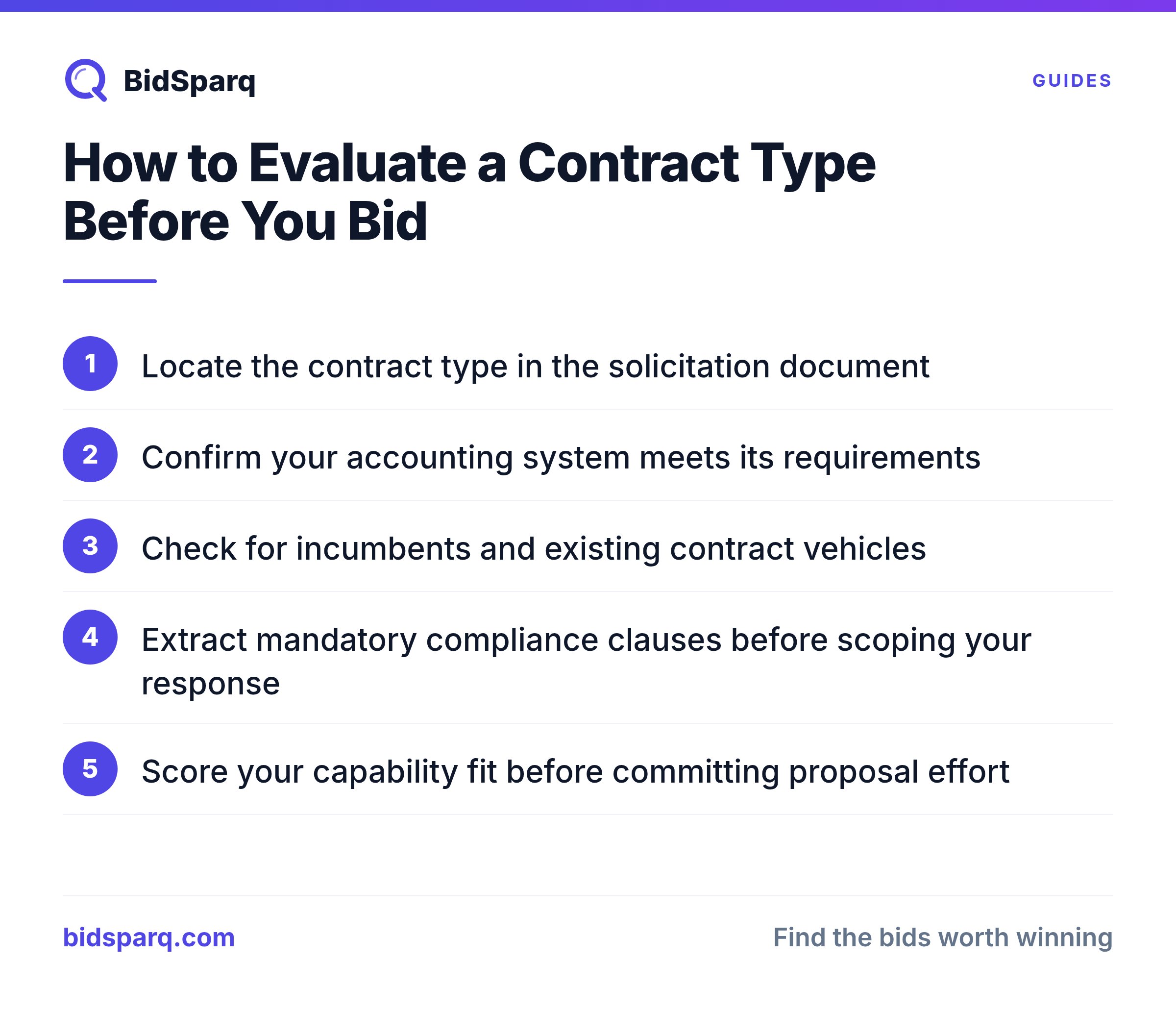
Open a solicitation and read the contract type before you read anything else. That single field tells you who absorbs cost overruns, what accounting systems the agency requires you to have, whether pricing is competitive or negotiated, and how you must document every dollar you spend in performance. Across public procurement, from school district technology RFPs to hospital capital projects to construction bids, vendors that skip this step build proposals on the wrong foundation. Government solicitations formalize these structures into specific contract types, each with distinct risk profiles, compliance obligations, and win strategies that are not interchangeable.
Fixed-Price Contracts: You Absorb the Risk
Price a fixed-price contract accurately, because cost overruns come entirely out of your margin. The most common form is Firm Fixed Price: you deliver the work for a set price regardless of what it actually costs you to perform. Fixed Price Incentive contracts share savings or overruns between vendor and agency based on an agreed formula, giving both parties a stake in efficiency. Fixed Price with Economic Price Adjustment allows the contract price to shift for documented inflation over long performance periods. Fixed-price vehicles suit vendors with well-defined scope, reliable cost history on similar work, and the discipline to hold to an estimate. They reward efficiency and punish assumptions.
Cost-Reimbursement Contracts: Built for Uncertain Scope
Choose cost-reimbursement when the agency genuinely cannot define the full scope upfront, not simply to reduce your financial exposure. Under Cost Plus Fixed Fee, the agency reimburses your allowable costs and pays a set fee regardless of outcome. Cost Plus Incentive Fee adjusts the fee based on performance targets, rewarding delivery under budget. Cost Plus Award Fee adds a subjective component: the agency's satisfaction rating drives a portion of your total compensation. The requirement most vendors overlook: cost-reimbursement contracts require a DCAA-compliant accounting system. If yours does not meet that standard, the solicitation is not within reach regardless of your technical qualifications.
Indefinite-Delivery Vehicles: The Long Game
Getting on an IDIQ vehicle is a starting position, not a guaranteed revenue stream. Indefinite Delivery, Indefinite Quantity contracts let agencies place orders within a ceiling over a multi-year period without running a full competition each time. Government-Wide Acquisition Contracts extend this model across agencies: a single on-ramp gives holders access to orders from multiple departments. GSA Multiple Award Schedule contracts operate similarly, with competition among schedule holders focused on delivery, capability, and specific pricing rather than full proposal cycles. The strategic value is clear: task-order competition is limited to vehicle holders. Incumbent vendors know this. Challengers need to know it too.
Matching Contract Type to Your Capabilities
Filter bid opportunities by contract type before you score technical fit. A strong capability match against a cost-reimbursement vehicle means nothing if you lack the required accounting infrastructure. A competitive fixed-price offer becomes a liability if you misestimated scope on a requirement that routinely runs over. BidSparq's semantic matching and AI fit scoring (0 to 100) identify solicitations by meaning, not keywords, while automated compliance extraction pulls mandatory contract-type-specific clauses before you open the full document. With 1,144 new solicitations mentioning contract types posted in the last 30 days, the volume makes manual triage unsustainable for any team trying to build a consistent pipeline.
The vendor who identifies the right contract type before writing a single word already holds a structural edge over everyone who skips that step.
FAQ
What are the most common government contract types for small businesses?
Firm Fixed Price contracts are the most common entry point for small businesses because they require no specialized accounting systems and apply across a wide range of solicitation sizes and agencies. IDIQ vehicles with small business set-asides and GSA schedule on-ramps are the next logical step for vendors building a repeatable pipeline. Cost-reimbursement contracts typically require DCAA-compliant accounting, which creates a meaningful barrier for smaller vendors earlier in their government contracting history.
What is the difference between an IDIQ and a blanket purchase agreement?
An IDIQ establishes a ceiling and a period of performance with minimum and maximum order quantities, and can be single-award or multi-award across multiple vendors. A Blanket Purchase Agreement is a simpler ordering mechanism set up against an existing contract, often a GSA schedule, to streamline repetitive purchases without a new competition. IDIQs are typically competed as standalone vehicles; Blanket Purchase Agreements are instruments for ongoing needs the agency already knows will recur.
How do I find out which contract type a government solicitation is using?
The contract type appears in the solicitation itself, typically in Section B of a Federal Acquisition Regulation-structured document, or in the contract terms section of a state or local solicitation. Discovery platforms with automated compliance extraction, such as BidSparq's RFP intelligence platform, pull this information from the source document and surface it before you open the full file, so you can filter by contract type at the top of your pipeline rather than discover it deep inside the solicitation under deadline pressure.
Start matching against open solicitations right now. Explore your matches free, no credit card needed.
Find RFPs that match your business
BidSparq monitors 23,000+ procurement sources and uses AI to score every opportunity against your capabilities. Try it free for 14 days.
Start Free Trial →