How to Write a Winning Government Proposal (Step by Step)
A practical guide to writing government proposals that win: from compliance matrices to technical approaches, pricing strategies, and common mistakes to avoid.
You found the perfect RFP. It matches your NAICS code, your certifications, your geographic area, and your past performance. Now you need to write a proposal that wins.
Government proposal writing is different from commercial sales. Evaluators score your proposal against specific criteria using a structured rubric. Miss a requirement, and you're eliminated: no matter how good the rest of your proposal is.
Here's how to write proposals that consistently score well.
Step 1: Read the Entire RFP (Twice)
Before writing a single word, read the complete solicitation. Pay special attention to:
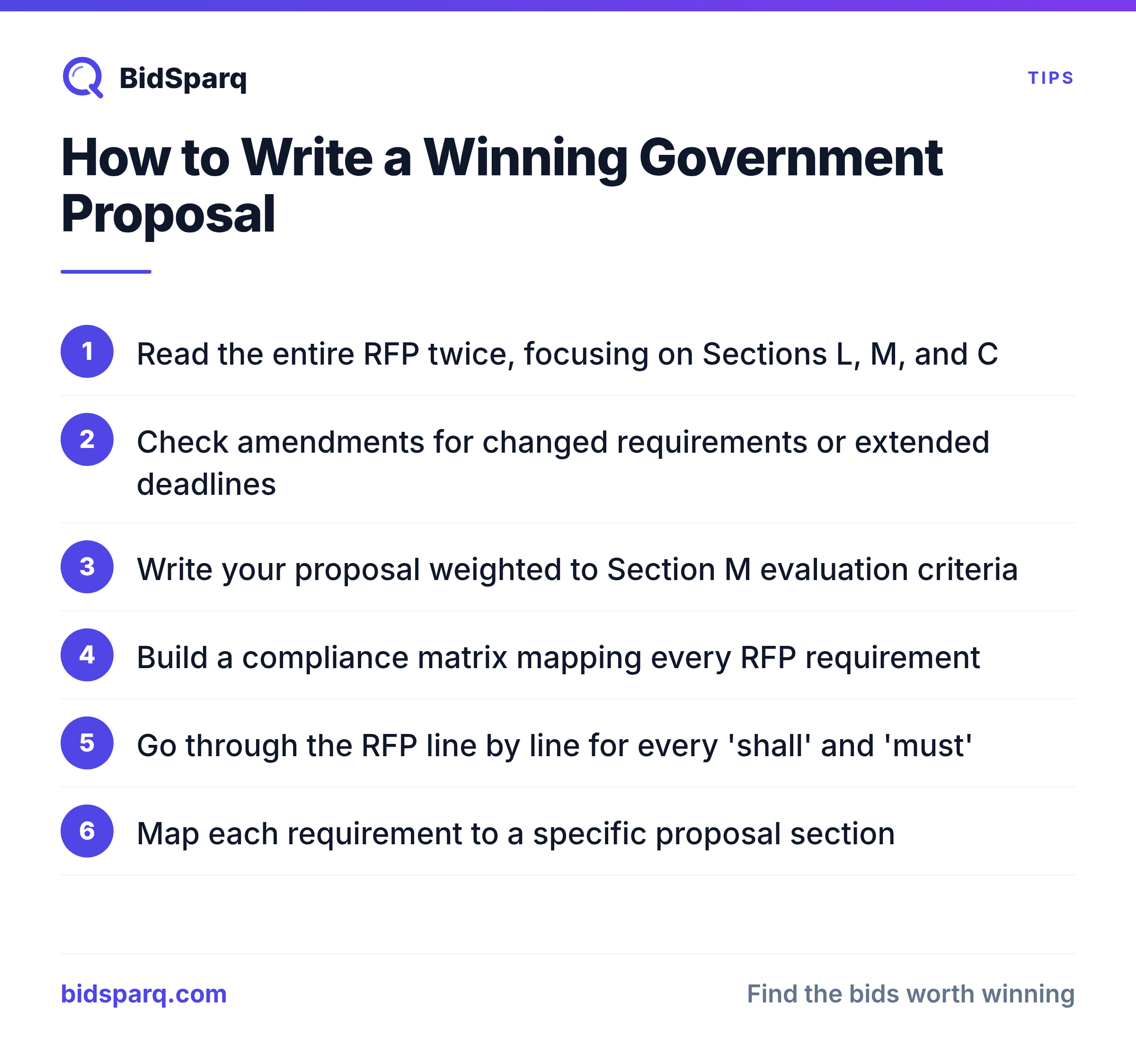
- Section L: Instructions to offerors. This tells you exactly what to submit and how to format it.
- Section M: Evaluation criteria. This tells you exactly how your proposal will be scored.
- Section C: Statement of Work / Performance Work Statement. This is what you're actually proposing to do.
- Amendments: Check for modifications that change requirements or extend deadlines.
Write your proposal to Section M. If technical approach is worth 40% and past performance is worth 30%, your proposal should reflect that weighting.
Step 2: Build a Compliance Matrix
A compliance matrix is a spreadsheet that maps every requirement in the RFP to a section in your proposal. It ensures you don't miss anything.
| RFP Section | Requirement | Proposal Section | Status |
|---|---|---|---|
| C.3.1 | Provide help desk support 24/7 | Technical Vol., Sec 3.1 | Complete |
| C.3.2 | Respond to P1 tickets within 15 min | Technical Vol., Sec 3.2 | In progress |
| L.5.1 | Page limit: 50 pages | All volumes | At 47 pages |
Go through the RFP line by line. Every "shall," "must," and "will" is a requirement that needs a response.
Step 3: Write the Technical Approach
Your technical approach should answer three questions:
- What will you do? (Your understanding of the requirement)
- How will you do it? (Your methodology and approach)
- Why is this the best approach? (Your rationale)
Tips for strong technical volumes:
- Mirror the RFP's language and structure
- Lead each section with your approach, not a restatement of the requirement
- Include specific details: tools, processes, timelines, staffing levels
- Use graphics and tables to break up text and convey complex information
- Show that you understand the agency's mission, not just the task
Step 4: Demonstrate Past Performance
Past performance is often the second-highest evaluation factor. Evaluators want evidence you've done similar work successfully.
For each reference:
- Match the scope, size, and complexity to the current RFP
- Quantify results: "Reduced ticket resolution time by 40%" beats "Improved service delivery"
- Include the contract number, agency, period of performance, and value
- Contact your references before submitting: make sure they'll respond positively to the agency's questionnaire
If you lack past performance: Highlight relevant commercial experience, subcontractor past performance, or key personnel experience. Every firm starts somewhere.
Step 5: Price to Win
In best-value evaluations, you don't need to be the cheapest, but you need to be competitive.
- Research what the government has paid for similar work (check FPDS for historical contract values)
- Price realistically: unrealistically low prices raise "risk" flags with evaluators
- Show your math: detailed cost breakdowns build confidence
- Include all required cost elements (labor, travel, ODCs, materials)
Common Mistakes That Kill Proposals
- Missing the deadline. Late proposals are rejected. No exceptions. Submit 24 hours early.
- Ignoring page limits. Evaluators stop reading at the page limit.
- Generic content. "We have 20 years of experience" means nothing. Show specific, relevant experience for this contract.
- Not answering the question. Respond to what they asked, not what you want to talk about.
- Weak past performance. Old or irrelevant references hurt more than they help.
Let AI build your compliance matrix
BidSparq's AI extracts mandatory requirements from every RFP and generates compliance checklists, competitive intel, and proposal guidance: so you can focus on writing, not searching.
Start Free 14-Day Trial →Next Steps
- Start your free trial: BidSparq's AI generates compliance matrices and win/loss assessments for every matched RFP
- Learn about set-aside programs that reduce your competition
- Master the solicitation first: how to read an RFP
- Understand NAICS codes to target the right opportunities
- Learn how to grow from a debrief: proposal debriefs guide
- Read our guide on finding government RFPs
Find RFPs that match your business
BidSparq monitors 23,000+ procurement sources and uses AI to score every opportunity against your capabilities. Try it free for 14 days.
Start Free Trial →