Higher Gov Pricing: Stop Guessing, Start Winning
Higher gov pricing demands more than competitive rates. Learn the compliance certifications, cooperative contract obligations, and AI-powered discovery strategies that determine whether your bid qualifies.
Pricing a bid for a higher education institution or government agency is not the same exercise as pricing commercial work. The rules are different, the compliance requirements are real, and submitting without understanding them can disqualify your proposal before anyone reads your technical approach.
The volume of opportunity in this market is substantial, and vendors who treat higher gov pricing as a discipline consistently out-compete those who approach each bid in isolation. That discipline starts with understanding what makes higher gov pricing different from everything else.
- Cooperative contract pricing creates downstream obligations: the rate you quote through NASPO ValuePoint, Sourcewell, E&I Cooperative Services, or OMNIA Partners can define expectations across every institution that later purchases through the same vehicle, effectively repricing your entire public sector book at once.
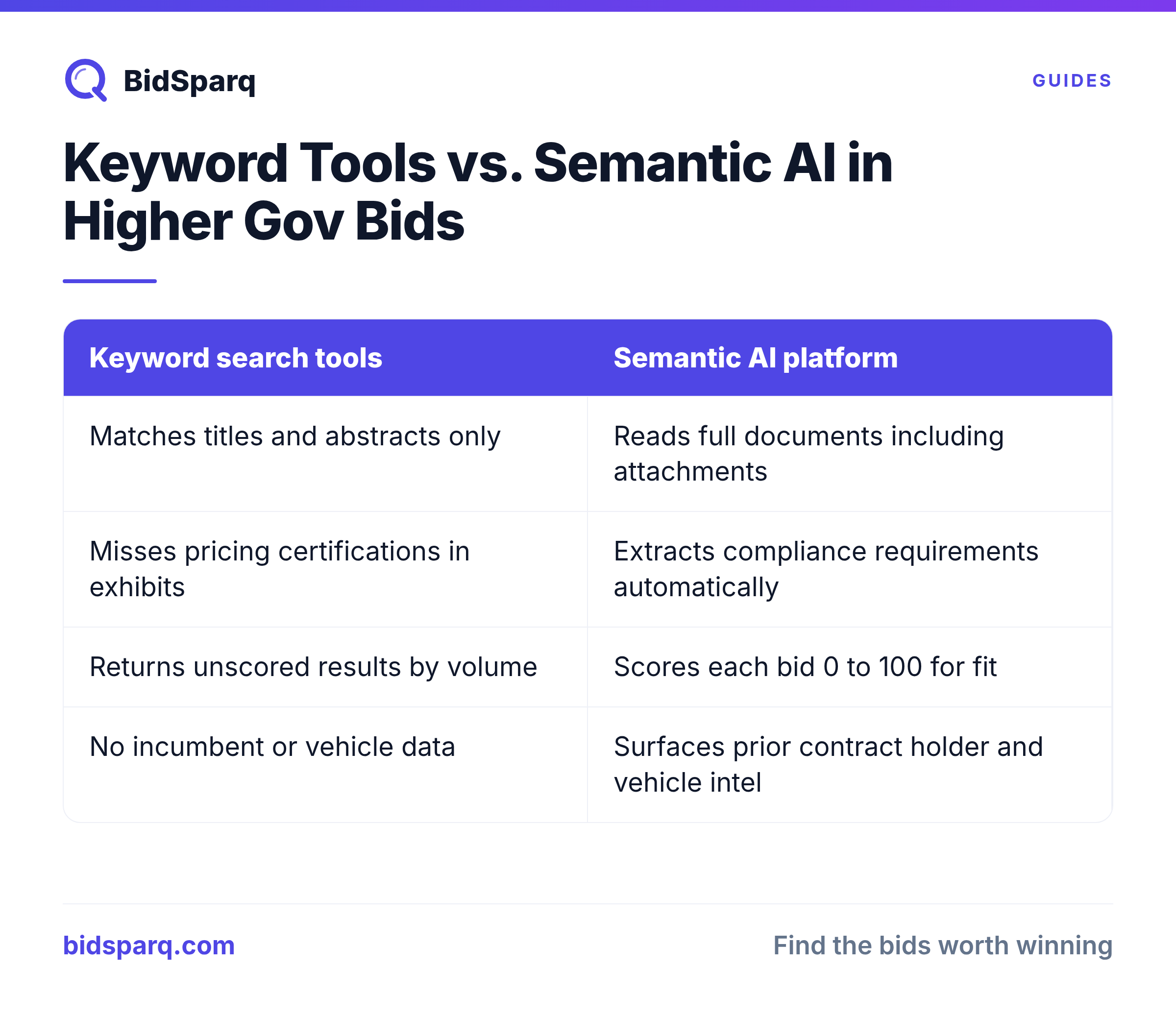
- Pricing certifications and best-price attestations appear in RFP attachments rather than the main solicitation body, and keyword-only search tools will never surface them: submitting without the required exhibit is a disqualifying error, not a correctable oversight.
- The market moves fast: as of September 2026, 1,327 solicitations mentioning “higher” close within the next 14 days across 23,000+ active sources.
- Where you focus geographically shapes your win rate: Pennsylvania and California alone account for nearly 600 of the currently open higher solicitations in that live feed.
- Before committing proposal resources, AI fit-scoring filters thousands of active bids down to the subset where your pricing structure, capabilities, and the buyer’s requirements actually align.
- Incumbent intel reveals the contract vehicle the prior holder used, giving you a real market-rate anchor instead of a guess when you set your price.
The short answer
Submit a bid to a higher education institution or government agency without understanding its pricing rules and you risk disqualification before anyone evaluates your technical approach. These buyers enforce formal procurement rules requiring price consistency and mandatory certifications with no equivalent in commercial sales. Violating those rules does not merely lose the bid; it can disqualify your submission entirely or create downstream legal exposure when auditors review contract awards. The practical answer for vendors is to identify every pricing-related compliance requirement before setting a rate, benchmark against real market data, and filter the opportunity pool to the bids where your pricing structure is genuinely competitive.
Why Higher Gov Pricing Is Uniquely Complex
Higher education and government buyers enforce procurement rules that turn pricing into a compliance exercise alongside a competitive one. Commercial buyers rarely impose price consistency requirements across channels. A university purchasing cooperative or state agency solicitation, by contrast, often requires you to certify that your quoted rate equals or beats every price you offer anywhere else. That obligation runs through the major cooperative purchasing vehicles: NASPO ValuePoint, E&I Cooperative Services, Sourcewell, and OMNIA Partners all carry price consistency terms in some form. The contract you win today sets the rate expectation for the next institution that finds you through the same vehicle, and the one after that. IT solution providers and curriculum vendors selling into this market encounter the same dynamic: price it wrong once and the consequences compound. Nowhere is price-consistency enforcement more systematic than in higher ed and government procurement, though any vendor selling to buyers who benchmark against published rates will recognize the stakes.
The Compliance Trap Most Vendors Miss
Pricing certifications, best-and-final price sheets, and most-favored-nation attestations frequently appear in RFP attachments rather than the main solicitation body. Keyword search tools that match on titles and abstracts will never surface them. Specific exhibits to watch for include the Certificate of Independent Price Determination, a standard requirement in many government solicitations, and the Price Reduction clause that ties your future pricing to the most-favored-customer rate you offered at award. Both can appear as appendices numbered well past the main terms, invisible to any tool that does not read the full document. The practical risk is straightforward: your team prices and submits a technically strong proposal without the required pricing exhibit, and the submission is rejected on a procedural technicality before it reaches evaluation. That scenario is entirely avoidable, but only if you read every attachment in every solicitation before pricing.
At scale, that means reading every document in every active pursuit. As of September 2026, 55,567 solicitations are open across the 23,000+ sources BidSparq tracks. Manually auditing even a meaningful fraction of that at the attachment level is not a repeatable workflow. It produces inconsistent results and diverts the proposal resources that should be focused on the pursuits most likely to win.
Start finding and vetting higher gov bids free, no credit card required.
How AI Changes the Pricing Calculus
Semantic matching and automated compliance extraction transform higher gov pricing from a research burden into a structured, repeatable decision. When a platform reads solicitation documents for meaning rather than matching keywords, it surfaces pricing requirements that keyword searches miss entirely. A solicitation for managed IT services at a state university system may bury a most-favored-nation certification requirement in an exhibit. Semantic analysis catches it, pulls the requirement into the opportunity summary, and flags the obligation before your team sets a price. Pair that with a fit score from 0 to 100, and the question of which bids to pursue becomes analytical rather than instinctive. Incumbent and contract-vehicle intelligence adds one more layer: knowing which cooperative vehicle the prior holder used gives you a realistic anchor for your own price positioning rather than a starting point built from guesswork.
Finding Higher Gov Bids Before the Window Closes
The higher gov opportunity pipeline is larger and faster-moving than most vendors realize, and geographic concentration matters considerably for territory planning. As of September 2026, 3,659 open solicitations mention “higher” across the sources BidSparq tracks. Pennsylvania leads active volume with 406 open solicitations, followed by California with 190. The distribution is broad enough that vendors in any region have real opportunities, but those leading states reward vendors who have active monitoring in place rather than periodic manual sweeps.
Of the currently open higher solicitations, 1,327 close within the next 14 days. For each one, a compliant, competitively priced proposal needs to be ready before the deadline. That urgency makes the triage step, identifying which opportunities genuinely fit before committing proposal resources, the highest-leverage point in the pursuit process. Beyond SAM.gov and your state’s official eProcurement portal, many higher education solicitations also surface through institution-specific procurement pages and BoardDocs agendas tied to governing board approvals, which makes broad-source aggregation essential rather than optional.
FAQ
Use these answers to pressure-test your higher gov pricing approach before your next submission.
What is higher gov pricing and why does it matter for vendors?
Higher gov pricing covers the pricing structures, compliance requirements, and competitive positioning strategies that apply when selling to higher education institutions and government agencies. These buyers enforce procurement rules including price consistency clauses, Certificate of Independent Price Determination requirements, and best-price attestations that directly determine submission eligibility. A vendor that prices without understanding those rules risks disqualification before the technical evaluation even begins.
How do I know if my pricing is competitive for a higher education RFP?
The most reliable approach combines incumbent intelligence with market benchmarking. Knowing which contract vehicle the prior holder used, and at what rate structure, gives you a real anchor for your pricing. Pair that with a fit score accounting for your qualifications and the buyer’s stated requirements, and you can make a data-grounded decision rather than a guess. Reviewing publicly posted contract awards in your category through procurement portals, databases like SAM.gov, and state budget transparency pages also provides useful rate context.
Do cooperative contracts affect the pricing I submit on direct higher gov bids?
Yes, and this is one of the most commonly overlooked aspects of higher gov pricing. Cooperative vehicles such as NASPO ValuePoint, E&I Cooperative Services, Sourcewell, and OMNIA Partners typically include a Price Reduction clause requiring you to pass along any better pricing you later offer to other buyers. If you hold a cooperative contract at a lower rate than the price you are quoting on a direct bid, you may be in violation of both the cooperative terms and the certification requirements in the new solicitation. Review your existing cooperative contract terms before pricing any new higher gov solicitation to ensure consistency across your public sector book.
See your matched higher gov opportunities free, no credit card needed.
Find RFPs that match your business
BidSparq monitors 23,000+ procurement sources and uses AI to score every opportunity against your capabilities. Try it free for 14 days.
Start Free Trial →