Aldevra Alternatives: What to Compare Before You Switch
Comparing Aldevra alternatives? See what Aldevra is built for, where teams outgrow it, and how to judge bid tools on coverage, matching, scoring and extraction.
If you are searching for Aldevra alternatives, the problem probably isn't bid alerts themselves. More likely, the alerts you get today don't match where your revenue actually comes from. A federal-centered feed works well for a federal-centered business. When your buyers also include school districts, county governments, hospital systems or private developers, the opportunities you most need arrive late or never arrive at all. A replacement is only worth switching to if it closes that gap.
- Aldevra is built around federal contracting, so it suits vendors whose pipeline is mostly federal agencies.
- Teams usually outgrow it on coverage, once state, local, education, healthcare or commercial buyers become a real share of revenue.
- Ask how matching works before you ask about price, because exact keyword alerts and meaning-based matching produce very different inboxes.
- Fit scoring and requirement extraction are what save the time: they let you rule out a weak bid before anyone reads the full packet.
- Test on your own past wins and misses, not on a vendor demo, to see which tool would actually have changed your results.
The short answer
Stay with a federal-focused service only if federal work is nearly all of your pipeline. If even a fifth of your target buyers are state, local, education, healthcare or commercial organizations, you will be better served by a platform that tracks all of those markets in one place and ranks every opportunity against your profile automatically. The deciding question is not which tool has the most features. It is which tool would have surfaced the bids you missed last quarter, and how quickly it would have told you they were worth pursuing.
What Aldevra offers and where teams outgrow it
Start by being clear about what Aldevra is designed to do. Aldevra is a federal-focused government contracting service. It helps vendors find and pursue federal opportunities, combining bid matching with contracting support aimed at federal buyers. For a company whose customers are mostly federal agencies, that focus is a strength, not a weakness.
The friction shows up when a business sells to more than one kind of buyer. A facilities services firm might win work from a VA medical center, a state university and a private hospital network in the same year. A K-12 technology reseller depends on district purchases that are posted on scattered district portals and in board agendas, and federal sources never list them. A construction subcontractor may chase municipal projects alongside private general contractor bids. In each case, a tool built around federal work leaves gaps the team has to fill by hand.
One quick diagnostic helps here. List the last few bids you found by accident, through a colleague, or too late to respond. If most of them came from non-federal buyers, coverage is your problem, and that should drive your evaluation.
The manual review is the real cost
Price the hours your team spends reading, not just the subscription. As of November 2026, 53,037 solicitations are open across the 33,000+ sources BidSparq tracks. Nobody reads that volume, so every tool filters it somehow, and whatever the filter removes, you never see. Exact keyword filters fail in both directions. They send solicitations that share a word with your services and nothing else, and they miss solicitations that describe your work in different language.
Each irrelevant match still costs a click, a download and several minutes of reading before someone dismisses it. Repeat that across every alert, every week, and the reading often costs more than the software. After enough noise, people start skimming, and skimming is how a good opportunity with an unfamiliar title gets passed over. A real alternative should cut that review down, not just repackage it.
See how automated matching cuts your weekly bid review with a 14-day free trial, no credit card required.
How the alternative categories compare
Sort your options by approach before you compare individual vendors. Most Aldevra alternatives fall into one of four categories, and each handles coverage, matching, scoring and extraction differently.
- Official portals such as SAM.gov and state eProcurement sites. These are free and authoritative for the buyers that post there. Coverage is limited to one jurisdiction per portal, so tracking many buyers means managing many logins and saved searches. Matching is search-based, and you rank bids and pull out requirements yourself.
- Federal-focused matching and contracting services. Aldevra sits in this group. These are a good fit when federal agencies dominate your pipeline. Before you assume a provider covers non-federal buyers, confirm its coverage with them directly.
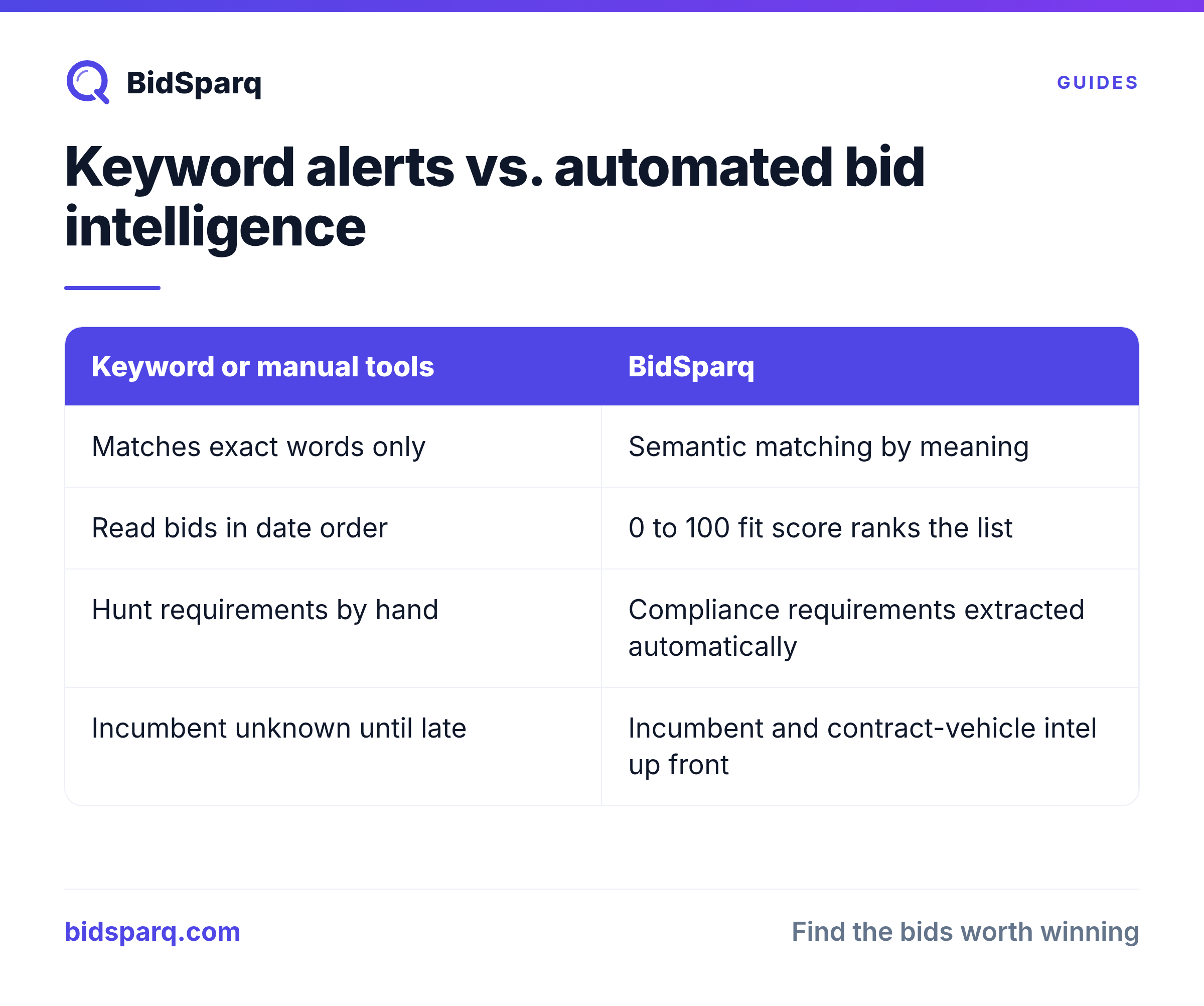
- Keyword alert aggregators. These pull listings from many sources into one feed, which widens coverage. Matching depends on the terms you choose, so you either get noise from broad terms or miss bids with narrow ones. Ranking and reading the bids are still your job.
- Automated bid intelligence platforms. These combine broad source coverage with software that does the first pass for you. In BidSparq's case, that means semantic matching that recognizes "building envelope restoration" as relevant to a "commercial roofing and waterproofing" profile, a fit score from 0 to 100 so you work the strongest bids first, automatic extraction of certifications, bonding, insurance and submission requirements into a checklist, and incumbent and contract-vehicle intelligence that shows whether an opening is real.
The practical difference is who does the first pass. With portals and keyword tools, your staff reads, ranks and checks every listing. With an automated platform, the software handles that work, and your staff's judgment goes to the bids that are left.
How to run a fair two-week test
Use your own pipeline as the benchmark, not a curated demo. Pull five to ten opportunities you pursued or found manually in recent months. Record where each came from, whether SAM.gov, a district's BoardDocs agenda, your state's official eProcurement portal or a hospital system's supplier page. Then build your profile in each tool you are evaluating and check whether it would have surfaced each opportunity, how it ranked them and what requirements it pulled out.
During the trial, repeat the check on live bids. Keep a simple log of relevant bids you would otherwise have missed, irrelevant matches you had to dismiss, and how long it took to go from alert to a bid or no-bid decision. After two weeks, that log will tell you more than any feature comparison chart.
FAQ
Is Aldevra only for federal contracts?
Aldevra is primarily known as a federal-focused government contracting service, and its strength is helping vendors pursue federal agencies. If you also sell to state, local, education, healthcare or commercial buyers, ask Aldevra directly what those markets cover before you rely on it for them.
What's cheaper than Aldevra?
Official portals such as SAM.gov are free, but you search, rank and review everything yourself, and that labor is a real cost. Paid tools should be compared on total cost, meaning the subscription plus the staff hours spent reviewing matches. BidSparq Pro Max is $249 per month, or $199 per month billed annually.
Does any bid tool cover SLED, healthcare and commercial buyers?
Yes. Some platforms track government, education, healthcare, construction, IT and commercial buyers together. BidSparq tracks 33,000+ sources across those markets, so a team selling to several buyer types can work from one ranked feed.
What are the best Aldevra alternatives for small businesses?
Small teams benefit most from automated ranking, because they have the least time to read. Choose a platform that covers the buyer types you actually target and scores every opportunity against your profile, so the strongest bids are at the top.
How do I compare bid matching services fairly?
Use your own history. Run recent bids you found manually through each tool, see which tool would have surfaced them, and count how many irrelevant matches came along with the good ones.
Is there a bid discovery tool with a free trial?
Yes. BidSparq Pro Max starts with a 14-day free trial that requires no credit card and gives full access, so you can test it on live opportunities. There is no free plan after the trial.
Your own pipeline is the fairest judge of any switch. Run your next two weeks of bids through AI matching free and compare what turns up with what your current alerts send you.
Find RFPs that match your business
BidSparq monitors 33,000+ procurement sources and uses AI to score every opportunity against your capabilities. Try it free for 14 days.
Start Free Trial →