FedBizOpps: Find Federal Bids Before Competitors Do
FedBizOpps became SAM.gov, but finding the right federal solicitations only got harder. Learn how semantic matching and AI fit-scoring help procurement teams win more.
Finding every relevant solicitation before the deadline closes is the core procurement problem, whether your team pursues school district contracts, hospital system RFPs, or federal awards. The tools most teams rely on, keyword search and manual portal monitoring, were not built for that problem. They return only what you already know to search for.
FedBizOpps, the legacy Federal Business Opportunities portal, shaped how a generation of federal contractors searched for work. It was replaced by SAM.gov in 2019, but its name persists because the underlying challenge it represented never went away. This post is for any procurement team that pursues federal work as part of a broader bid strategy and wants to stop missing winnable solicitations.
- FedBizOpps became SAM.gov in 2019, but the consolidation added scope and complexity rather than simplicity.
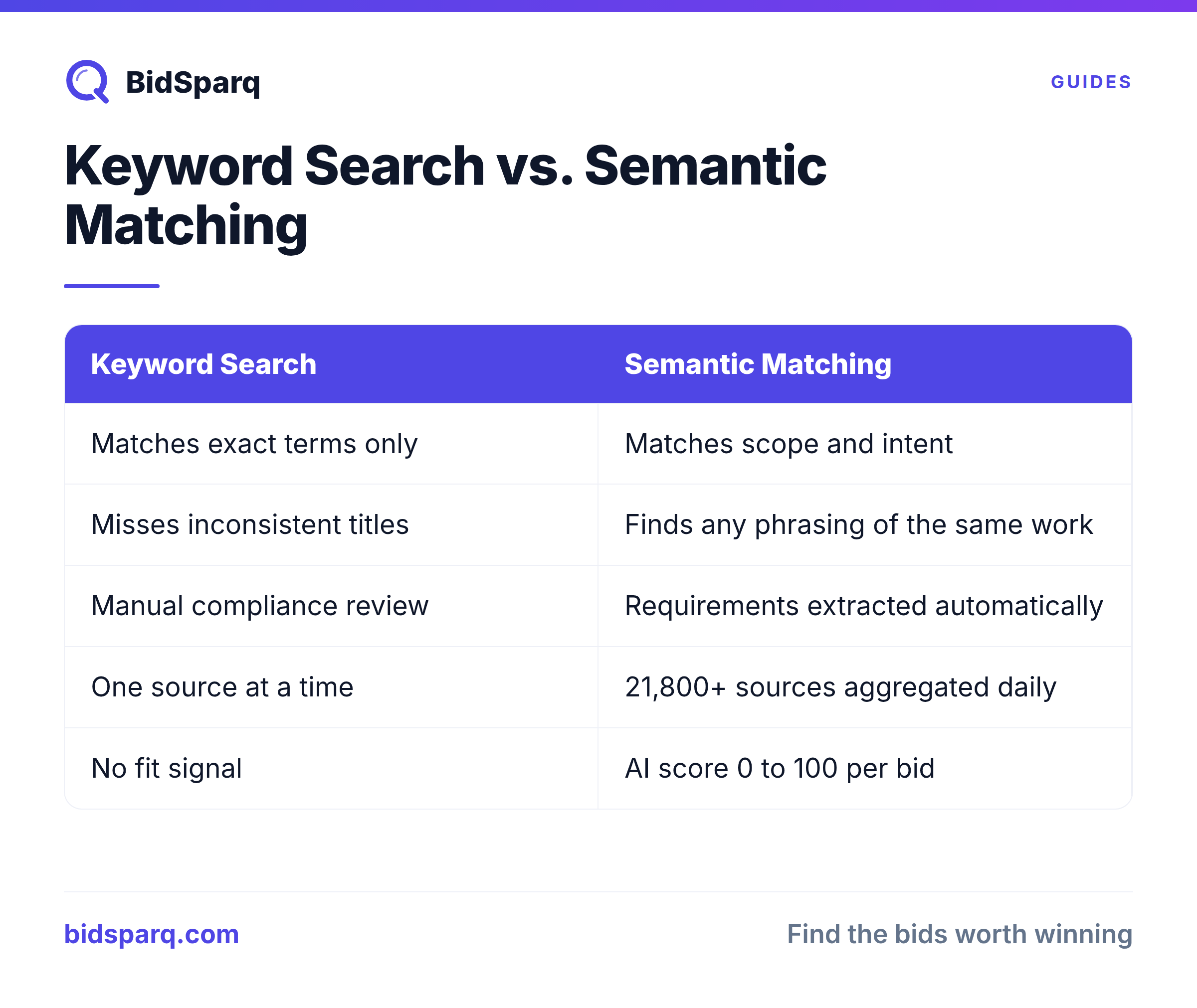
- Keyword search misses critical opportunities because contracting officers across every sector use inconsistent terminology for the same scope of work.
- Semantic matching finds bids by meaning, not title, catching solicitations that exact-match tools routinely skip.
- AI fit-scoring from 0 to 100 lets teams prioritize pursuits in minutes instead of hours of manual triage.
- Automated compliance extraction surfaces bonding, certification, and set-aside requirements without reading every attachment.
- Federal is one market among many: education, healthcare, construction, and commercial procurement all issue formal solicitations that reward systematic discovery.
The Search Problem That Spans Every Procurement Market
Procurement search fails for the same reason across every sector: the people writing solicitations do not use standardized language. A general contractor searching for "roofing" on a school district procurement portal will miss solicitations filed under "roof membrane restoration," "building envelope repair," or "capital improvement phase two." All describe work that contractor is qualified to bid. Keyword search finds one.
Healthcare procurement compounds the problem: medical suppliers searching by product category find nothing when a solicitation is scoped by procedure type, an entirely different vocabulary. IT services firms searching by technology stack routinely miss contracts framed around service outcomes rather than the tools required to deliver them. The gap is sharpest in federal contracting, where identical IT infrastructure work might appear as "Enterprise Network Modernization Services" at one civilian agency and "Tactical Communications Infrastructure Refresh" at a defense posting. A search for "network upgrade" returns neither. No NAICS filter resolves a mismatch that lives entirely in how a contracting officer chose to title the posting.
What FedBizOpps Was and Why the Name Still Matters
FedBizOpps launched in the early 2000s as the federal government's single point of entry for contract opportunities above the simplified acquisition threshold. It consolidated a fragmented patchwork of agency bulletin boards and paper notices into one searchable database. For the teams that built workflows around it, FedBizOpps defined what federal bid search looked like: keyword boxes, NAICS filters, and agency drop-downs.
In 2019, the General Services Administration merged FedBizOpps into SAM.gov as part of a broader consolidation of federal procurement systems. The new platform covers contract opportunities, entity registration, exclusions, wage determinations, and federal assistance listings in one place. The scope expanded substantially. But the keyword search habits built around FedBizOpps transferred directly, causing teams to miss solicitations filed under terms they did not think to search.
| FedBizOpps | SAM.gov | |
|---|---|---|
| Scope | Federal contract opportunities above the simplified acquisition threshold only | Contract opportunities, entity registration, exclusions, wage determinations, and federal assistance listings |
| Search interface | Keyword search with NAICS filters and agency drop-downs | Keyword search with NAICS, agency, and set-aside filters; substantially more complex navigation |
| Data coverage | Federal solicitations from participating agencies; no vendor or registration data | All prior FedBizOpps solicitations plus integrated vendor registration and federal assistance records |
| Key limitations | Single-purpose portal with no entity management; retired November 2019 | Keyword search habits transferred unchanged from FedBizOpps; expanded interface complexity; no semantic matching or fit-scoring |
Why Keyword Search Fails Federal and Non-Federal Teams Alike
The most damaging bid misses are not the solicitations a team reviews and declines. They are the ones that never appear in search results. Federal contracting officers write solicitations in their own language, shaped by agency culture and program history. A facilities services contract might appear as "Base Operations Support Services" at one installation and "Facilities Support Contract" at another. A team searching for "facilities management" misses both.
The problem compounds when a team pursues work across multiple sources. Federal opportunities appear on SAM.gov and on agency-specific portals. State and local opportunities appear on dozens of separate e-procurement platforms. School district and university RFPs often live on district-specific sites. Healthcare and commercial solicitations add more sources still. Teams running keyword searches across all of them spend more time on search mechanics than on bid decisions.
Semantic Matching and AI Scoring: What Modern Bid Discovery Looks Like
Semantic matching reads solicitation language the way an expert reviewer would, identifying scope and intent rather than matching character strings. Instead of asking whether a solicitation title contains a specific phrase, semantic search asks whether the solicitation describes work a team is qualified to pursue. That shift produces significantly broader coverage, particularly for federal solicitations where title conventions vary by agency and program office.
BidSparq applies semantic matching across 23,000+ distinct bid sources aggregated daily. As of August 2026, 69,096 solicitations are open across those sources. Each receives an AI fit score from 0 to 100 based on how closely its scope, structure, and requirements align with a team's configured profile. A high score signals strong alignment worth pursuing. A low score signals a tangential match not worth prioritizing. Teams move from reading every solicitation to reviewing only the ones worth their time.
Compliance extraction works alongside scoring. Bonding requirements, small business set-aside designations, required certifications, and teaming clauses appear in solicitation attachments, amendment files, and exhibit pages. Automated extraction surfaces them at the point of discovery, so a team knows immediately whether it is structurally eligible before committing pursuit resources to any opportunity, federal or otherwise.
Find out which of those 69,096 open solicitations match your team's profile. Explore the platform free, no credit card needed.
Federal Is One Vertical: The Case for Broader Market Coverage
Teams that treat federal as their only pursuit market leave winnable contracts in education, healthcare, construction, and commercial procurement untracked. State and local agencies, K-12 school districts, universities, hospital systems, and private commercial buyers all issue formal solicitations through structured procurement processes. Many of those buyers have longer contract cycles, less incumbent concentration, and more accessible entry points than federal agencies.
Incumbent and contract-vehicle intelligence matters across all of those markets. Knowing who holds the current contract on a bid, when that contract expires, and whether an existing vehicle can be leveraged changes the pursuit decision before a team drafts a single sentence of their response. That intelligence is available at the bid level across verticals, which means teams pursuing education alongside federal have the same visibility into competitive position as teams focused exclusively on SAM.gov.
The aggregation challenge is real: education, healthcare, and commercial solicitations are scattered across hundreds of portals with no central equivalent of SAM.gov. The teams with the best pipeline coverage solve that problem once, across all sources, rather than maintaining a separate monitoring workflow for each market.
FAQ
Is FedBizOpps still active, and where do I find federal bids now?
FedBizOpps was retired in 2019 and fully replaced by SAM.gov. All federal contract opportunities that were published on FedBizOpps are now posted at SAM.gov under the Contract Opportunities section. Teams that still reference FedBizOpps in their workflows or training materials should update those references to SAM.gov. Using a bid aggregator that pulls SAM.gov alongside agency-specific portals and other sources gives broader coverage than SAM.gov alone.
What is the difference between keyword search and semantic search for federal contracts?
Keyword search returns solicitations that contain the exact words or phrases you type. Semantic search returns solicitations that describe the scope of work you pursue, regardless of the specific words used. Federal contracting officers do not use standardized titles or terminology, so keyword search routinely misses relevant opportunities. Semantic search closes that gap by interpreting meaning rather than matching strings, which is why teams using semantic tools surface solicitations their competitors miss.
How do I evaluate whether a federal solicitation is worth pursuing before reading the full document?
AI fit-scoring assigns each solicitation a numeric value from 0 to 100 based on how closely its scope, requirements, and structure align with your team's capabilities. That score lets you rank open opportunities and focus review time on the highest-scoring solicitations first. Automated compliance extraction narrows the field further by flagging solicitations where eligibility requirements, bonding thresholds, or set-aside designations do not match your qualifications, before you invest hours in a full review.
Start exploring matched solicitations free at BidSparq's RFP discovery platform. No credit card needed.
Find RFPs that match your business
BidSparq monitors 23,000+ procurement sources and uses AI to score every opportunity against your capabilities. Try it free for 14 days.
Start Free Trial →