TxDOT Unit Prices: How to Read Them Before You Bid
TxDOT unit prices are rolling averages of past winning bids, not a price list. Here is how estimators should adjust them by quantity and district, where to check bid tabs, and how to find the lettings worth pricing.

A unit price average tells you what the market charged on someone else's quantities, in someone else's district, months ago. It does not tell you what to bid on yours. The same pay item measured in the hundreds of units routinely prices at a multiple of the same item measured in the tens of thousands, and a blended average lands somewhere between the two, matching neither job. That is the trap in TxDOT unit prices: the data is public, detailed, and easy to misuse, so estimators either anchor to the average and leave margin behind, or ignore it and price blind against competitors who did the reading.
- Quantity moves the number more than anything else. Fixed costs spread across a small quantity push the unit price far above the same item on a large quantity, and the average hides that curve.
- District and timing matter because haul distance, local material supply, and the month of the letting push the same item up or down from one report to the next.
- Bid tabulations beat averages when the question is how a specific competitor prices a specific item on a specific kind of job.
- The report to pull is TxDOT's 12-month Average Low Bid Unit Price table, published statewide and by district under the Letting pages and refreshed monthly.
- Finding the right letting is its own workload: as of October 2026, 765 new "txdot" solicitations were posted in the last 30 days.
The short answer
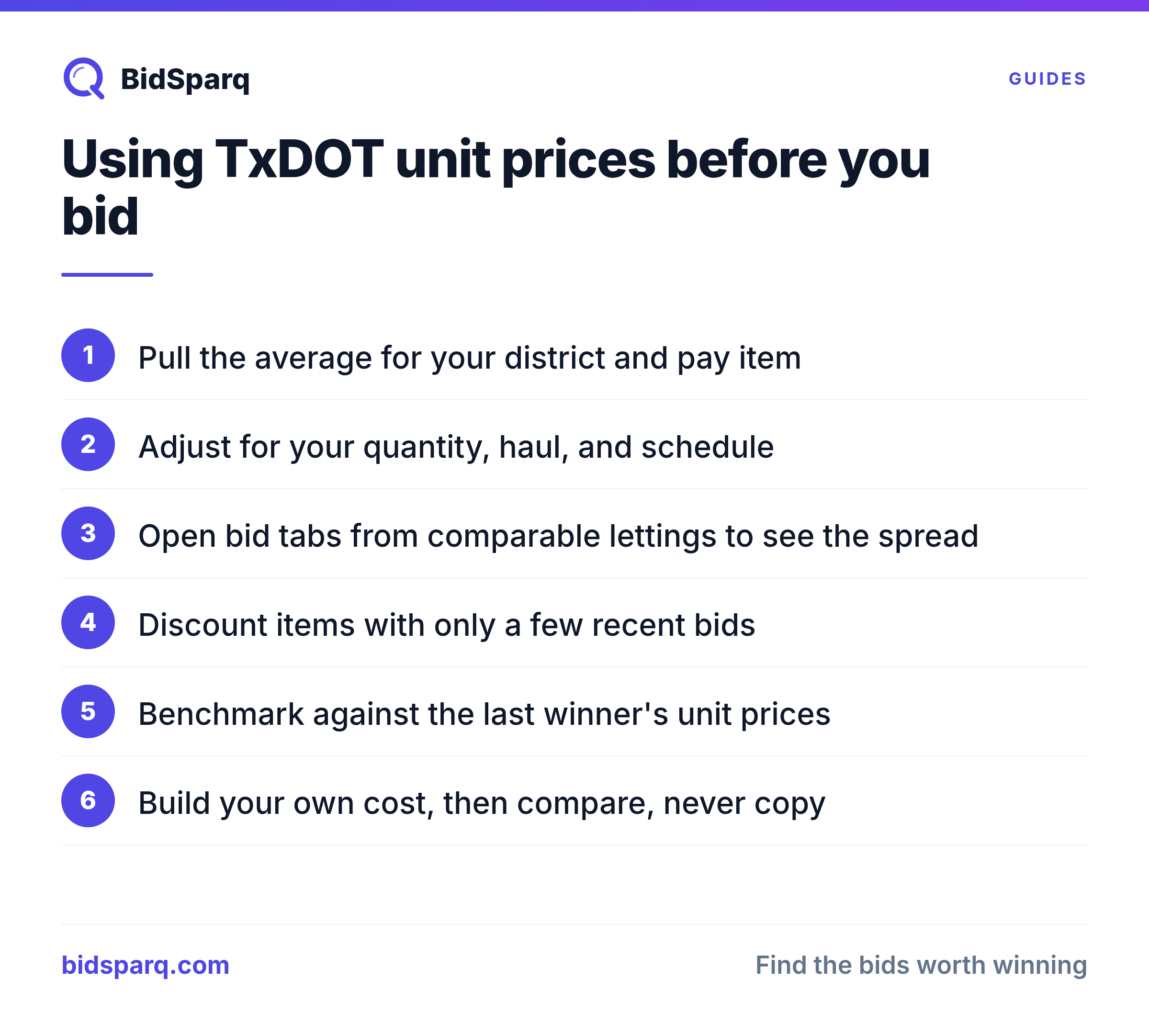
TxDOT unit prices are the published average low bid prices per pay item from recent Texas Department of Transportation lettings. They are averages of winning bids, not a price list, and the right way to use them is as a benchmark to check your own cost buildup, not as the number you bid. Pull the 12-month average for the district you are bidding in, adjust it for your quantity and haul, then open the bid tabulations from comparable lettings to see the full spread between bidders rather than the midpoint. Discount any item with only a handful of recent bids, because one unusual project can swing it. Most state DOTs publish an equivalent report, so the same discipline transfers to heavy civil work anywhere.
What a TxDOT unit price actually measures
Read the average as a weighted history of winning bids, not as a cost estimate. TxDOT lets highway projects on a unit price basis. Each pay item in the proposal carries an estimated quantity, each bidder enters a unit price, the extensions are summed, and the lowest responsive total wins. The published averages are built from the unit prices of those low bidders over a rolling 12-month window, so the report reflects what it took to win, on the jobs that were let, with the quantities those jobs happened to carry.
Take Item 341, dense-graded hot-mix asphalt, the pay item a paving subcontractor quotes to a general contractor on a widening job. The statewide average for that mix type looks like a safe anchor. But the average blends large urban overlays with small rural patching jobs, bidders with their own plants against bidders hauling from a competitor's, and lettings from a month when asphalt binder was cheap against one when it was not. The number is real. It is just not the subcontractor's number. One more wrinkle: the engineer's estimate is typically built from the same averages, so a bid that lands near the average will look reasonable to everyone in the room and still be wrong for the actual job.
Why the average is usually the wrong number to bid
Adjust for quantity, location, and timing before you trust a single figure. Quantity is the biggest distortion. Fixed costs such as mobilizing a crew or setting up a plant get spread across the estimated quantity, so Item 341 hot-mix on a few hundred tons of patching prices nothing like Item 341 on a full-depth urban overlay. The same curve applies to Item 360 concrete pavement, where paving train setup and batch plant logistics dominate the cost of a short section and nearly disappear on a long one. A blended 12-month average flattens both into a single line.
Location is next. A traffic control firm pricing Item 502, barricades, signs, and traffic handling, for a district far from its yard carries per diem and idle equipment that a local competitor does not. The district tables narrow this gap but do not close it, because TxDOT districts are large and the work inside them is not uniform. Timing matters too. Letting season and material escalation both leave fingerprints on recent averages that may not apply to a project advertised today.
Finally, averages inherit the strategies of the people who set them. Unbalanced bids, where a contractor loads price onto items expected to overrun and shaves it off items expected to underrun, feed straight into the statistics. Item 500 mobilization is the classic example: it is paid as a lump sum or a percentage of the contract, it scales with project size rather than with any unit of work, and bidders front-load it to improve cash flow, so its average is a blend of strategies rather than costs. Item 502 traffic handling gets the same treatment on phased projects. Treat those lines with particular suspicion.
Where to check TxDOT unit prices and bid results yourself
Start with the primary sources, all of which are free. TxDOT publishes its 12-month Average Low Bid Unit Price tables under the Letting pages on its website, in two versions: a statewide table and a set of district tables, each listing the pay item number, description, unit, and average low bid price for the trailing 12 months of lettings. The same pages post the bid tabulations from each monthly letting, which list every bidder's unit prices item by item. Those tabulations are where the real intelligence lives: they show the spread, who was aggressive on which items, and how far the second and third bidders landed from the winner. The TxDOT Standard Specifications define what each pay item includes, which matters because two agencies can use the same item number and pay for different scopes of work.
For trend context beyond Texas, the Federal Highway Administration's National Highway Construction Cost Index tracks how highway construction costs are moving nationally, which helps explain why an average from a year ago may already be stale. And because many cities, counties, utility districts, and transit agencies in Texas adopt TxDOT specifications for their own roadway work, you will see TxDOT item numbers referenced in solicitations posted on the Electronic State Business Daily and on local agency bid pages. An engineering consultant preparing an opinion of probable cost for a municipal street reconstruction will typically start from the TxDOT district table for exactly this reason, then adjust for the smaller quantities a city job carries.
The scale problem: finding the lettings worth pricing
Treat discovery as its own workload, because it is one. TxDOT's own monthly letting schedule is only the start. Every local agency that builds to TxDOT specifications advertises separately, on its own portal or in its own board packet, and those are the jobs where the quantities are smaller, the competition is thinner, and the unit price history is harder to find. As of October 2026, 57,546 solicitations are open right now across the 23,000+ sources BidSparq tracks, and 3,010 of them mention "txdot".
Reading that volume by hand means checking dozens of portals on a rotating schedule, then opening each proposal to learn whether the pay items match the work you self-perform. Keyword alerts help less than they should. A solicitation for a drainage improvement project may never use the words "concrete" or "riprap" in its title, and a transit agency's bus lane rehabilitation may never say "paving" anywhere a search would catch it. The result is that estimators spend hours on discovery that should be spent on takeoff, and still miss lettings they would have won.
As of October 2026, 100 "txdot" solicitations close within the next 14 days. Match them to your crews and equipment on the free tier, no credit card needed.
How to turn unit price data into a go/no-go decision
Run every letting through the same five checks before you spend an estimating hour on it. The unit price history is only useful once you know which projects to apply it to, and the decision comes down to five questions you can answer from the proposal, the 12-month table, and the last comparable bid tab:
- Quantity band. Is the estimated quantity for your controlling item, say Item 341 or Item 360, in the same range as the jobs behind the published average, or is it small enough that the average is meaningless for you?
- Haul distance. How far is the project from your yard or plant, and does the district table already reflect bidders who sit closer than you do?
- Depth of data. How many bids from the last 12 months stand behind the average for that item? A line built from two lettings is an anecdote, not a benchmark.
- Disqualifiers. Does the bonding requirement, prequalification status, or DBE goal rule you out before pricing begins?
- Incumbent. Who won the last comparable letting in that district, and what did their item-by-item unit prices look like in the bid tab?
Done manually, those five checks take an estimator most of a morning per letting, and a keyword alert gets you none of them. Automation covers each one. Semantic matching reads a solicitation for the work it is asking for rather than the words it happens to use, so a county bridge deck rehabilitation surfaces for a concrete repair contractor even when the title never says concrete, which answers the quantity and scope question before the proposal is opened. A 0 to 100 fit score then ranks each match against the scope you actually perform and the territory you can serve, which is the haul distance check, and it is how a bridge contractor and an erosion control firm can look at the same letting and each get an honest answer about whether it is theirs. Automated compliance extraction pulls the bonding requirement, prequalification status, Disadvantaged Business Enterprise (DBE) goal, and submission deadline into one view, so the disqualifiers show up before the takeoff begins rather than after. Incumbent and contract history shows who won the last comparable project, which tells you exactly whose unit prices to pull from the bid tabulations as your competitive benchmark. The depth-of-data check stays with you and the report, but it takes seconds once the other four are done.
BidSparq does this across the whole procurement market, including healthcare, education, commercial, and government RFPs, but for a heavy civil estimator the payoff is narrower and sharper: the right lettings and the right competitor's numbers, with the hours left over to price them properly.
The average tells you where the market has been. The bid tabs and your own cost buildup tell you where to go.
Run your next letting through the free tier and see which ones fit before you price them.
FAQ
Are TxDOT unit prices the same as the engineer's estimate?
No, but they are closely related. The engineer's estimate for a specific project is typically built from the published 12-month average low bid unit prices, adjusted by the designer for project conditions. The averages themselves are a market statistic drawn from past low bids, while the estimate is one agency's prediction for one job. A bid near the estimate is not automatically a good bid.
How often are TxDOT average low bid unit prices updated?
TxDOT publishes the Average Low Bid Unit Price tables monthly, after each letting is tabulated, and each table is a rolling 12-month average ending with the most recent letting. The statewide and district versions are refreshed together. Always check the period stated in the report header before relying on a figure, and compare it against the bid tabulations from the most recent lettings for the same item, because material costs and contractor capacity can shift faster than a 12-month average reflects.
Can I use TxDOT unit prices for city or county road projects?
Yes, and many local agencies and their consultants do exactly that, since much Texas municipal and county roadway work is built to TxDOT specifications and uses TxDOT pay item numbers. Adjust for the smaller quantities, shorter durations, and tighter sites that local projects usually involve, all of which tend to push unit prices for items like 341 hot-mix and 502 traffic handling above the statewide average.
Find RFPs that match your business
BidSparq monitors 23,000+ procurement sources and uses AI to score every opportunity against your capabilities. Try it free for 14 days.
Start Free Trial →