Hospital RFP Database: Why Keyword Search Misses Bids
A hospital RFP database pays off only if it finds bids by meaning, scores fit, and extracts compliance terms early. Here is how to compare free and paid sources.
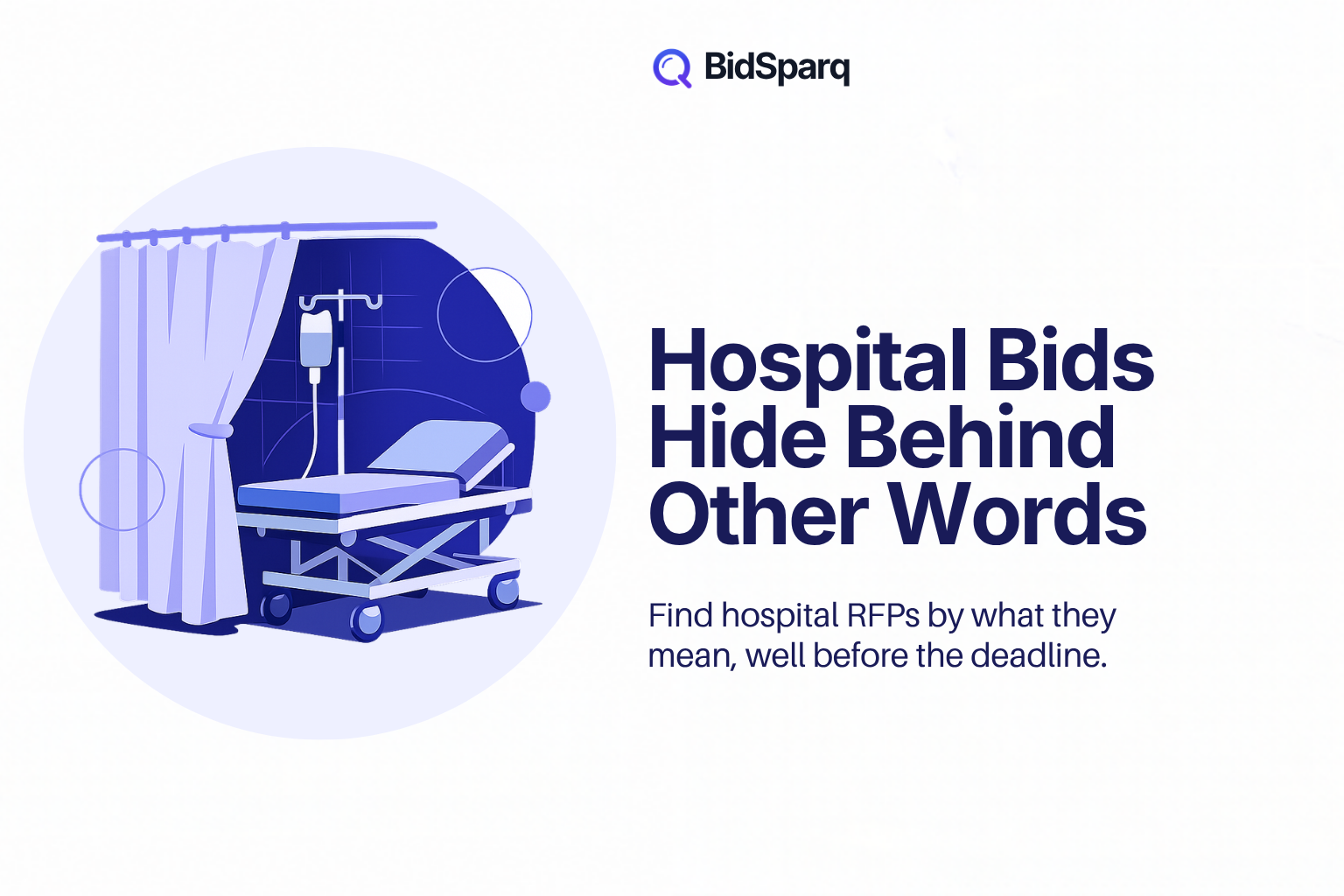
Keyword alerts miss most hospital RFPs because hospitals describe the work in their own operational language. A cleaning contract gets posted as 'environmental services.' Biomedical equipment maintenance shows up as 'clinical engineering support.' A six-figure renovation can sit under 'environment of care improvements.' On top of that, much of hospital spending is committed before any public bid appears. A vendor who runs exact-phrase searches on public bid boards sees a thin slice of the market, and usually sees it late.
- Surface bids your current alerts never return by searching on what a service means, so plant operations, sterile processing, and patient experience work shows up even when it is written in hospital terms.
- Screen out disqualifying requirements before anyone reads the full RFP. A compliance checklist up front saves hours on bids your insurance, credentialing, or data-handling setup cannot support.
- Write fewer, stronger proposals by spending team time only on bids that score as a strong match for your capabilities and history.
- Gain months of lead time on capital and equipment work by watching where hospital spend gets approved before it is posted.
- Know whether a rebid is winnable by checking the incumbent, the contract expiration, and any scope changes before you commit resources.
The short answer
A hospital RFP database is a single searchable feed of open solicitations from public hospitals, health systems, academic medical centers, and federal medical facilities, filterable by service, location, and deadline. The ones worth paying for match bids by meaning and score each one against your capabilities, so a facilities vendor searching for 'maintenance' also sees plant operations work. As of November 2026, 472 open solicitations in the sources we track mention 'hospital'. Free official portals each cover their own slice of that total. A paid aggregator earns its cost by pulling the slices together and telling you which bids deserve your team's time.
Why hospital bids are so hard to track by hand
If you sell into hospitals, expect to monitor dozens of separate sources. Hospital procurement is fragmented by ownership. A county-owned hospital may post through the county purchasing office. A hospital district may run its own bid page. A university medical center often publishes through the university's procurement site, and federal medical facilities post on federal systems. Private nonprofit health systems frequently use supplier portals that hide opportunities until you register.
The volume never slows down. In the last 30 days, 509 new 'hospital' solicitations were posted. A vendor selling food service, imaging maintenance, or interior renovation into hospitals would have to check every relevant page every few days and still hope a keyword alert caught the bids worded in unfamiliar terms. When a manual process fails, it usually fails quietly: the bid turns up with three days left, or turns up after the award.
Find the open hospital RFPs that match your services in one scored feed, free for 14 days with no credit card.
Free vs paid hospital RFP databases: how to compare
Judge every source on the same five capabilities before you commit time or budget to it. Hospital bids come from three types of sources, and each has a different trade-off.
- Official portals such as SAM.gov and state eProcurement systems are free and authoritative. Each covers only its own buyers, and search is keyword based.
- Paid aggregators combine thousands of portals, agency pages, and buyer sites into one feed. Quality varies widely. Some simply republish listings, while others analyze each solicitation document.
- GPO and health-system supplier portals require registration and often show opportunities only to approved vendors. No aggregator sees everything inside them, so register directly with the systems you target.
Coverage gaps cost the most in the largest markets. As of November 2026, California (71) and New York (57) are posting the most 'hospital' solicitations, spread across county, district, university, and state buyers that each publish on their own sites. Use this checklist to compare any paid option against what you can do with free portals alone:
- Coverage. Ask how many sources the platform monitors and whether that includes county, district, university, and commercial buyers alongside federal and state portals. Then test it against hospital bids you already know about.
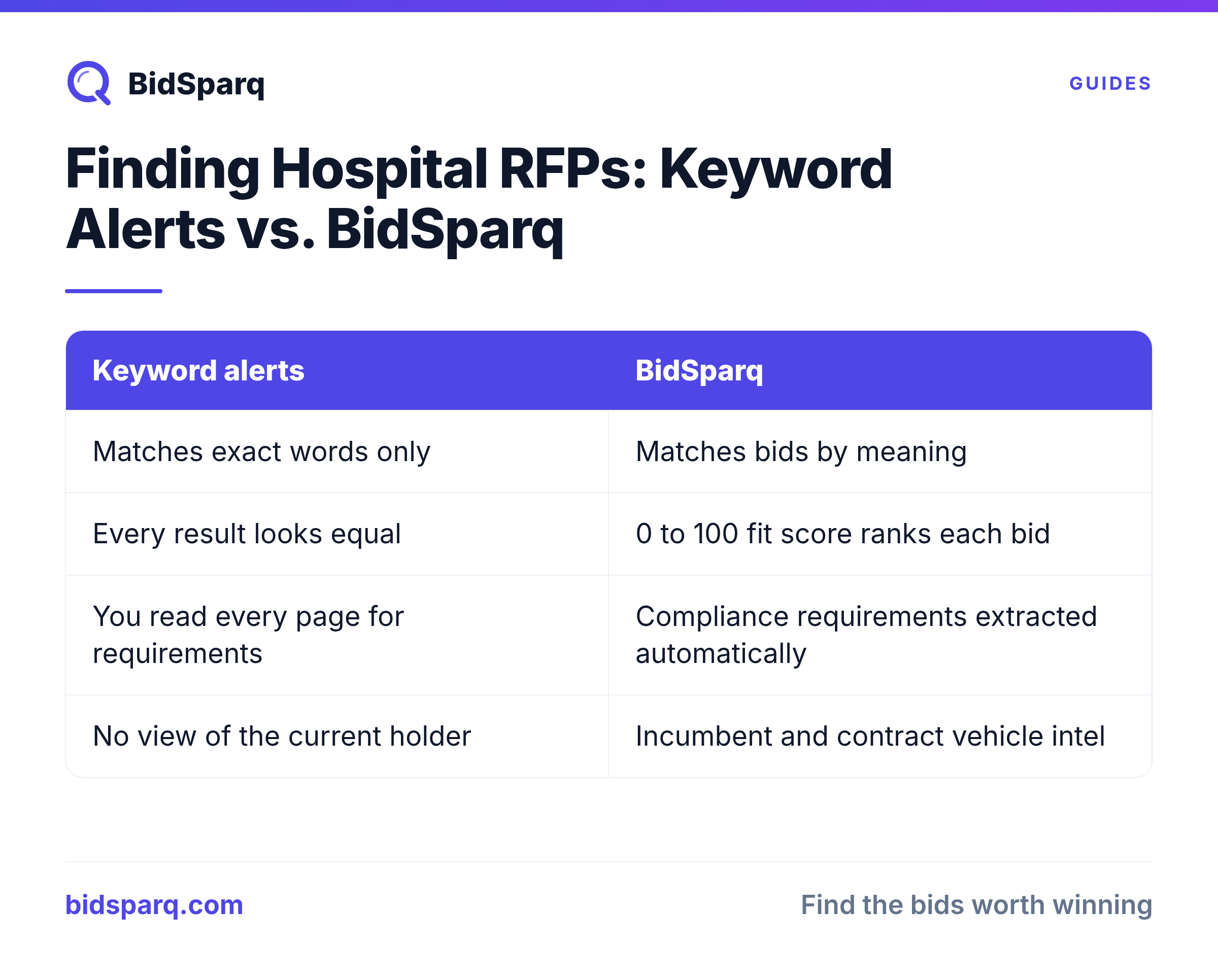
- Semantic matching. Keyword tools return documents containing your exact terms. They miss the 'environmental services' cleaning contract and flood you with every bid that mentions 'hospital' in a boilerplate clause. Semantic matching reads what the solicitation actually asks for, so a medical equipment servicer sees clinical engineering RFPs even when the word 'maintenance' never appears.
- Fit scoring. A 0 to 100 score against your capabilities and history pushes strong matches to the top of the feed, well above a parking lot resurfacing job that only mentions a hospital campus. Manual review gives every bid equal weight until someone has read it.
- Compliance extraction. Insurance limits, HIPAA business associate terms for vendors who touch patient data, credentialing for staff entering clinical areas, and infection control protocols for construction should be pulled into a checklist automatically, before anyone spends hours reading.
- Incumbent data. Look for who holds the current contract, when it expires, and whether the buyer tends to use a cooperative agreement instead of a full open bid. A rebid with an entrenched incumbent and an unchanged scope is rarely worth chasing. One with a new scope and an expiring contract often is.
What this looks like on a typical bid. Picture a standard environmental services RFP from a public hospital. An automatically extracted compliance checklist would surface items like these:
- The required insurance types and the minimum limits you must carry at award.
- Vendor credentialing through the hospital's vendor management system for any staff entering patient care areas.
- Infection prevention training requirements and documented cleaning protocols for isolation rooms and surgical suites.
- Background checks and health screenings, such as immunization records, for on-site staff.
- The mandatory pre-bid walkthrough, the question deadline, and the required submission format.
The fit score next to that checklist explains its own ranking. It shows which scope items match services you have delivered before, whether the facility sits inside your service area, and which requirements you have never met, such as a sterile processing component bundled into a clinical engineering RFP. Your team makes the go or no-go call from one screen instead of an 80-page PDF.
Hospitals are one vertical in a much larger procurement market with the same fragmentation problem. Education, construction, IT, utilities, and commercial buyers scatter their postings just as widely. BidSparq runs all five checks automatically across 33,000+ sources, and Pro Max costs $249/mo ($199/mo billed annually) after a 14-day free trial.
How hospitals actually buy, beyond open RFPs
Track the channels where hospital spend is committed before a public bid exists. Open RFPs show only part of what hospitals buy. These three channels shape most of the rest, and each one needs its own approach.
Group purchasing organizations. Most U.S. hospitals belong to a GPO such as Vizient, Premier, or HealthTrust. The GPO negotiates contracts for categories like medical supplies, equipment, food service, and purchased services, and member hospitals buy off those agreements instead of issuing their own RFPs. If a GPO already holds a contract in your category, member hospitals may never run an open bid for it. Learn each GPO's supplier process, track when your category comes up for renewal, and treat a GPO award as access to hundreds of facilities at once.
VA and federal channels. VA medical centers post solicitations on SAM.gov, and many set work aside for small, veteran-owned, or service-disabled veteran-owned businesses. Medical equipment, supplies, and pharmaceuticals often move through Federal Supply Schedule contracts managed by the VA National Acquisition Center, so getting on a schedule can matter more than chasing individual bids. Military treatment facilities also post through SAM.gov.
Hospital district and county board postings. Public hospital districts and county health boards publish meeting agendas and minutes, often through BoardDocs or their own websites. Approved capital projects, equipment purchases, and contract renewals appear there weeks or months before the RFP is released, which makes board agendas the earliest public signal for construction and equipment work.
Whichever channel surfaces a lead, verify the details at the original posting before you start writing, because addenda regularly change deadlines and scopes.
How to triage a hospital pipeline
Rank every hospital bid by fit first, feasibility second, and effort last. Sorting by deadline is the most common mistake, because it steers your team toward whatever is most urgent instead of what it can win. As of November 2026, 215 'hospital' solicitations close within the next 14 days, and many of them are already out of reach for a quality response.
- Fit. Does the scope match what you deliver well, and can you meet every hard requirement on the compliance checklist? If any requirement is a clear no, drop the bid on the spot.
- Feasibility. Can you still produce a strong response before the deadline, including site visits, references, and internal pricing approvals? As a working rule, drop a bid that closes in under 7 days if you have done no preparation for it. A rushed, generic proposal burns real hours and rarely beats a prepared incumbent.
- Effort. For bids that pass both tests, weigh proposal effort against contract value and your realistic odds, using incumbent and scope history to judge whether the rebid is a genuine opening.
Then protect the pipeline upstream. Keep a short list of target health systems, review their supplier pages and the buying channels above every month, and log contract expiration dates as you find them. Each expiration you record is a bid you can start preparing for before the RFP is posted.
FAQ
Where do I find hospital bids?
Start with free official sources: SAM.gov for federal medical facilities and your state eProcurement portal for state-run and university hospitals. Next, register on the supplier portals of every health system you want to sell to, since many private systems post only there. An aggregated database saves you from checking each source by hand and catches bids worded in terms your alerts would miss.
Is there a free hospital RFP database?
Official portals such as SAM.gov and state eProcurement systems are free to search, but each covers only its own buyers and relies on keyword search. Aggregated databases that combine thousands of sources and add semantic matching, fit scoring, and compliance extraction are usually paid. Many offer a free trial, so you can test coverage against hospital bids you already know before paying anything.
Do private hospitals post RFPs publicly?
Sometimes, but less consistently than public hospitals. Many private and nonprofit health systems issue RFPs through supplier portals that require vendor registration, invite pre-qualified vendors directly, or buy through their GPO. Registering with your target systems and learning their GPO's supplier process is the most reliable way to get invited.
See the compliance checklist and fit score for this week's hospital bids: start your 14-day free trial, no credit card required.
Find RFPs that match your business
BidSparq monitors 33,000+ procurement sources and uses AI to score every opportunity against your capabilities. Try it free for 14 days.
Start Free Trial →