State Procurement Portals: The Complete 2026 Guide to All 50 States
Every state has its own procurement portal with different registration requirements. Here's a comprehensive guide to finding and navigating state bid boards across all 50 states.
One of the biggest frustrations in government contracting is the sheer fragmentation of state and local procurement. Unlike federal contracting, where SAM.gov serves as the central hub, every state runs its own procurement portal with its own registration process, search interface, and notification system.
The result? Contractors spend hours every week checking dozens of separate websites, creating accounts on platforms they'll only use once, and still missing opportunities because they didn't know where to look.
"I'm so tired of clicking links only to be met with 'You must register on our county-specific site to view this solicitation.'" (r/GovernmentContracting)
This guide covers the procurement portal for every state, the major platforms that power local government bidding, and how to stop checking 100+ sites manually.
How State Procurement Works
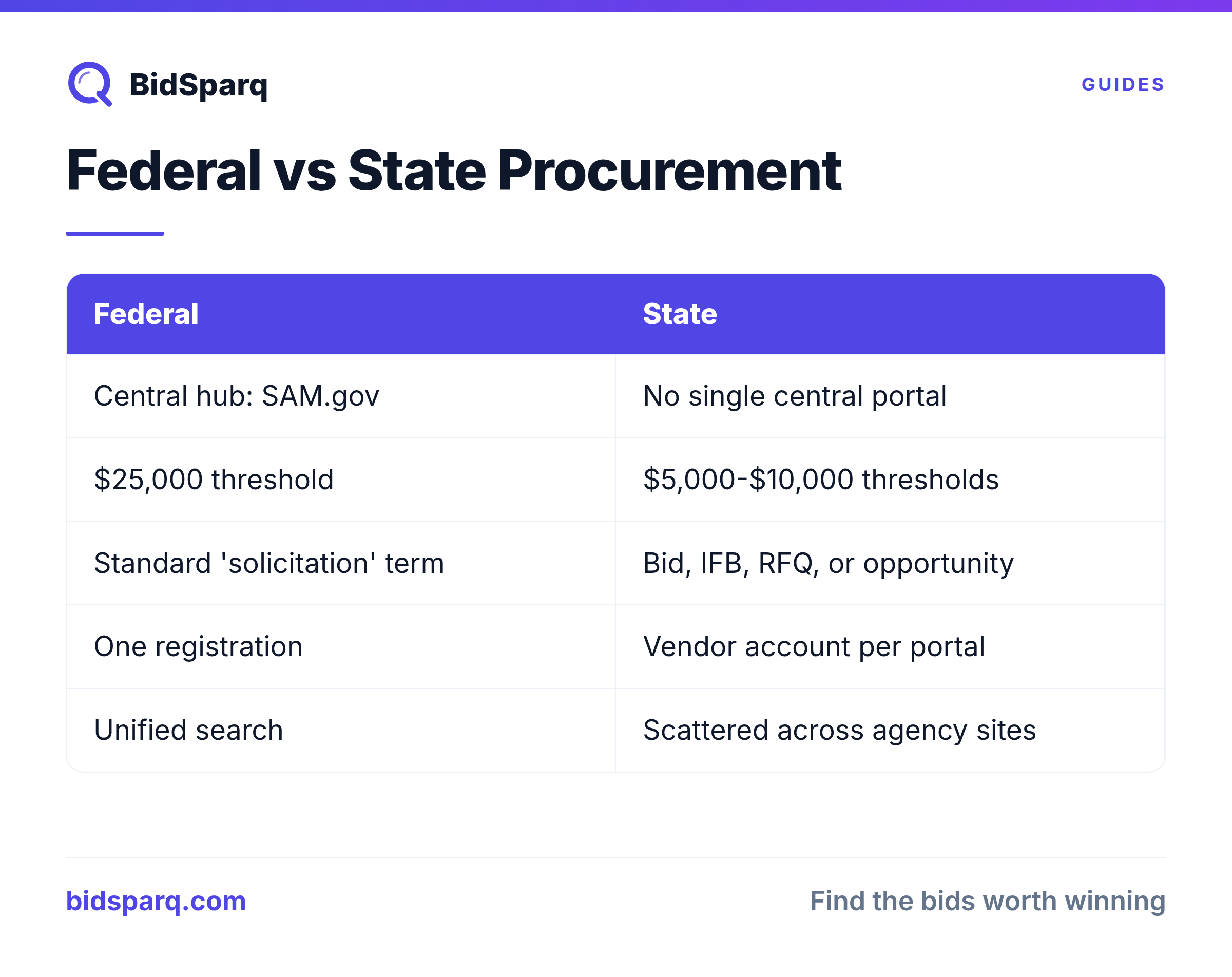
State procurement follows a different structure than federal. Key differences:
- No single central portal. Each state operates independently. Some states (Texas, Virginia, Maryland) have well-organized central bid boards. Others scatter opportunities across individual agency websites.
- Lower thresholds. Many states post solicitations starting at $5,000-$10,000, compared to the federal $25,000 threshold on SAM.gov.
- Different terminology. What the federal government calls a "solicitation," states might call a "bid," "invitation for bid," "request for quote," or "procurement opportunity."
- Registration walls. Most state portals require you to create a vendor account before you can view bid documents or receive notifications.
State-by-State Procurement Portals
Well-Organized Central Portals (Easiest to Use)
These states have centralized, searchable bid boards where most state-level solicitations are posted in one place:
| State | Portal | Notes |
|---|---|---|
| Texas | Texas SmartBuy / ESBD | One of the best state portals. Searchable by keyword, NIGP code, and agency. |
| Virginia | eVA (eva.virginia.gov) | Comprehensive. Includes state, university, and local government bids. |
| Maryland | eMaryland Marketplace Advantage | Central portal with email notifications by commodity code. |
| California | Cal eProcure | Covers state departments. Cities and counties post separately. |
| New York | NYS Contract Reporter | Requires subscription ($25/month) for full access. State-level only. |
| Georgia | Georgia Procurement Registry (GPR) | Free registration. Covers state agencies and some authorities. |
| Illinois | Illinois Procurement Gateway / BidBuy | Covers all state agencies. Separate portal for CMS contracts. |
| Michigan | SIGMA (Statewide Integrated Governmental Management Application) | Modern portal with good search functionality. |
| North Carolina | NC eProcurement (IPS) | Interactive Purchasing System. Free vendor registration. |
| Washington | WEBS (Washington Electronic Business Solution) | Free. Sends email notifications by commodity code. |
Fragmented States (Opportunities Spread Across Multiple Sites)
In these states, you'll need to check multiple portals because there's no single comprehensive source:
- Florida: MyFloridaMarketPlace (MFMP) for state contracts, but counties and cities use their own portals (many on DemandStar or BidSync).
- Ohio: Ohio Procurement website for state, but major cities (Columbus, Cleveland, Cincinnati) each have their own systems.
- Pennsylvania: PA eMarketplace for state, but PEPPM for education technology and individual county/city portals for local.
- New Jersey: NJ eProcurement for state, but authorities like NJ Transit and NJ Turnpike post separately.
- Colorado: Colorado BIDS for state agencies, but Denver, Colorado Springs, and other cities have independent procurement offices.
The Platforms Powering Local Procurement
Here's what most contractors don't realize: hundreds of cities, counties, and school districts don't build their own procurement websites. Instead, they use commercial platforms. If you learn these platforms, you unlock access to thousands of local opportunities.
IonWave
Used by hundreds of local agencies, particularly school districts and small cities. Each agency has its own IonWave portal with separate registration. The interface is consistent across agencies, but you need individual accounts for each one.
Bonfire
Modern procurement platform used by mid-size cities and counties. Better user interface than most, but still requires per-agency registration. Common in Canada and increasingly popular in the US.
Municipal procurement portals
Used by 345+ local government agencies. Bids are sometimes buried in meeting agendas rather than in a dedicated procurement section. Requires familiarity with each site's structure.
PlanetBids
Common in California and the western US. Used by cities, school districts, and special districts. Each agency has its own PlanetBids portal.
DemandStar / BidSync / Periscope
These platforms aggregate local government bids and provide notification services. DemandStar covers many Florida agencies. BidSync is widely used across the Southeast.
BuyBoard / TIPS-USA / SourceWell
These are cooperative purchasing platforms: a different model entirely. Agencies join a cooperative and can purchase through pre-negotiated contracts without running their own RFP. If you get on a cooperative contract, you gain access to thousands of agencies at once.
Smart Registration Strategy
You can't register on every portal. Here's how to prioritize:
- Start with your home state's central portal. This is non-negotiable for any government contractor.
- Register on the states where you have past performance. Evaluators favor local experience.
- Target the platforms, not individual agencies. One BidSync account gives you access to dozens of agencies. One IonWave registration per district is painful: let a tool handle it.
- Set up email alerts on every portal you register on. Don't rely on manual checking.
- Consider cooperative contracts (BuyBoard, SourceWell, TIPS-USA): one award opens thousands of doors.
The Problem with Manual Monitoring
Even if you register on every relevant portal, manual monitoring doesn't scale. Here's the math:
- 10 state portals × 5 minutes each = 50 minutes/day
- 20 local agency portals × 3 minutes each = 60 minutes/day
- 5 cooperative platforms × 3 minutes each = 15 minutes/day
- Total: 2+ hours every day just checking for new opportunities
And that's before you read a single solicitation or start any bid/no-bid analysis.
How BidSparq Solves the Fragmentation Problem
BidSparq scrapes 23,000+ procurement sources including state portals, IonWave sites, Bonfire portals, thousands of city & county sites, and cooperative platforms: so you don't have to. Every opportunity is:
- Aggregated into a single searchable dashboard
- Scored by AI against your business profile and NAICS codes
- Delivered weekly as a ranked digest of your top matches
- Filterable by state, set-aside type, contract value, and deadline
Instead of checking 30 portals every morning, you check one dashboard and review the opportunities AI says are worth your time.
Next Steps
- Start your free trial: see matched opportunities from your state without registering on dozens of portals
- Read our guide on finding government RFPs beyond state portals
- Learn how NAICS codes affect which opportunities you see
- Understand the bid/no-bid framework for deciding which opportunities to pursue
Find RFPs that match your business
BidSparq monitors 23,000+ procurement sources and uses AI to score every opportunity against your capabilities. Try it free for 14 days.
Start Free Trial →