Request for Roadside Mowing Procurement Portal: How To Win
Roadside mowing bids appear across dozens of portals under half a dozen names. This guide shows contractors where to search, what compliance requirements to expect, and how to score the bids worth pursuing.

Contractors who bid on roadside mowing contracts face a sourcing problem before they face a competition problem. These solicitations scatter across state DOT bid pages, county purchasing boards, municipal bid portals, and park district websites, each running on its own schedule and its own system. Missing one is not bad luck. It is a discovery failure.
- Roadside mowing solicitations appear under many names, including "right-of-way mowing," "vegetation management," and "highway grounds maintenance," so keyword-only searches miss most active bids.
- Early discovery is the first competitive edge because finding bids before competitors gives contractors time for site visits, subcontractor quotes, and thorough document review before the deadline.
- Compliance requirements shift by agency: bonding thresholds, insurance minimums, and equipment specifications vary enough that each solicitation demands individual review before committing proposal resources.
- Not every open bid deserves a response. Fit scoring by geography, bonding capacity, and scope size filters a regional pipeline down to the pursuits worth the proposal effort.
- Knowing the current incumbent tells you the baseline price point and signals how aggressively an agency is likely to rebid.
The short answer
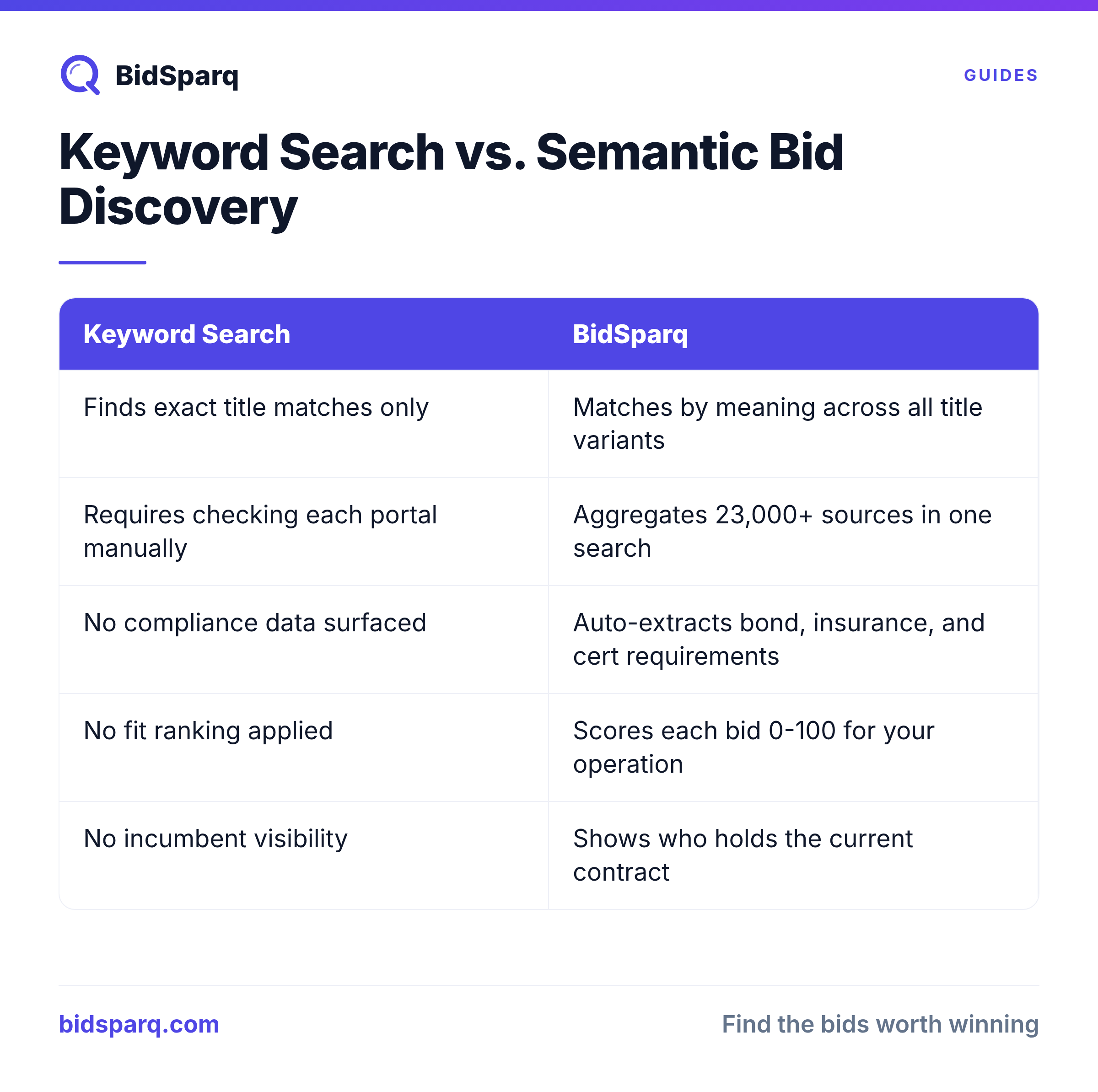
The fastest route to roadside mowing contracts is a procurement portal that covers all public agencies, not just one level of government. State DOT bid pages, county purchasing boards, and municipal systems each operate independently, so single-source searches will miss most active solicitations. A platform that aggregates across all of those sources, matches by meaning rather than exact keywords, and scores each opportunity for fit converts a multi-hour manual search into a focused shortlist you can act on the same day.
Why roadside mowing bids scatter across portals
Roadside mowing is not a single agency's domain; it is a contract type issued at every level of government, by hundreds of distinct agencies, on overlapping schedules. State departments of transportation post multi-year right-of-way vegetation management contracts. Counties award annual mowing agreements for rural road shoulders. Municipal public works departments issue smaller seasonal contracts. Park authorities and school districts add grounds-maintenance solicitations to the mix, each through their own procurement portal or published bid notice.
There is no single inbox for all of them. A state DOT may run on a statewide eProcurement system. A county may post bids on its own purchasing page or a regional aggregator. A municipality may use a commercial bid management platform or issue a legal notice through a local publication. The systems do not talk to each other, and the calendars do not align.
The naming problem compounds the discovery problem. A single agency may describe the same work as "roadside mowing services" in one contract cycle and "vegetation management and mowing" in the next. A contractor searching for one phrase on one portal will miss most of what is actually open.
Where to search for roadside mowing solicitations
Start with the official sources your target agencies use, then layer in aggregators to cover the gaps. For federally funded highway projects, SAM.gov lists contracts where federal dollars flow through to state and local agencies. Your state DOT's own procurement page is the primary source for statewide right-of-way contracts; most DOTs publish an active solicitation register directly on their website.
Below the state level, county and municipal bids require a different approach. Platforms such as DemandStar and BidNet aggregate solicitations from local agencies and allow vendors to filter by geography and commodity code. As of September 2026, BidSparq tracks 62,587 open solicitations across its 23,000+ sources, with 17,995 new solicitations posted in the last 30 days. That volume illustrates why portal-by-portal manual searches are not a sustainable sourcing strategy at any meaningful scale.
California leads active solicitation counts right now with 1,342 open solicitations in the request category, followed by Pennsylvania with 898. Contractors working in high-volume states face the densest competition, which makes early discovery and systematic qualification more important, not less.
The discovery discipline that works for roadside mowing bids transfers directly to vegetation and grounds-care contracts across commercial and institutional markets as well.
Search active mowing bids now, with no credit card required. Find open roadside mowing solicitations free on BidSparq and see which opportunities fit your geography and bonding capacity before the deadlines pass.
What compliance requirements roadside mowing RFPs typically include
Every roadside mowing solicitation carries a compliance checklist, and the specifics differ enough between agencies that reviewing each one individually is not optional. Performance bonds are common for contracts above certain dollar thresholds; the bond percentage and minimum surety rating vary by agency. Commercial general liability and auto insurance minimums appear in nearly every solicitation, and some agencies require additional insured endorsements naming specific entities on the certificate.
Equipment specifications are another variable. Some solicitations define minimum cutting widths or specific slope capabilities required for embankment work. Contracts that include chemical vegetation control typically require state-certified pesticide applicator licenses for at least one crew operator. Work zone traffic control credentials appear frequently for highway shoulder mowing assignments.
A platform with automatic compliance extraction reads each solicitation and surfaces the bond, insurance, equipment, and certification requirements without requiring a line-by-line document review. That matters when 5,560 solicitations in the request category close within the next 14 days and proposal time is the scarcest resource on your desk.
How to score and prioritize the bids worth pursuing
A 0-to-100 fit score applied before any proposal work begins is the fastest way to separate high-probability pursuits from long shots. The score weighs factors specific to your operation: the geographic radius you can realistically service, your bonding capacity relative to the estimated contract value, your equipment capabilities against the specification, and your track record in the work category.
Semantic matching changes what shows up in that scored list. A platform that searches by meaning catches solicitations titled "vegetation management program" or "highway right-of-way services" as readily as those that use the exact phrase "roadside mowing." Keyword tools return only exact matches and leave most of the pipeline invisible.
Incumbent and contract-vehicle intelligence adds a final layer. Knowing who holds the current contract, the previous award value, and whether the work runs through a standing vehicle tells you whether a rebid is genuinely competitive or structured as a renewal, and helps you price accordingly.
The vendors who win consistently are the ones who find every relevant bid early enough to prepare well.
Stop searching portals one by one. Start your free roadside mowing bid search today, no credit card needed, and see every open solicitation matched and scored for your operation.
FAQ
Where can I find roadside mowing bids near me?
Start with SAM.gov for federally funded highway projects, then check your state DOT's active solicitations page and any statewide eProcurement portal your state operates. For county and municipal work, platforms such as DemandStar and BidNet aggregate local agency bids by geography and commodity code. A cross-source aggregator that applies semantic matching will also surface solicitations titled "right-of-way maintenance" or "vegetation management" that a direct keyword search on a single portal would miss entirely.
What is included in a request for roadside mowing services?
A request for roadside mowing services, typically published as an RFP, RFQ, or IFB, specifies the route miles or acreage to be maintained, the number of required cuttings per season, the maximum allowable grass height before and after service, equipment requirements, bonding and insurance minimums, and any requirements for certified pesticide applicators. Work zone traffic control responsibilities appear frequently for highway shoulder work. Requirements vary significantly by agency and contract size, so reading the full solicitation document is always necessary.
How do I bid on a DOT mowing contract for the first time?
Register as a vendor on your state DOT's procurement portal and obtain any required vendor certifications, including small or disadvantaged business classifications if applicable. Review the solicitation documents carefully for bonding requirements, insurance minimums, and equipment specifications before attending any pre-bid meeting or site tour the agency offers. Prepare your bid based on the actual acreage, cutting cycle, and mobilization costs in the solicitation rather than general estimates. Submit through the agency's designated portal by the stated deadline, since late submissions are disqualified without exception.
Find RFPs that match your business
BidSparq monitors 23,000+ procurement sources and uses AI to score every opportunity against your capabilities. Try it free for 14 days.
Start Free Trial →