What Is a GWAC and How to Win Task Orders on One
A GWAC is a pre-competed federal contract vehicle available to any agency. Learn what is a GWAC, how on-ramps work, and how to win task orders.
Contract vehicles have reshaped how buyers manage repeat purchases across procurement markets. Healthcare systems use preferred vendor arrangements. School districts pre-qualify contractors. In federal procurement, the most consequential version of this structure is the government-wide acquisition contract, known as a GWAC.
- A GWAC is a pre-competed IDIQ contract that covers a defined scope and gives multiple vendors access to task orders without a new full procurement each time.
- A single GWAC is issued by one agency but available government-wide, multiplying the opportunity pool for any vendor holding a position on the contract.
- On-ramps are competitive and infrequent, so vendors who miss an entry window often wait years before the next cycle opens.
- Incumbent and contract vehicle intelligence determines whether a task order is worth pursuing before you invest in a proposal.
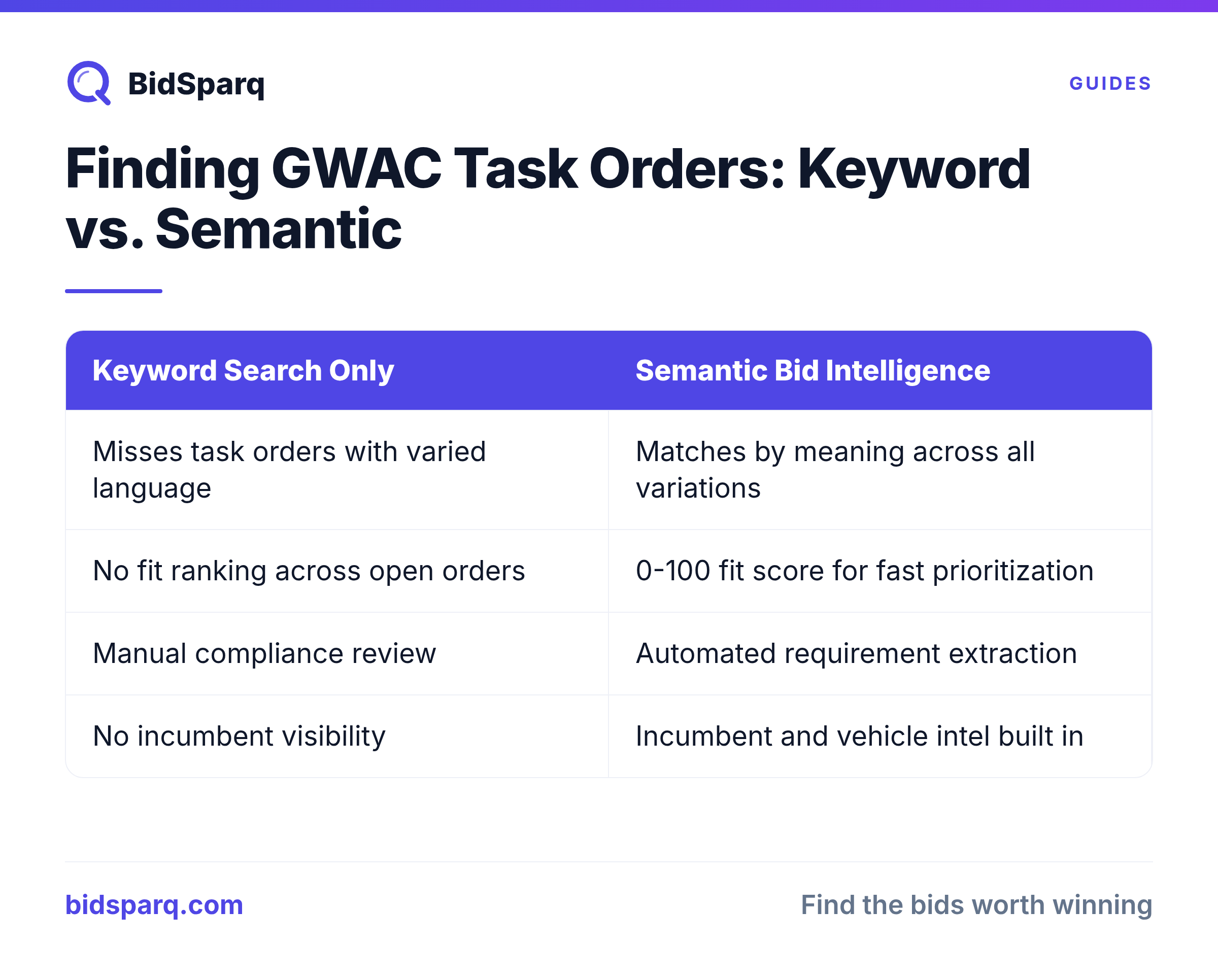
- Semantic bid discovery surfaces task orders by meaning rather than exact keyword matches, capturing opportunities that keyword-only tools miss.
- AI fit-scoring from 0 to 100 lets you rank active opportunities by match strength so your team focuses on the right ones first.
What Is a GWAC?
A government-wide acquisition contract is an indefinite delivery, indefinite quantity (IDIQ) contract established by a designated federal agency that any federal agency can use to place task orders. The sponsoring agency runs a competitive process to select vendors, negotiates terms and scope upfront, and then other agencies order against the vehicle for years. This reduces duplicative procurement across the federal government, gives agencies access to vetted vendors, and lets contractors compete for recurring business without responding to a full solicitation every time a need arises.
GWACs are most common in information technology, professional services, and adjacent technical fields, where agencies have ongoing and evolving needs that benefit from a standing pool of qualified vendors.
How GWACs Work: Task Orders and Access
Holding a position on a GWAC is the prerequisite, not the prize, because the real competition happens at the task order level. Each task order is a distinct procurement with its own scope, period of performance, and specific requirements. Agencies may issue task orders with competition among all GWAC holders, or they may restrict competition to a subset based on small business status or other socioeconomic set-asides already built into the vehicle.
This means vendors need two distinct capabilities: winning a spot on the GWAC during the on-ramp, and then consistently identifying and winning individual task orders once they are on the vehicle.
Getting on a GWAC: On-Ramps and Timing
The entry point for any GWAC is the on-ramp, a competitive solicitation window during which the sponsoring agency evaluates vendor proposals against defined technical and past performance criteria. On-ramps are not open continuously. When a window closes, vendors typically cannot join until the next on-ramp, which may be tied to the vehicle's recompete cycle and could be years away.
For vendors targeting GWAC positioning, monitoring on-ramp announcements across multiple vehicles simultaneously is critical. Missing a single announcement can create a multi-year gap in federal opportunity access. As of July 2026, there are 63,752 open solicitations across the 23,000+ sources BidSparq tracks, and GWAC on-ramp notices are part of that active pool.
Using Intelligence to Win GWAC Task Orders
The competitive edge on GWAC task orders comes from identifying the right opportunities early and knowing the agency's history before you commit proposal resources. Task orders often carry short response windows, and vendors who discover them late are structurally disadvantaged before they write a word.
BidSparq's semantic matching finds task orders by what they mean, not just whether a specific keyword appears in the notice title. Fit-scoring from 0 to 100 ranks open opportunities against your capabilities so your team prioritizes rather than sorts. Automated compliance and requirement extraction surfaces what the agency is actually asking for, and incumbent plus contract vehicle intelligence tells you what you are walking into before you commit to a bid.
GWAC vs. Other Federal Contract Vehicles
Understanding where a GWAC sits among federal contracting instruments helps vendors decide which vehicles are worth pursuing and which task orders to target. A multiple award schedule (MAS), administered by GSA, is broad in category coverage and does not require an on-ramp competition in the same way. An agency-specific IDIQ limits the vendor's customer to one buyer. A GWAC sits between these: it is government-wide in scope but built on a rigorous competitive award, which typically concentrates higher-value, more complex task orders than a schedule would.
FAQ
What is a GWAC in government contracting?
A GWAC, or government-wide acquisition contract, is a pre-competed indefinite delivery, indefinite quantity (IDIQ) contract established by one federal agency but available for task orders placed by any federal agency. Vendors win a position on the GWAC through a competitive on-ramp process, then compete for individual task orders issued under the vehicle by various agencies across the federal government.
How do I get on a GWAC?
Getting on a GWAC requires submitting a competitive proposal during an open on-ramp solicitation period. The sponsoring agency evaluates vendors on technical approach, past performance, and sometimes price. On-ramps have fixed windows and do not stay open continuously, so monitoring for announcements early is critical. Missing an on-ramp often means waiting for the next competitive cycle, which can be several years away depending on the vehicle.
What is the difference between a GWAC and a GSA Schedule?
A GSA Schedule, also called a multiple award schedule (MAS), is a long-term contract with pre-negotiated pricing administered by the General Services Administration across a wide range of product and service categories. A GWAC is typically issued by a specific agency, covers a more defined scope, and requires a competitive on-ramp for vendor entry. Both give federal agencies a faster path to qualified vendors, but GWACs generally apply to more complex, higher-value work and involve more rigorous competitive evaluation for entry than a standard schedule.
Explore federal bid intelligence and GWAC task orders with no credit card needed. See your matches free and know which opportunities fit your capabilities before the window closes.
Find RFPs that match your business
BidSparq monitors 23,000+ procurement sources and uses AI to score every opportunity against your capabilities. Try it free for 14 days.
Start Free Trial →