GSA Rates San Francisco: What Bidders Must Price In
GSA rates San Francisco explained for bidders: how federal per diem and GSA Schedule labor rates work, where to look them up, and how to price them into a proposal without getting tossed.
If you price travel, lodging, or labor into a bid that touches San Francisco, the GSA rate is the number the evaluator already knows. Quote above it and you look careless. Quote below it and you eat the difference on one of the most expensive hotel markets in the country. The lookup itself takes a minute. Knowing which rate applies, for which month, under which buyer's policy, is where bids go wrong.
- GSA rates for San Francisco are federal per diem ceilings for lodging and meals, reset each federal fiscal year on October 1.
- Two different numbers travel under the same name: per diem for trips, and awarded hourly labor rates on GSA Multiple Award Schedule contracts.
- Many non-federal buyers borrow the GSA table as their reimbursement ceiling, so the rate matters well outside federal work.
- Month of travel changes the answer in seasonal-rate cities, not just the city itself.
- Discovery, not the lookup, is the expensive part: finding every solicitation that references a rate ceiling before it closes.
The short answer
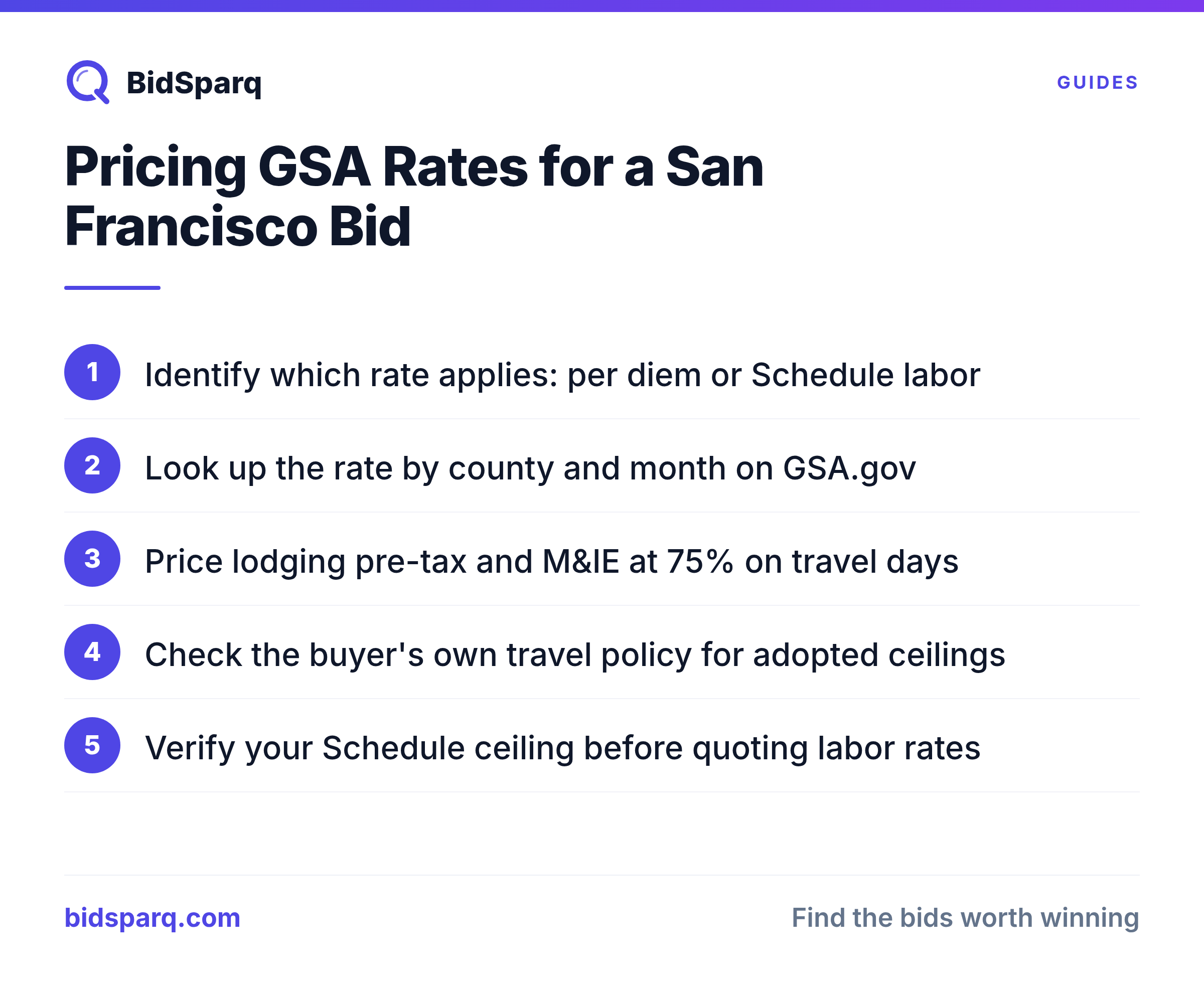
GSA rates for San Francisco are the federal per diem amounts for lodging and for meals and incidental expenses (M&IE) that apply to official travel in San Francisco County, published by the U.S. General Services Administration for each federal fiscal year. You look them up on the GSA.gov per diem page by city, state, or zip code, and the lodging figure can differ by month because GSA assigns seasonal lodging rates to high-demand locations, and San Francisco has frequently been one. The lodging number is a ceiling before taxes, and M&IE is paid at 75 percent on the first and last day of travel. The same phrase also refers to the hourly labor rates contractors have been awarded on GSA Schedule contracts, which buyers compare when evaluating Bay Area pursuits.
Two things people mean by GSA rates
Decide which rate the solicitation is talking about before you price anything. A construction firm sending a superintendent and two inspectors to a federal building renovation in San Francisco cares about per diem: the lodging ceiling per night and the daily M&IE figure for every person on travel status. An IT services firm chasing a task order on the GSA Multiple Award Schedule cares about something different: the ceiling labor rates already awarded on its Schedule contract, which it can discount but not exceed without a modification. Both get called GSA rates in conversation. They live on different pages, follow different rules, and fail different ways when you confuse them. Per diem is set by GSA for the government traveler and applies to contractor travel only when the contract says it does, usually by reference to the Federal Travel Regulation. Schedule labor rates are negotiated per contractor and published on GSA eLibrary and GSA Advantage, where competitors and buyers can read them.
How to look up San Francisco per diem correctly
Pull the rate from GSA.gov for the exact county and month of travel, then price lodging and M&IE as separate lines. Start with the zip code or county rather than the city name, because neighboring Bay Area counties can carry different rates and a hotel across the county line is priced on a different row. Read the lodging column for the month the work actually happens, since a seasonal location can show more than one figure in a single fiscal year. Treat the lodging number as a pre-tax ceiling: for federal travelers, lodging taxes in the continental United States are reimbursed as a separate miscellaneous expense, so do not bury them inside the room rate. Apply the full M&IE figure to full days and 75 percent to the first and last travel day. The Federal Travel Regulation does let an agency approve actual-expense reimbursement above the ceiling in limited circumstances, but you should never assume that approval in a bid. Rates change every October 1, so a proposal priced in summer for work that starts in winter needs a note explaining which fiscal year's table you used and how you will handle the reset.
Where GSA rates show up outside federal contracts
Check the buyer's own travel policy, because many non-federal buyers adopt the GSA table as their ceiling without saying so in the solicitation. State agencies, public university systems, county governments, and hospital districts often write their reimbursement rules to track the federal per diem schedule, sometimes word for word, sometimes with a local cap layered on top. A consulting firm answering a California state agency RFP can lose points for quoting a flat hotel figure when the agency's policy says reimbursement follows GSA lodging for the destination. The same spillover happens with Schedule pricing: under GSA's Cooperative Purchasing program, eligible state and local governments can buy certain IT and security products and services directly off GSA Schedule contracts, so your awarded labor rates can become the opening number in a city or school district negotiation you never expected. This is where a federal pricing detail quietly becomes an education, healthcare, and local government issue, and why every vertical of the procurement market ends up reading the same rate table.
The scale problem: finding the bids that reference rates
Treat the rate lookup as the easy part and solicitation discovery as the real work. As of October 2026, 54,999 solicitations are open across the 23,000+ sources BidSparq tracks, and 5,300 of those open solicitations mention "rates" somewhere in the text. California alone accounts for 367 of them right now. 3,188 "rates" solicitations close within the next 14 days. No team can read that volume by hand, and keyword alerts on individual portals do not help much, because "rates" appears in bids about interest rates, utility rates, hourly rates, and per diem rates alike. Semantic matching reads the solicitation for meaning, so a request that says "travel reimbursed per Federal Travel Regulation" or "lodging not to exceed the applicable federal per diem" matches a travel-heavy services firm even when the words GSA or San Francisco never appear. Automated compliance extraction then pulls the travel clause, the locality, the labor category list, and the rate ceiling into one checklist instead of leaving a proposal manager to hunt through a 90-page PDF. Incumbent and contract-vehicle intelligence tells you whether this buyer has historically awarded through a GSA Schedule, which means your published Schedule rates are already on the evaluator's screen before you submit. A 0 to 100 fit score sorts the pile so the solicitations closing in two weeks that actually match your labor categories rise above the ones that merely contain the word rate.
See which open rate-driven solicitations fit your firm free, no credit card needed.
Pricing mistakes that get bids tossed
Price to the ceiling for the right month, show your math, and never pad. The most common error is pulling a rate for the wrong county or the wrong month, which produces a lodging line that is either unallowable or visibly low. The second is quoting lodging with taxes rolled in, which inflates the number past the ceiling and reads as a mistake to any contracting officer who checks. The third is applying full M&IE to travel days, a small overstatement that signals you have not read the Federal Travel Regulation. On the labor side, quoting a rate above your awarded Schedule ceiling is not a negotiation opener, it is a compliance problem, because buyers can verify your ceiling on GSA eLibrary in seconds. If your proposal cites a labor category that was awarded to a competitor and not to you, FPDS and USAspending.gov make that easy to find as well. Price transparently: name the fiscal year table, the county, the month, and the per-day arithmetic, and state that lodging is pre-tax. Evaluators do not reward cleverness on travel. They reward a number that matches the one they already have.
FAQ
What is the GSA per diem rate for San Francisco?
It is the federal lodging ceiling and M&IE amount for San Francisco County, set by the General Services Administration for each federal fiscal year beginning October 1. The exact figures are published on the GSA.gov per diem lookup and can vary by month, so check the page for the fiscal year and month of your travel rather than relying on a number from a prior bid.
Do GSA rates apply to non-federal contracts in San Francisco?
Often, yes, by adoption. Many California state agencies, public universities, counties, and healthcare districts write their travel reimbursement policies to follow the GSA per diem table, and some state and local buyers can purchase directly off GSA Schedule contracts under Cooperative Purchasing. Read the buyer's travel policy and the solicitation's pricing instructions before assuming either way.
How do GSA Schedule labor rates work for San Francisco work?
A contractor's Schedule labor rates are ceiling prices awarded on its GSA Multiple Award Schedule contract and published on GSA eLibrary and GSA Advantage. The contractor can offer a discount below those rates on any task order but cannot exceed them without a contract modification. Location does not change the ceiling unless the contract was awarded with locality-based pricing, so a Bay Area task order is usually priced at or below the same national rates.
Start free and find the rate-sensitive bids closing this month before your competitors do.
Find RFPs that match your business
BidSparq monitors 23,000+ procurement sources and uses AI to score every opportunity against your capabilities. Try it free for 14 days.
Start Free Trial →