GFE Equipment: Definition, FAR 52.245-1, and Bidding Strategy
GFE equipment triggers FAR 52.245-1 obligations and solicitation language most contractors miss. Here is how to find every relevant contract and bid it to win.
Contracts involving GFE equipment reshape every part of your bid: price, staffing, compliance documentation, and post-award property management. Most contractors know GFE exists. Far fewer know how to surface every solicitation that mentions it, decode what each agency expects in sections L and M, or price the compliance obligations without creating liability after award.
- GFE terms appear in solicitation sections L and M, in property attachments, and in SOW language that varies by program office, so checking only the abstract or title misses requirements that can reshape your entire technical approach and price model.
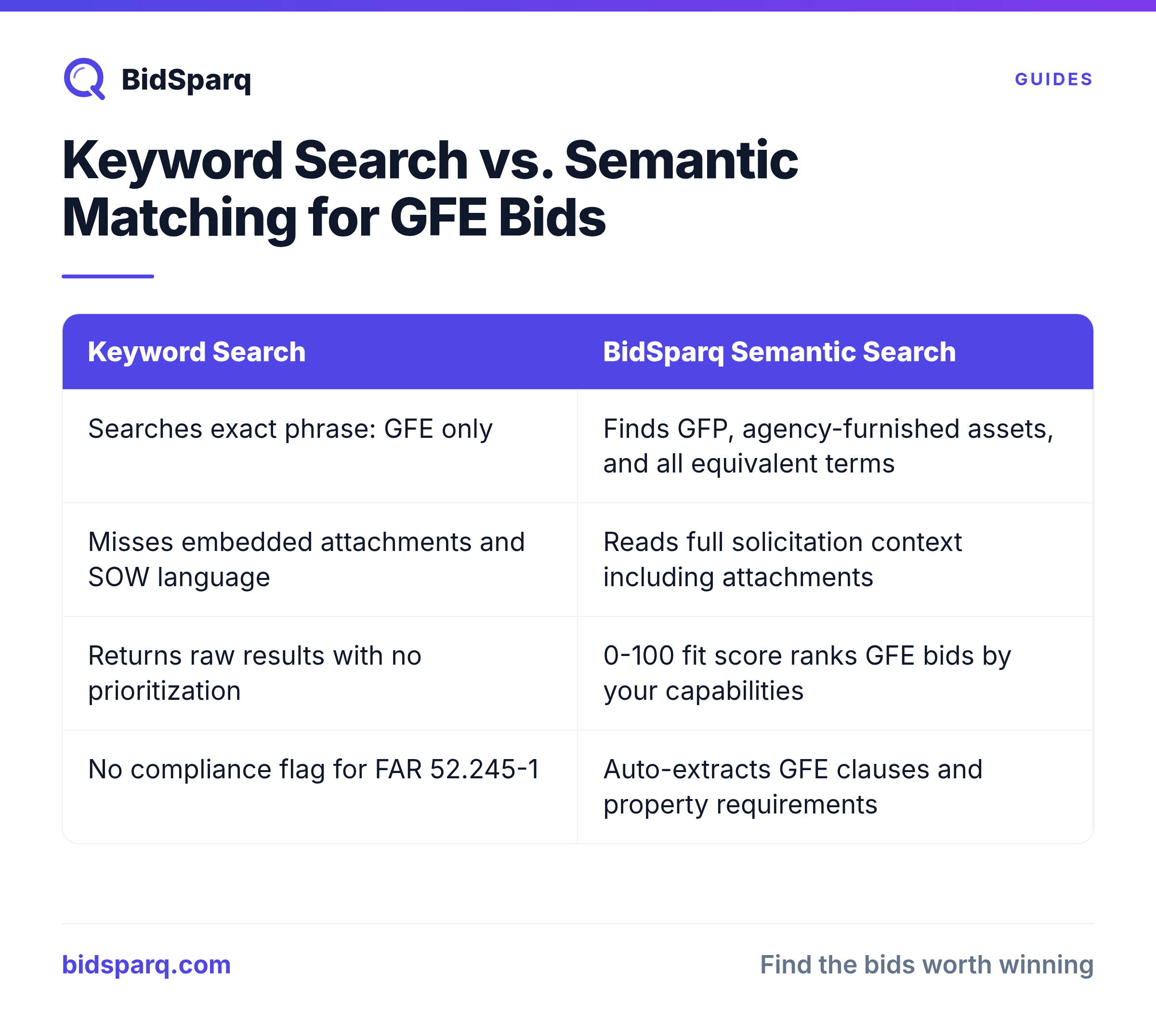
- Agencies phrase GFE provisions inconsistently across sources, so keyword searches miss a significant share of relevant solicitations across federal, state, and local portals.
- FPDS contract records reveal how prior modifications changed GFE scope for the incumbent, giving your capture team a pricing anchor and technical baseline before you write a single word of your proposal.
- FAR 52.245-1 requires five specific property management system elements, and proposals that address each one explicitly score measurably higher in the management section than proposals that treat GFE as a pass-through detail.
- Your property management system must appear in your proposal, not as a post-award retrofit, which means capture teams need the GFE equipment list early in the process.
The short answer
GFE equipment is government-owned property that an agency provides to a contractor for use during contract performance, at no direct cost to the contractor but with significant compliance obligations attached. Understanding GFE matters at the bid stage, not only after award, because it changes your price model, your technical approach, and the management systems you must demonstrate. Agencies disclose GFE requirements in solicitation sections L and M, in attachments, and in statement-of-work language that varies widely from one program office to the next, making manual search unreliable. The contractors who win GFE-heavy competitions consistently are the ones who surface the full requirements before proposal submission and build their compliance response around what the government will and will not supply.
What GFE actually means in a contract
When an agency designates equipment as GFE, it transfers use of that property to the contractor while retaining ownership and financial responsibility for its value. The contractor receives the equipment, uses it to perform the work, and is obligated to maintain it, track it in a property management system, and return it in the condition specified at contract close.
Loss or damage creates contractor liability under FAR 52.245-1 unless the contractor can demonstrate the government was responsible. On the pricing side, GFE reduces what you must supply from your own resources, which should lower your proposed costs. Evaluators expect that reduction to appear clearly in your cost proposal. Understating or ignoring GFE in your price model raises red flags during cost realism review and risks a deficiency finding.
Where GFE language hides in solicitations
Agencies do not use a single standard phrase to signal that a contract involves government-furnished equipment. A solicitation might say "government-furnished property," "GFP," "agency-furnished assets," or simply reference Attachment J with a property list embedded dozens of pages deep. On SAM.gov, the same underlying requirement appears under multiple phrasings across different program offices.
USASpending.gov and the Federal Procurement Data System (FPDS) can reveal how prior contract modifications changed GFE scope, giving you a useful baseline before you bid. Your state's official eProcurement portal is the equivalent starting point for state and local equipment solicitations, where agencies often invent their own terminology.
This variation is why semantic matching, which reads intent rather than exact phrasing, surfaces solicitations that a literal keyword search drops entirely. As of October 2026, 58,176 solicitations are open across the 23,000+ sources BidSparq tracks, with 8,344 mentioning equipment in some form and 4,372 of those closing within the next 14 days. The window to find and qualify GFE opportunities is shorter than most teams assume.
See your GFE equipment matches free, no credit card needed. Semantic search surfaces the full set of relevant solicitations, not just the ones using the exact phrase you searched.
Building a competitive bid when GFE is involved
The strongest proposals in GFE-heavy competitions address the government's property obligations directly in the technical volume, not only in the cost volume. Evaluators want evidence that you have a property management system capable of receiving, tracking, and returning GFE, that your team understands the maintenance requirements for the specific equipment involved, and that your price reflects both what the government provides and what you must still furnish.
Incumbents hold a natural advantage because they have operated the equipment and can cite performance history. Challenging an incumbent means doing thorough pre-proposal research on prior contract terms and any modifications that changed GFE scope. FPDS contract records and USASpending.gov award details are the right starting points for that research.
In FPDS, look specifically for contract modifications that added or removed GFE line items, changes to property management terms, and any cure notices tied to equipment handling. That record tells you where the incumbent is vulnerable and where your proposal needs to establish a credible alternative. A challenger who can cite specific gaps in the incumbent's GFE track record converts pre-proposal research into a direct scoring advantage.
Your cost proposal must reflect both the GFE offset and the support costs that remain. Correctly modeling the GFE reduction and making the management overhead visible shows evaluators a team that has read the solicitation carefully, which is itself a discriminator during competitive range reviews.
Compliance requirements you cannot skip
FAR 52.245-1, Government Property, is the controlling clause in virtually every contract that involves GFE equipment, and evaluators expect your proposal to address its requirements whether or not the solicitation explicitly tells you to. The clause defines five property management system elements that your proposal must cover:
- Identification: Each item of GFE must be tagged and uniquely identified on receipt so you can match government records to physical assets throughout the contract.
- Records: You must maintain a complete property record system capturing each item's condition, location, and history of use, available for contracting officer audit at any time.
- Physical inventory: Periodic physical counts must be performed and reconciled against your records, with discrepancies documented and reported promptly.
- Subcontractor control: If any GFE flows to a subcontractor, your prime contract property management system must extend to cover their receipt, use, and return of that property.
- Relief-of-responsibility procedures: When GFE is lost or damaged due to government action or causes outside your control, you must follow documented procedures to seek formal relief from liability under the clause.
The same clause discipline applies outside the federal arena. A Virginia state construction contract for heavy equipment or a California IT procurement covering agency-furnished servers requires the same systematic approach: read every property clause before you bid, document your management system explicitly, and name the accountable individual. State solicitations use different clause numbers but impose equivalent accountability and audit rights.
Proposals that describe the specific system you will use and name the person responsible for property management score measurably better in the management section than proposals that treat GFE as a pass-through detail. Automated compliance extraction pulls GFE-related clauses, special contract requirements, and property attachments in one pass, so your capture team sees the full compliance picture before you commit resources to a bid.
FAQ
What is GFE equipment in a government contract?
GFE stands for government-furnished equipment. It is property the government owns and provides to a contractor to use during contract performance. The contractor does not pay for the equipment but must manage it under FAR 52.245-1, maintain it to the standard specified, and return it at contract completion. Loss or damage the contractor cannot attribute to government negligence creates financial liability.
How do I find solicitations that include GFE equipment?
Start with SAM.gov for federal opportunities and search both "GFE" and "government-furnished property," then check solicitation sections L and M and any property attachments rather than relying on the title alone. For prior contract details, USASpending.gov and FPDS show whether GFE was part of earlier awards and how its scope changed through modifications. For broader coverage across federal, state, and local sources with inconsistent terminology, a platform using semantic search rather than keyword matching surfaces the full range of relevant language. As of October 2026, 10,591 new equipment solicitations were posted across the sources we track in the last 30 days alone.
Does GFE equipment lower my bid price?
It should, but only if you price it correctly. Because the government supplies the equipment, you remove that asset cost from your direct cost proposal. You must still account for the labor and systems required to receive, track, maintain, and return the GFE, and those support activities carry real cost. Failing to price them either understates your proposal and creates performance risk, or produces a cost number that looks inflated next to a competitor who correctly modeled the GFE offset and the management overhead both.
Ready to find every GFE equipment solicitation that fits your capabilities? Start searching open bids free on BidSparq and see fit scores across 23,000+ sources before your competitors do.
Find RFPs that match your business
BidSparq monitors 23,000+ procurement sources and uses AI to score every opportunity against your capabilities. Try it free for 14 days.
Start Free Trial →