How to Run an FPDS Manual Search (and What It Can't Tell You)
Learn how to run a manual FPDS-NG search step by step, what contractors miss by relying on it alone, and how to layer live solicitation data and automated fit scoring to close the gap between historical award records and open opportunities.
Working backward from past awards to find future opportunities is one of the most common research habits in federal contracting, and one of the most expensive. The Federal Procurement Data System records who won a federal contract, when the work ended, and at what value. It does not show you what is open right now, whether a scope fits your capabilities, or whether you are about to compete against a contractor with years of embedded performance history.
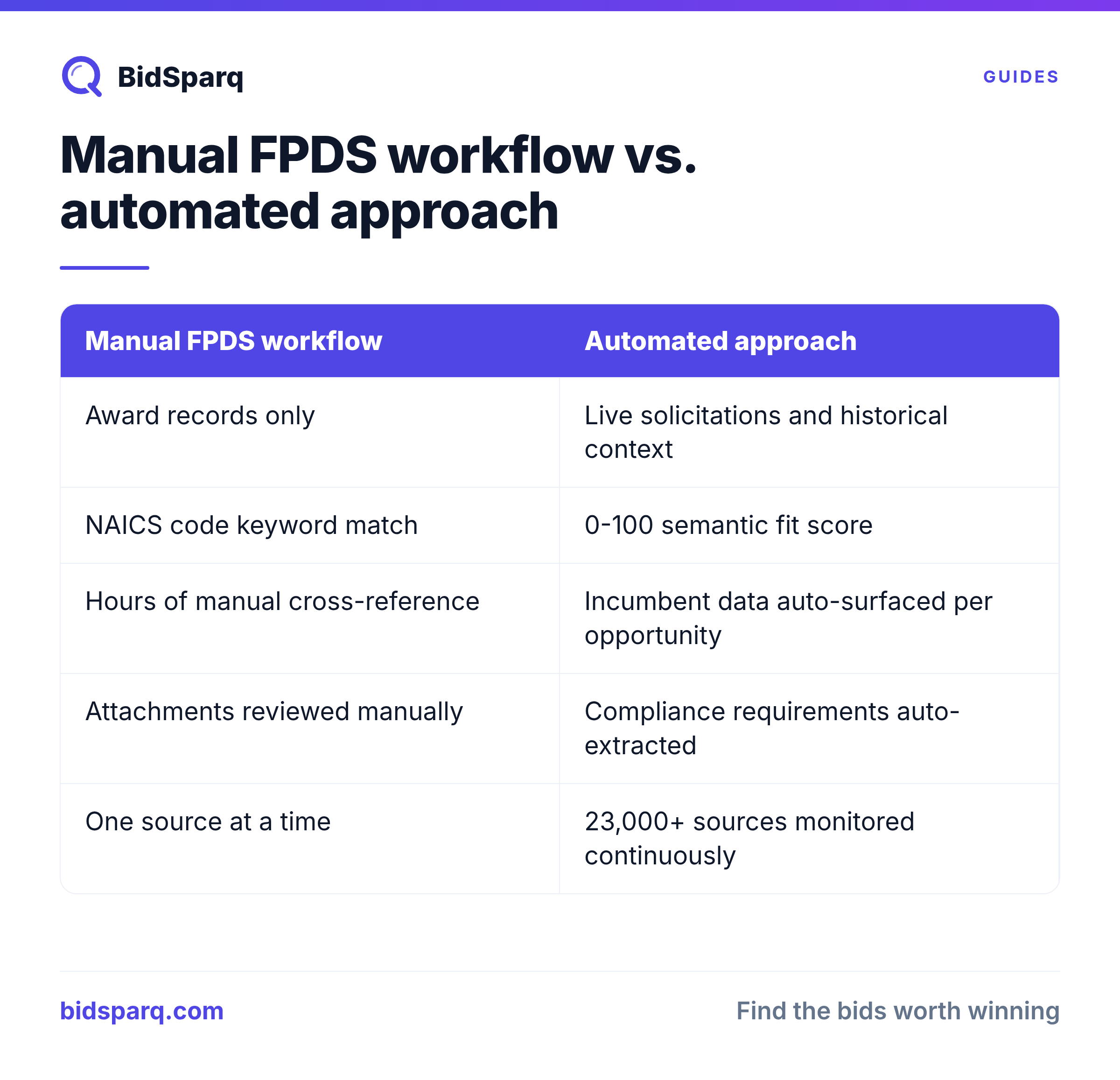
- FPDS is a historical archive, not an opportunity feed; it captures awarded contracts, not the active solicitations your pursuit team needs.
- Manual FPDS lookups are keyword-dependent and miss semantically relevant opportunities that a shared NAICS code or search term will not surface.
- Incumbent and vehicle intelligence buried in FPDS requires hours of cross-referencing to extract, even though that same data can be surfaced automatically alongside each scored opportunity.
- Compliance requirements, clearance levels, and set-aside restrictions live in attached documents that FPDS never indexes and keyword searches routinely skip.
- Layering FPDS award history with live solicitation data and automated fit scoring produces the kind of competitive picture that manual workflows simply cannot replicate.
The short answer
FPDS manual research is the practice of querying the Federal Procurement Data System to understand an agency's buying history, and it works best as a depth layer, not a discovery engine. The system is authoritative and free, which is why procurement teams often start there, but it records contract actions after execution, not the solicitations actively accepting proposals. Treating FPDS as your primary source means you are always researching the past to find work the government has already awarded. The higher-leverage approach is to start with a live solicitation feed, score opportunities for fit, and then use FPDS to add incumbent context and market depth to the pursuits that score well.
What FPDS actually contains and what it was never built to do
FPDS-NG, accessible at fpds.gov, is the authoritative record of federal contract actions going back to 2004. Every award above the micro-purchase threshold, every contract modification, every delivery order against an IDIQ vehicle is logged here. That makes it genuinely valuable for one specific task: understanding who an agency buys from, at what funding levels, and through which contract vehicles. Heading into a recompete cycle, that context is hard to replace.
What FPDS was never built to do is surface open solicitations, draft RFPs, sources-sought notices, or acquisition forecasts. For live opportunities, contracting teams check SAM.gov, agency-specific procurement portals, and published acquisition forecasts. The gap between a historical award record and a live opportunity feed is precisely where manual research becomes both time-consuming and unreliable. A construction general contractor pursuing public work typically monitors a state bid portal, several county procurement boards, and direct notice systems from project owners, with no centralized archive to reveal who won comparable projects or which owner consistently favors an incumbent. That contractor faces the same incumbent-blindness and attachment-buried compliance challenges as a federal contractor relying solely on FPDS, just spread across a different stack of siloed portals. That same fragmentation exists across every market segment, which is why modern solicitation platforms track 23,000+ sources across federal, state, local, and private markets, bringing automated fit scoring and incumbent context to every vertical.
The real cost of manual FPDS research
A rigorous pursuit workflow built around FPDS typically requires pulling award data from fpds.gov, cross-referencing spending trends on USASpending.gov, checking active solicitations on SAM.gov, and reviewing each agency's published acquisition forecast. Each step is a separate system with its own search syntax and export format. For teams working multiple opportunities at once, that process repeats for every pursuit on the pipeline.
As of September 2026, 52,237 solicitations are open across the 23,000+ sources we track. Of those, 1,218 mention the term "manual," with 519 of them closing within the next 14 days. Another 1,421 solicitations referencing manual processes were posted in the last 30 days alone. Not one of them surfaces through a standard FPDS search, because FPDS does not track solicitations. That is the gap no manual workflow can close.
How to run a manual FPDS-NG search
Open fpds.gov and use the Advanced Search fields to pull award data by agency, NAICS code, Product Service Code (PSC), awardee name, and date range, with each filter narrowing the record set before you export. Navigate to the Advanced Search tab at the top of the page. The most productive combination for competitive intelligence is Agency Name plus NAICS code, which shows you what a specific buyer has awarded in your core capability area. Adding a date range covering the last two to three fiscal years keeps results relevant to current buying patterns rather than legacy programs that may have since ended. The PSC filter is especially useful when your work spans multiple NAICS categories, because PSC codes describe the type of deliverable rather than the industry classification of the performing company.
Once you have filtered to a manageable result set, use the Export to CSV option to download the raw data. Preserve at minimum: Contractor Name, Contract Number, Award Amount, Period of Performance, and Contracting Agency. Cross-referencing those contract numbers on USASpending.gov then adds cumulative obligated value and modification history for each award, giving you a fuller picture of how the agency has used each vehicle over time.
Two data-quality issues to account for before drawing conclusions. Contracting officers sometimes apply NAICS codes based on the agency's primary mission rather than the nature of the actual work, so a logistics support contract at a defense agency may be coded under the agency's dominant NAICS rather than the supply chain services code you would expect. Filtering by NAICS alone will miss a meaningful share of relevant awards as a result. There is also a structural lag: federal contract actions typically appear in FPDS 30 to 90 days after the award date, so a contract signed last month may not yet be searchable. Relying on FPDS to capture the most recent competitive activity in an agency can leave you with a materially incomplete picture of who is currently winning work.
The layers that FPDS data cannot supply
Beyond incumbent identification, FPDS research leaves critical intelligence gaps that most federal contractors treat as unavoidable. Contract vehicle eligibility, whether the agency is routing work through a GWAC or IDIQ you already hold, rarely surfaces in FPDS without manual cross-referencing of the contract number against the vehicle's ordering procedures. Compliance requirements including clearance levels and set-aside restrictions are embedded in statements of work and attachments that FPDS never indexes. BidSparq pulls clearance levels, set-aside designations, and scope signals automatically from attached documents, so compliance fit surfaces with each scored opportunity rather than at the end of a manual document review. Semantic fit, whether the actual scope of work matches your capabilities beyond a shared NAICS code, requires reading the documents themselves.
Each of these gaps is a decision point where teams either invest manual research hours or accept the risk of pursuing opportunities they are not positioned to win, or missing the ones they would have scored well on. Automated extraction changes that calculation: when compliance signals and fit indicators are pulled from source documents continuously, the manual burden on each pursuit drops sharply.
Putting FPDS in its proper place in your pursuit workflow
Replace the reactive FPDS search loop with a monitored feed that surfaces, scores, and filters opportunities before you ever open a new tab. Semantic matching understands that a solicitation for "logistics support services" may be highly relevant to a contractor whose past performance is in supply chain management, even if those phrases never share a document. That connection disappears in a keyword search and never appears in FPDS at all.
Incumbent and contract vehicle context, the data you were mining FPDS to find, can be surfaced automatically alongside each scored opportunity. A 0-to-100 fit score gives your team a defensible basis for which pursuits to invest proposal resources in and which to pass on. FPDS becomes what it always was: a confirmation and context layer, not the discovery engine your pipeline depends on.
FAQ
What does FPDS show, and can you use it to find open federal contracts?
FPDS-NG records federal contract awards, modifications, and orders after they are executed. It is a historical database, not a solicitation board. Open solicitations are published on SAM.gov, not in FPDS. Manual FPDS research is most useful for pre-recompete competitive analysis: identifying the incumbent contractor, understanding which contract vehicle the agency prefers, and sizing the historical spend in your target area.
How do you find incumbent contractors using a manual FPDS search?
Search FPDS-NG by agency, NAICS code, or program office to identify recent awards in your target area. Note the awardee name, contract vehicle, contract number, and period of performance. Cross-referencing that contract number on USASpending.gov shows modification history and total obligated value. The process works but requires multiple systems and manual reconciliation for every pursuit target. Platforms that automate incumbent lookup pull this context alongside opportunity scoring, eliminating the separate research step entirely.
What is the difference between FPDS and SAM.gov for federal contracting?
FPDS is a backward-looking record of what federal agencies have already bought and from whom. SAM.gov, the System for Award Management, is where agencies publish active solicitations, sources-sought notices, and procurement forecasts. Effective federal market research uses both: SAM.gov to find what is accepting bids now, and FPDS to understand the competitive history and incumbent context behind each live opportunity.
Try BidSparq's federal opportunity feed free and get semantic matches, fit scores, and incumbent context without the manual FPDS loop.
Find RFPs that match your business
BidSparq monitors 23,000+ procurement sources and uses AI to score every opportunity against your capabilities. Try it free for 14 days.
Start Free Trial →