Best Freelance Sites for Government Projects, Ranked
The best freelance sites for government projects span official portals, state eProcurement systems, and real-time bid aggregators. This guide covers where agencies actually post solicitations, what keyword search misses, and how to find and win government work consistently.
Finding paid government work as a freelancer is harder than it looks. Agencies buy more services than most people realize, from technical writing and software development to design and consulting, but they do not post those opportunities in one place, and they do not wait long.
- Federal contracting requires active SAM.gov registration before any agency can award you a contract, a step many freelancers overlook until it costs them an opportunity.
- State and local governments account for the majority of government procurement volume, yet most freelancers focus on federal sources and miss most of what agencies actually buy.
- Knowing who holds the incumbent contract changes how you position your proposal, yet most discovery tools give you no visibility into incumbents or existing contract vehicles.
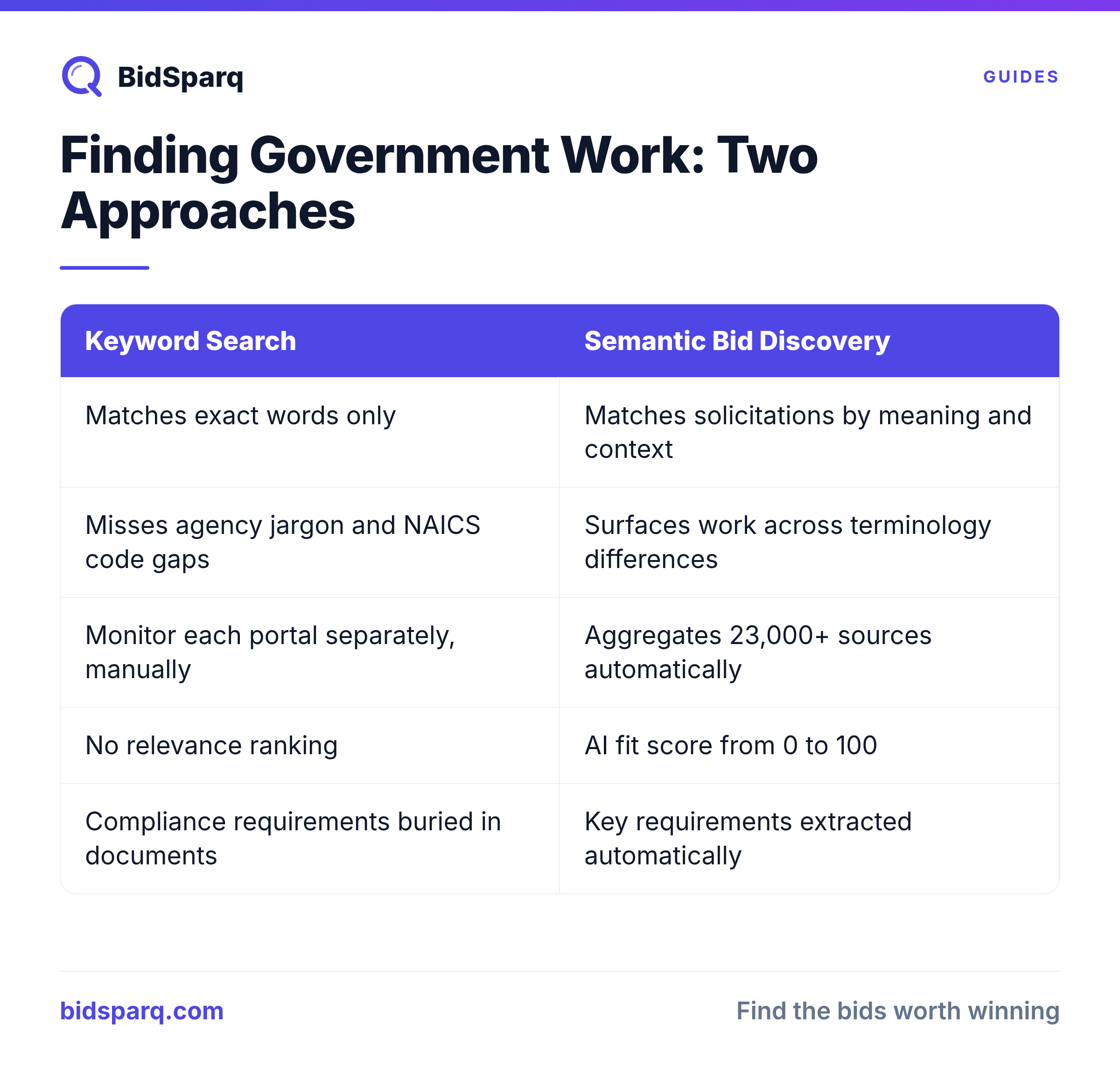
- Keyword searches fail on government solicitations because agencies write in NAICS codes, category terms, and contract vehicle language that rarely matches how vendors search.
- Automated compliance extraction surfaces the must-meet requirements in a solicitation so nothing critical is buried in a late amendment you missed while monitoring portals manually.
- As of October 2026, 866 government solicitations close within the next 14 days, which means real-time monitoring is not optional for freelancers who want to respond competitively.
The short answer
The best sites for finding government freelance projects are SAM.gov for federal work, your state's official eProcurement portal for state contracts, and a real-time bid aggregator for comprehensive coverage across both. General freelance platforms like Upwork do carry some government postings, but agencies post there inconsistently and most solicitations never leave official procurement systems. As of October 2026, 58,403 solicitations are open across the 23,000+ sources BidSparq tracks, spread across thousands of separate portals, which is why single-platform searching misses most of the market. The practical approach is layered: official sources for authority and credibility, an aggregator for scale and coverage, and a fit-scoring tool for prioritization before you commit to writing.
SAM.gov and the federal layer
Register on SAM.gov before you pursue any federal contract: active registration is required before an agency can award you work, full stop. SAM.gov is the federal government's System for Award Management, and vendors must maintain an active registration to be eligible for federal contract awards. The site also hosts the federal opportunity database, where agencies publish solicitations for services, consulting, software development, training, and more. It is authoritative, free, and updated daily. The limitation is scope and search quality: SAM.gov covers federal agencies only, and its search is keyword-based, meaning solicitations written with different terminology than your search terms will not surface. For federal work, it is the mandatory starting point. For state, local, and institutional procurement, you need to look beyond it.
State, local, and institutional portals
State and local governments post an enormous volume of procurement outside the federal system, and each jurisdiction manages it differently, which is what makes this layer so easy to miss. Most states operate an official eProcurement portal where agencies publish solicitations, but portal names and structures vary widely by state. A reliable starting approach: search your state's official website for "procurement" or "vendor registration" to find the right entry point. Beyond state portals, local governments and school districts often use separate systems. BoardDocs and similar agenda-publishing platforms post school board meeting agendas that include bid approvals and upcoming solicitation notices. County and municipal procurement offices post on their own agency sites, independent of state systems. USASpending.gov tracks awarded federal contracts and can reveal which agencies regularly buy what you offer, a useful targeting tool before a new solicitation even posts.
Monitoring SAM.gov, your state portal, dozens of county and agency sites, and board agenda systems is a significant ongoing time commitment. Browse open government solicitations free on BidSparq, no credit card required, to see matched opportunities across 23,000+ sources in one view.
Where freelance platforms fit and where they fall short
Freelance marketplaces are a supplementary channel for government work, not a primary one, and treating them as a primary source means missing most of what is available. Platforms like Upwork and Toptal do carry government project listings, typically from smaller agencies, innovation offices, or subcontractors seeking specialized help. These are worth monitoring, particularly for short-term technical and creative work. The gap is coverage: most government solicitations are subject to procurement laws requiring official publication on government portals, not third-party platforms. A school district's curriculum development contract, a transit authority's software project, or a state agency's communications retainer will post on a government portal. Supplementary channel use makes sense. Relying on these platforms as your primary pipeline does not.
Real-time monitoring and fit scoring
The core challenge in government procurement is not finding the right portals; it is monitoring them fast enough to respond before deadlines close. As of October 2026, 866 open solicitations across tracked sources close within the next 14 days. That compression means the window from posting to deadline is short, often shorter than the time it takes to discover the opportunity through periodic manual searching. Semantic matching addresses one side of this problem: instead of requiring you to guess the right keyword, it matches solicitations by meaning, surfacing work written in agency language that describes the same services you provide. AI fit scoring on a 0 to 100 scale addresses the other side: it tells you, before you invest hours in a proposal, whether a solicitation is a genuine match for your capabilities and past performance. Automated compliance extraction then pulls the must-meet requirements from the document, so nothing critical is buried in a late amendment.
FAQ
Can a freelancer or sole proprietor actually win government contracts?
Yes. Government agencies at the federal, state, and local level regularly award contracts to individual consultants, sole proprietors, and small firms. Many federal and state programs include small business set-asides that specifically favor smaller vendors over large primes. The key requirements are active registration (SAM.gov for federal work, your state system for state contracts), any required licenses or certifications for your category, and a compliant, responsive proposal. A well-matched smaller vendor can and regularly does outcompete a larger firm on a specialized solicitation.
Is SAM.gov the only site I need for government freelance work?
No. SAM.gov is essential for federal work but covers federal agencies only. State and local governments, school districts, healthcare systems, and public authorities post the majority of government procurement on separate portals: state eProcurement systems, agency websites, and agenda platforms like BoardDocs. A comprehensive approach requires monitoring both federal and sub-federal sources. That is why aggregators pulling from 23,000+ distinct sources are practical alongside direct portal access: no single government portal covers everything.
How do I find government RFPs that match my specific skills?
Start with keyword searches on SAM.gov and your state's procurement portal to understand the language agencies use when they buy what you offer. Then identify the relevant NAICS codes (North American Industry Classification System codes) that agencies use to categorize solicitations by industry: these codes open filtered searches that plain keyword terms miss. Tools using semantic matching surface relevant work even when the solicitation uses different terminology from your own. Reviewing recently awarded contracts in your category on USASpending.gov also reveals which agencies buy regularly, giving you a target list to monitor proactively rather than waiting for broad search results to surface opportunities.
Start finding government solicitations matched to your capabilities. Try BidSparq's free bid-discovery tier, no credit card needed, and see your matches across thousands of open opportunities posted right now.
Find RFPs that match your business
BidSparq monitors 23,000+ procurement sources and uses AI to score every opportunity against your capabilities. Try it free for 14 days.
Start Free Trial →