SCA Wages 2026: What to Check Before You Price a Bid
SCA wages in 2026 are not one number. Here is how to find the wage determination that governs your service contract, build labor rates from it, and plan for revisions.
Most searches for SCA wages in 2026 are looking for a rate table. There isn't one. The Service Contract Act does not set a national wage. It sets a process, and contractors who price labor from last year's numbers, a competitor's rate card, or a general salary survey end up with a bid that is either too high to win or too low to perform.
The pain is the same whether you staff a janitorial crew, an IT help desk, a food service line, or medical support roles on a federal service contract. Labor is most of the price. If the wage floor is wrong, everything built on top of it is wrong too.
- Job classification is where pricing goes wrong. Mapping your people to the wrong occupation in the SCA Directory of Occupations changes the wage floor for every hour you bid.
- Fringe benefits sit on top of the hourly rate. Health and welfare, vacation, and paid holidays are separate obligations listed on the determination.
- A predecessor's union agreement can set your floor. When the incumbent's workforce is covered by a collective bargaining agreement, a successor contractor generally owes at least those wages and fringes.
- Price adjustments cover less than many contractors expect. The standard clauses reimburse the wage and fringe increase itself, without overhead or profit on it.
- State and local wage rules are a different system. A prevailing wage or living wage clause in a state, city, or school district bid is not the SCA, and it has its own rates and paperwork.
The short answer
There is no single SCA wage rate for 2026: what you owe is set by the specific Department of Labor wage determination incorporated into your contract, which varies by locality and occupation. Wage determinations are published on SAM.gov and are revised throughout the year, so the revision number attached to your solicitation matters more than the calendar year. The health and welfare fringe rate is usually updated once a year by the Department of Labor and appears on each determination. Price from the revision in your solicitation, then expect a newer one to be incorporated at each option period or extension.
Find the wage determination that governs your contract
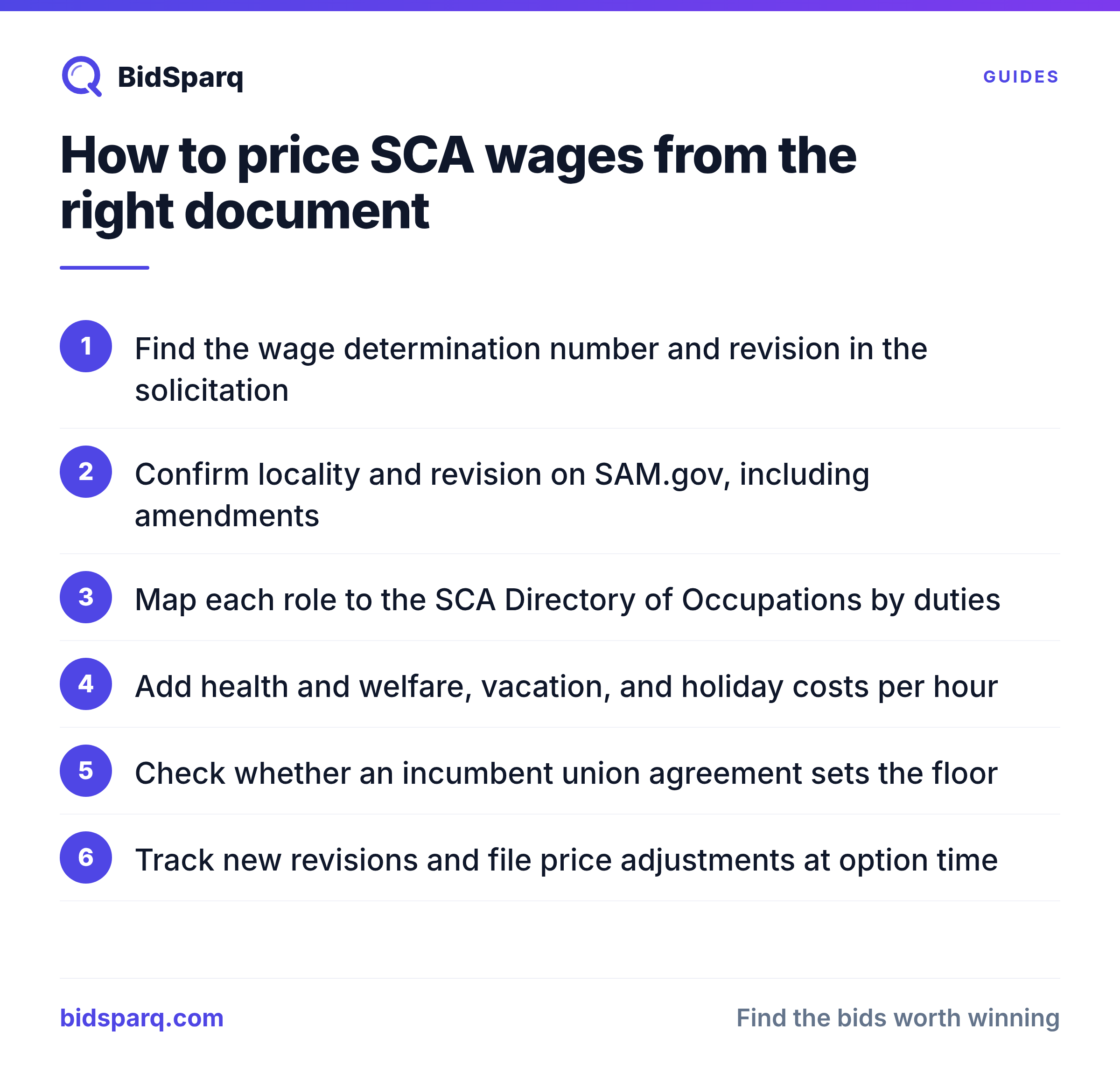
Start with the determination number and revision cited in the solicitation, not with a web search for rates. A solicitation covered by the Act (the FAR calls it Service Contract Labor Standards) will include clause FAR 52.222-41 and will attach or reference a wage determination. That document is the authority. It lists minimum hourly wages by occupation for a specific geographic area, along with the fringe benefits owed.
You can look up any determination yourself in the Wage Determinations section of SAM.gov. Check three things before you price. First, that the locality matches the actual place of performance. Second, that the revision is the one named in the solicitation or its latest amendment, because an amendment can swap in a newer revision before proposals are due. Third, whether the determination is a standard area determination or one based on a collective bargaining agreement, since the second kind reflects the incumbent's negotiated wages and fringes instead of area averages.
The Department of Labor's Wage and Hour Division publishes the governing guidance, including the annual memorandum that announces the health and welfare rate. If a term on the determination is unclear, that is the place to resolve it.
Build the labor rate from the determination up
Map every position to a listed occupation first, then add the fringe obligations line by line. The SCA Directory of Occupations describes the duties behind each title. Match on duties, not on the job titles your company uses internally. A help desk technician and a computer operator may sound interchangeable in a staffing plan and carry different wage floors on the determination.
If a role you need is not listed, do not invent a rate. The conformance process, filed on Standard Form 1444 after award, is how an unlisted class gets an approved wage. Price that role conservatively, because the approved rate has to bear a reasonable relationship to the listed classes.
Then layer in the fringes the determination spells out. Health and welfare is stated as an hourly amount and can generally be met through benefits, cash, or a mix. Vacation accrues based on years of service, and that service typically counts time with predecessor contractors on the same work. Paid holidays are listed by name. Each of these is a real cost per hour, and leaving one out is how a winning bid turns into a losing contract.
Keep in mind that the Act covers service employees. Bona fide executive, administrative, and professional staff are exempt, so not every person on the contract is priced from the determination.
Stop reading every solicitation by hand
Accept that the wage language is rarely on page one, and that finding it manually does not scale. The determination is usually an attachment. The clause references sit deep in the contract terms. The revision can change by amendment. For a team pursuing more than a handful of opportunities at a time, checking each one by hand means opening every file, searching for clause numbers, and cross-referencing SAM.gov before anyone has decided whether the bid is worth pursuing at all.
The volume is real. As of November 2026, 118 of the open solicitations across the 33,000+ sources BidSparq tracks mention wages, and 55 of them close within the next 14 days. Another 120 were posted in the last 30 days. Keyword alerts catch some of these and miss others, because one buyer writes about service contract labor standards, another about prevailing wage, and a third only attaches a determination without describing it.
Try RFP software that reads the wage requirements for you, free for 14 days with no credit card.
Let software surface the wage clauses and the incumbent
Automate the reading so your estimators spend their time on the price, not on the search. Two capabilities matter most for wage-driven bids. Automatic compliance extraction pulls requirements out of the solicitation documents, including labor standards clauses and referenced wage determinations, so the obligation is visible before you commit to bid. Semantic matching finds opportunities by meaning, which is how a solicitation that never uses your exact keyword still reaches you.
Incumbent and contract vehicle intelligence is the third piece, and for SCA work it is directly tied to cost. Knowing who holds the current contract tells you whose workforce you may inherit, whether a collective bargaining agreement could set your wage floor, and how much accrued vacation seniority might come with the staff. Manual tools leave that research to you. An AI fit score from 0 to 100 then helps you decide which of the matching bids deserve a full pricing effort.
Wage requirements are not only a federal concern. As of November 2026, the states posting the most solicitations that mention wages are New York (22), California (14), and Pennsylvania (13), and the same discipline applies to prevailing wage and living wage clauses in education, healthcare, construction, and commercial bids.
Plan for the determination to change mid-contract
Treat the wage determination as a moving input and know your price adjustment clause before you sign. On a multi-year or option-year contract, the contracting officer incorporates a current determination at each option exercise or extension. If wages or fringes rise, clauses such as FAR 52.222-43 allow a price adjustment on fixed-price contracts.
Read the limits closely. The adjustment covers the actual increase in wages and fringe benefits you are required to pay, plus the related payroll taxes and workers' compensation. It excludes general and administrative costs, overhead, and profit. The clause also has you warrant that your prices do not already include a contingency for those increases. And the request has a notice window, so track each new determination when it arrives and file promptly.
The practical upshot is to keep a clean record of what each employee was paid under the old determination and what the new one requires. That difference is your claim. Contractors who cannot document it leave money on the table every option year.
Start a 14-day free trial of bid discovery and compliance extraction, no credit card needed, and see which open service solicitations fit your business.
FAQ
What is the SCA health and welfare rate for 2026?
The Department of Labor announces the health and welfare fringe rate in an All Agency Memorandum, usually once a year, and the rate then appears on each revised wage determination. The figure that binds you is the one printed on the determination incorporated into your contract. Look it up on SAM.gov by determination number and revision instead of relying on a number quoted elsewhere.
Do SCA wage determinations change during a contract?
Yes. The determination in your contract stays in effect for the current period, and a current revision is incorporated when an option is exercised or the contract is extended. If the new revision raises wages or fringes on a fixed-price contract, the price adjustment clause lets you request an increase limited to the added labor cost and related payroll expenses.
Does the Service Contract Act apply to state and local contracts?
No. The Act applies to service contracts with the federal government and the District of Columbia. State agencies, cities, and school districts often have their own prevailing wage or living wage requirements, which use different rate schedules and reporting rules, so read each solicitation's labor terms on their own.
Find RFPs that match your business
BidSparq monitors 33,000+ procurement sources and uses AI to score every opportunity against your capabilities. Try it free for 14 days.
Start Free Trial →