Food Bidding: How to Find and Win Food Contracts
Food bidding rewards vendors who see the right solicitations early and submit complete responses. Learn where food bids post, which codes to search, and how awards work.
Most food vendors lose bids they never saw. The contract existed, the product fit, and the price would have competed, but the solicitation sat on a portal nobody on the team checks, under a title nobody thought to search for. Food bidding is a visibility problem first and a pricing problem second.
- As of November 2026, 810 of the open solicitations mention "food", and they are spread across thousands of separate buyer portals.
- Search by product and by code. Buyers title bids "fluid milk" or "inmate meals", and they classify them under NAICS and PSC codes that a keyword alert for "food" never touches.
- Why do low bids lose? A missing certification or spec sheet makes a bid non-responsive, and it is rejected before anyone compares prices.
- Work backward from the school year. Most school food contracts start July 1, so the bids come out in late winter and spring.
- 287 "food" solicitations close within the next 14 days, which means a bid found late is usually a bid skipped.
- Before you pursue a buyer, check whether they bid openly or buy through a cooperative contract, because that decides whether you can sell to them at all.
The short answer
Food bidding is the process of competing for contracts to supply food products or food service to institutional buyers by answering a formal solicitation with pricing, product specifications, and compliance documents. Product bids for dairy, bread, produce, and grocery items are usually issued as an invitation for bids and awarded by line item or by lot to the lowest responsive, responsible bidder. Food service management contracts are more often run as RFPs and scored on menu quality, staffing, and experience, with price as one factor. Awards typically run one year with renewal options, so most contracts return to market on a predictable cycle.
Who buys food by bid, and when
Institutional food buyers purchase on a calendar, and the calendar is the first thing to learn. School nutrition programs are the clearest case. The school year runs July 1 through June 30, so districts release milk, bread, produce, and grocery bids in late winter and spring, with awards approved by the board before summer. A vendor who starts looking in August is a year early for the next round.
Schools also buy through federal channels. Under the USDA DoD Fresh Fruit and Vegetable Program, districts spend USDA Foods entitlement dollars on fresh produce supplied by vendors under contract with DLA Troop Support, the Defense Logistics Agency arm that also buys food for military dining facilities. Produce distributors who want that business compete for the DLA contract, not for each district.
The market is much wider than schools. Public hospitals, state universities, correctional facilities, and senior nutrition programs all bid food. So do private buyers: a private university putting its dining program out to RFP, or a nonprofit health system buying patient meals through a group purchasing organization such as Premier or Vizient, runs a competition that looks much like a public one, with less public notice.
Where food bids are posted, and why manual checking breaks down
A distributor serving one metro area can face dozens of separate portals, each with its own login. The well-known sources are only the start:
- SAM.gov lists federal food and food service opportunities, including DLA Troop Support solicitations.
- The USDA Agricultural Marketing Service publishes commodity purchase solicitations for federal nutrition programs.
- Your state's official eProcurement portal covers state agencies and often universities.
- School board agendas, many published through BoardDocs, show upcoming food contract approvals and renewals before a bid is released.
Past that list, individual school districts, hospital purchasing departments, and cooperatives each post on their own sites, in their own formats, on their own timing. The scale is the problem. As of November 2026, 54,228 solicitations are open right now across the 33,000+ sources BidSparq tracks, and 924 new "food" solicitations were posted in the last 30 days. No team checks that many sources by hand, and one missed check can mean waiting out a full contract term.
If that workload sounds familiar, see your food bid matches free for 14 days, no credit card needed.
Search by what you sell, and by code
A bid titled "Fluid Milk and Cultured Products" never uses the word food, and that is the normal case. Buyers name bids by product: shelf-stable milk, fresh-cut produce, bread and rolls, inmate meals, cafeteria management. A keyword alert for "food" misses most of them and fills your inbox with food truck permits and pet food.
Classification codes help. The NAICS codes most food vendors should search are:
- 424410, General Line Grocery Merchant Wholesalers
- 424430, Dairy Product Merchant Wholesalers
- 424470, Meat and Meat Product Merchant Wholesalers
- 424480, Fresh Fruit and Vegetable Merchant Wholesalers
- 424490, Other Grocery and Related Products Merchant Wholesalers
- 722310, Food Service Contractors
Federal buyers also use Product Service Codes. Group 89, Subsistence, covers food products, including 8905 (meat, poultry, and fish), 8910 (dairy foods and eggs), 8915 (fruits and vegetables), and 8920 (bakery and cereal products). Food service contracts usually sit under S203.
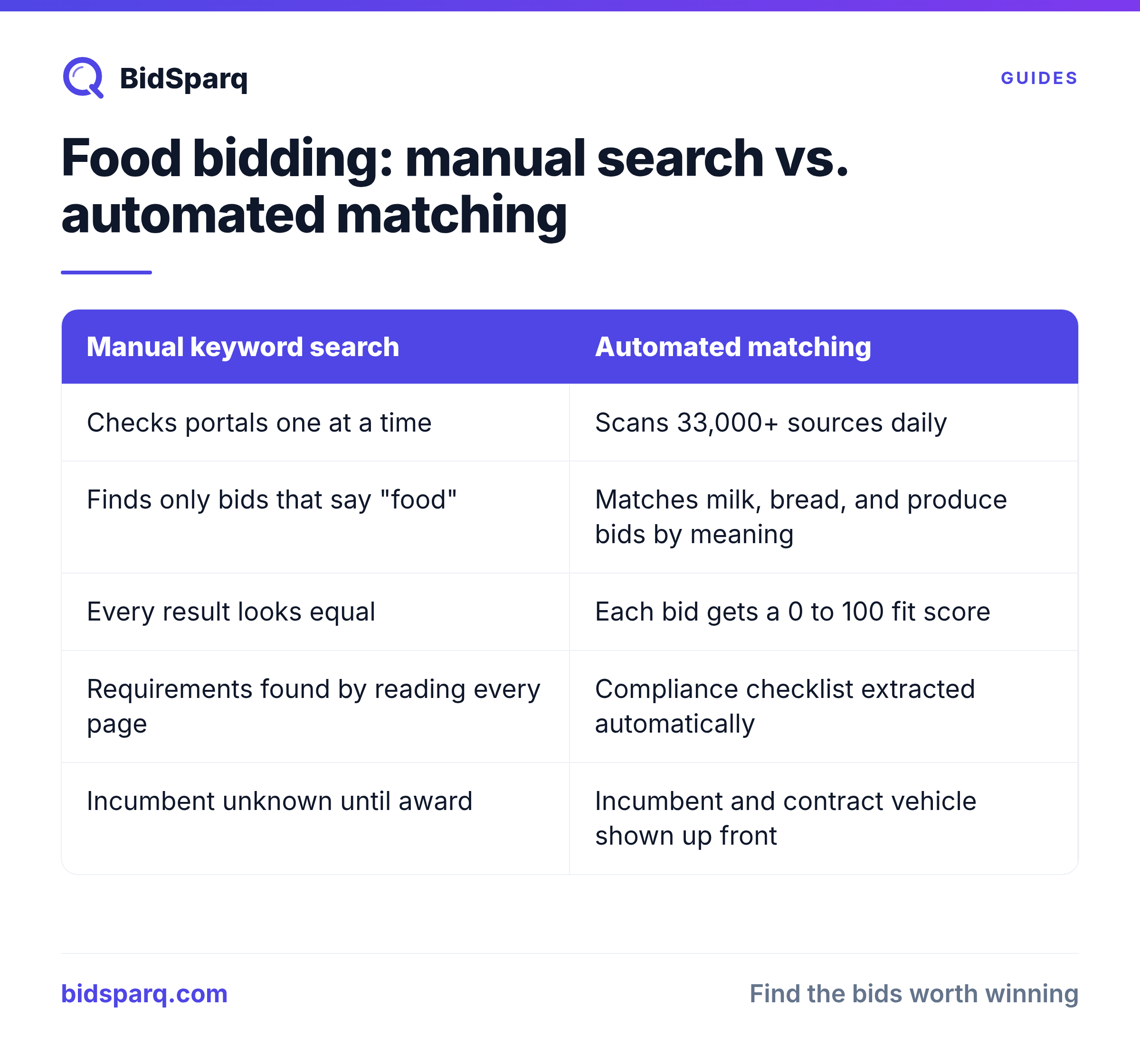
Codes still have limits, because many local buyers never assign one. This is where automated tools and manual keyword tools part ways. BidSparq uses semantic matching, which reads each solicitation by meaning, so a dairy distributor sees the milk bid without guessing the buyer's phrasing or code. Each match gets an AI fit score from 0 to 100, so your team starts with the strongest fits and skips most of the sorting. The same matching, scoring, and compliance extraction work for any category a distributor also sells, such as janitorial supplies, equipment, and services.
Read the compliance requirements before you price
Pull every requirement out of the bid package before you spend an hour on pricing. Food solicitations carry more conditions than most. Product specifications can dictate pack sizes, grades, and nutrition standards. Many buyers ask for food safety documentation, insurance certificates, signed certifications, and sometimes product samples.
School bids funded with federal meal dollars add federal rules. The Buy American provision at 7 CFR 210.21(d) requires school food authorities to purchase domestic commodities and products to the maximum extent practicable, so expect to certify the origin of what you offer and to document any exception. A bid that leaves that certification blank can be thrown out no matter how low the price is.
Doing this by hand means reading the whole package with a highlighter and hoping nothing is buried in an appendix. Automated compliance extraction turns the package into a checklist on the first read. You know up front whether you can meet the terms, and you avoid discovering a missing form the night before the deadline.
Learn who holds the contract and how the buyer purchases
Find out who the incumbent is, when the term ends, and whether the buyer bids openly before you decide to pursue. Food contracts tend to run a base year with renewal options, which makes the next rebid predictable once you know the current term. Incumbent and contract-vehicle intelligence shows who holds the work today and how the buyer sources it. Without it, you are piecing that together from old board minutes and award notices.
The purchasing method matters as much as the timing. Many public buyers skip their own bid and buy from a contract a cooperative has already competed, through organizations such as Sourcewell, OMNIA Partners, BuyBoard, and TIPS. If your target district buys groceries that way, the path to that customer runs through the cooperative's solicitation, and no local bid may be coming. A first-time rebid with an expiring term is a real opening. A cooperative buyer calls for a different plan.
FAQ
How do I find food bids for my business?
Start with SAM.gov for federal opportunities, your state's official eProcurement portal, and the purchasing pages of nearby school districts, hospitals, and universities. Search by product name and by NAICS codes such as 424410, 424430, 424480, and 722310, not the word "food". Because sources are so fragmented, many vendors use a bid aggregation platform that matches solicitations to their products automatically.
What documents do you need to bid on a food contract?
Most food bids ask for completed pricing sheets, product specification sheets, and signed certifications. Many also require food safety documentation and proof of insurance. School nutrition bids add federal requirements such as the Buy American provision at 7 CFR 210.21(d), and some buyers request samples. Always work from the checklist in the solicitation itself.
What does "lowest responsive, responsible bidder" mean?
It is the award standard for most food product bids. Responsive means the bid itself conforms to the solicitation: every form signed, every line priced as instructed, every required document attached. Responsible means the bidder can actually perform, with the capacity, delivery capability, and record to fulfill the contract. The award goes to the lowest price among bidders who pass both tests.
Are food bids always awarded to the lowest price?
No. Product bids usually go to the lowest responsive, responsible bidder, so an incomplete low bid still loses. Food service management RFPs are scored on several factors, such as menu quality, staffing, and experience, with price as one part of the evaluation.
How long do food contracts typically run, and how do they renew?
Most run one year with options to renew. School contracts usually follow the July 1 through June 30 school year. Federal rules limit school food service management company contracts to one year, with up to four additional one-year renewals, before the work must be rebid. Renewal is the buyer's option, so strong incumbent performance usually delays the next open competition.
How do cooperative contracts change who can sell to a buyer?
When a buyer purchases through a cooperative such as Sourcewell, OMNIA Partners, BuyBoard, or TIPS, it orders from vendors already awarded on that cooperative's contract and may not issue its own bid. To sell to that buyer, you need to win a place on the cooperative contract or supply a vendor who holds one. Check how a buyer purchases before you wait for a local solicitation.
Build food bidding into a weekly routine
Food bidding rewards the vendors who see more of the market and pursue less of it. The routine has three steps. See every relevant solicitation, including the ones titled by product and posted on portals you have never visited. Qualify hard, using fit, compliance requirements, incumbent status, and the buyer's purchasing method to cut the list to bids you can win. Then submit a complete response, because completeness decides more food awards than a few cents per case.
Each step is slow by hand and fast when it is automated, and the calendar does not wait. As of November 2026, 287 "food" solicitations close within the next 14 days. Find the open food bids that fit your product line with a 14-day free trial, no credit card required.
Find RFPs that match your business
BidSparq monitors 33,000+ procurement sources and uses AI to score every opportunity against your capabilities. Try it free for 14 days.
Start Free Trial →