Finance Tenders: Where to Find Them Before They Close
Finance tenders rarely use the word finance in the title. Here is where audit, banking, actuarial, and advisory solicitations get posted, and how to qualify them before you commit proposal hours.
Most finance tenders do not announce themselves as finance tenders. They are posted as external audit services, banking and depository services, actuarial valuations, revenue cycle reviews, or investment advisory, and they sit on thousands of buyer portals that share no common vocabulary. A firm that searches for the word "finance" sees a slice of its market and assumes the slice is the whole thing.
The problem is not a shortage of work. The work is scattered and inconsistently labeled, and the windows to respond are short.
Key takeaways
- The word "finance" is a weak search term. Buyers title these solicitations by the service they need, such as audit or actuarial work.
- Windows are short. As of November 2026, 193 open solicitations mentioning "finance" close within the next 14 days.
- Who holds the contract today shapes your odds, because many finance engagements are rebids of an existing relationship.
- Paperwork can end a bid early. A missing license or insurance certificate can remove a response before anyone reads the pricing.
- Score before you write. A quick fit check on every opportunity keeps a small team from spending proposal hours on work it was never positioned to win.
- Private and institutional buyers issue them too: hospital systems and universities buy financial services through formal solicitations just as public agencies do.
The short answer
Finance tenders are formal solicitations for financial services, such as audit, accounting, banking, actuarial, investment advisory, and financial software, issued by buyers across healthcare, education, commercial, and government markets. To find them, search by the service performed instead of the word finance, and check new postings daily because many are open for only a few weeks. As of November 2026, 584 open solicitations across the 33,000+ sources we track mention "finance," and 528 new ones were posted in the last 30 days.
What counts as a finance tender
Define your market by service line before you run a single search. "Tender" is the common term outside the United States for what American buyers usually call an RFP, RFQ, or invitation to bid, and the finance category underneath it is wider than most firms assume.
A hospital system may solicit a revenue cycle assessment or a charge capture audit. A university may seek an investment advisor for its endowment or a new provider for merchant card processing. A school district needs an independent auditor for its annual financial statements. A construction owner may want cost verification on a large capital program. A city or state agency may be shopping for banking services, debt collection, actuarial work on a pension plan, or a replacement for its financial management software.
Each of those is a finance tender. Almost none of them will carry that label, which is why a firm's own service list makes a better search vocabulary than any single category name.
Where to look for finance tenders
Check several source types, because no single portal carries the whole market. Finance solicitations surface in different places depending on who is buying.
- SAM.gov lists United States federal contract opportunities, including audit support, financial management, and accounting services.
- Your state's official eProcurement portal carries state agency solicitations and often those of universities and local bodies that piggyback on it.
- BoardDocs board agendas show when a school board or local governing body is authorizing an audit RFP or approving a banking contract, often before the solicitation itself is easy to find.
- A state comptroller's budget pages reveal where money is allocated, which hints at financial systems and advisory work on the way.
- EMMA, the municipal market disclosure site, lets you read an issuer's financial filings before you decide whether a pursuit is worth it.
- TED and the UK Find a Tender service publish public tenders for firms that work in European and UK markets.
Geography matters as well. As of November 2026, the states posting the most "finance" solicitations in our data are New York (159), California (38), and New Jersey (34). Hospital systems, private universities, and utilities frequently post on their own supplier portals, so a search confined to public aggregators misses much of the commercial side.
Why manual searching breaks down
Stop relying on a keyword alert and a handful of bookmarked portals. The manual routine looks manageable until you add it up: separate logins for every portal, a different category code system on each one, and saved searches that only fire when a buyer happens to use your exact words.
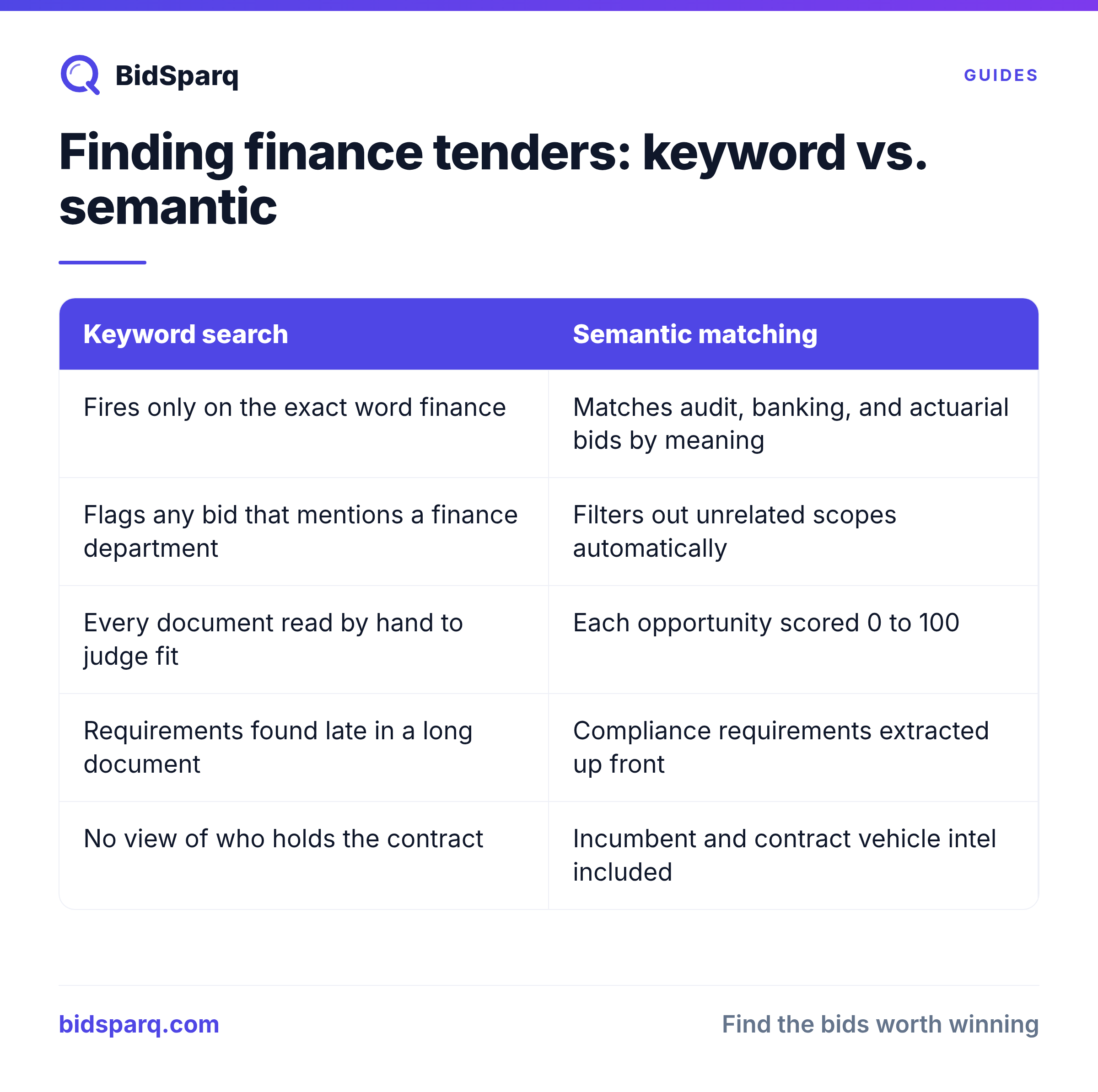
The vocabulary gap does the most damage. A solicitation titled "professional auditing services" or "depository and lockbox services" never contains the word finance, so a keyword tool passes over it. Meanwhile the same alert floods your inbox with construction bids that mention a finance department in the boilerplate. Someone has to read every one of those to sort real opportunities from noise, and that someone is usually a partner or senior manager whose time is the most expensive in the firm.
Semantic matching closes that gap. BidSparq matches solicitations by meaning, so a profile describing governmental audit work surfaces the auditing bid that never says finance and filters out the paving contract that does. That is the difference between an automated read of the market and a manual one.
Start a 14-day free trial of semantic finance tender matching, no credit card needed, and compare the results with what your keyword alerts have been sending.
How to qualify a finance tender before you commit
Qualify every opportunity before anyone drafts a word. Finding the tender is only the first filter. The expensive mistakes happen when a team writes a full response to a bid it could not have won.
Start with fit. Does the scope match work your firm has actually delivered, for a buyer of similar size and type? An AI fit score from 0 to 100 answers that in seconds for every new posting, where a manual review takes a careful read of each document.
Then check compliance. Finance tenders are heavy on mandatory requirements: professional licensing in the buyer's state, minimum insurance limits, peer review reports, independence statements, and references from comparable engagements. Automated compliance extraction pulls those requirements out of the solicitation into a list you can check against, so a gap shows up on day one and not the night before the deadline.
Finally, look at incumbency. If the current provider has held the engagement for years and the buyer is satisfied, your pricing and approach need to give evaluators a reason to switch. Incumbent and contract vehicle intel tells you who holds the work now and how it was bought, which a keyword tool cannot do at all.
Turn finance tenders into a pipeline
Treat rebids as a calendar, since most finance contracts come back on a cycle. Audit, banking, and advisory engagements typically run for a fixed term with renewal options, and then the buyer goes back to market. A contract awarded today is a tender you can plan for years ahead.
Record every relevant award you see, including the ones you lost or skipped. Note the term and the incumbent. Use the time before the rebid to get onto the buyer's vendor list, attend pre-proposal meetings when they are offered, and build the comparable references that the next solicitation will ask for. Firms that win finance work consistently are rarely surprised by a posting. They saw it coming and were already qualified when it opened.
FAQ
What are finance tenders?
Finance tenders are formal, competitive solicitations in which a buyer asks firms to bid on financial services or systems. Common scopes include external audit, accounting support, banking and treasury services, actuarial valuations, investment advisory, debt collection, and financial management software. Buyers include hospital systems, universities, school districts, utilities, private companies, and government agencies at every level.
Where can I find finance tenders?
Look across several source types: SAM.gov for United States federal opportunities, your state's official eProcurement portal, BoardDocs agendas for school boards and local bodies, and the supplier portals of hospital systems and universities. Firms working internationally can check TED and the UK Find a Tender service. Search by the specific service, such as audit or actuarial, because many relevant postings never use the word finance.
Is there software that finds finance tenders automatically?
Yes. Bid discovery platforms aggregate postings from many portals and alert you to matches. BidSparq tracks 33,000+ sources daily, matches by meaning instead of keywords, scores each opportunity from 0 to 100, and extracts compliance requirements automatically. Pro Max is $249/mo, or $199/mo billed annually. See your finance tender matches free for 14 days, no credit card needed.
Find RFPs that match your business
BidSparq monitors 33,000+ procurement sources and uses AI to score every opportunity against your capabilities. Try it free for 14 days.
Start Free Trial →