Government Transportation Contracts in Indianapolis: How to Bid
Where government transportation contracts in Indianapolis are posted, from IndyGo and INDOT to school districts, and how to qualify each bid before you commit hours.
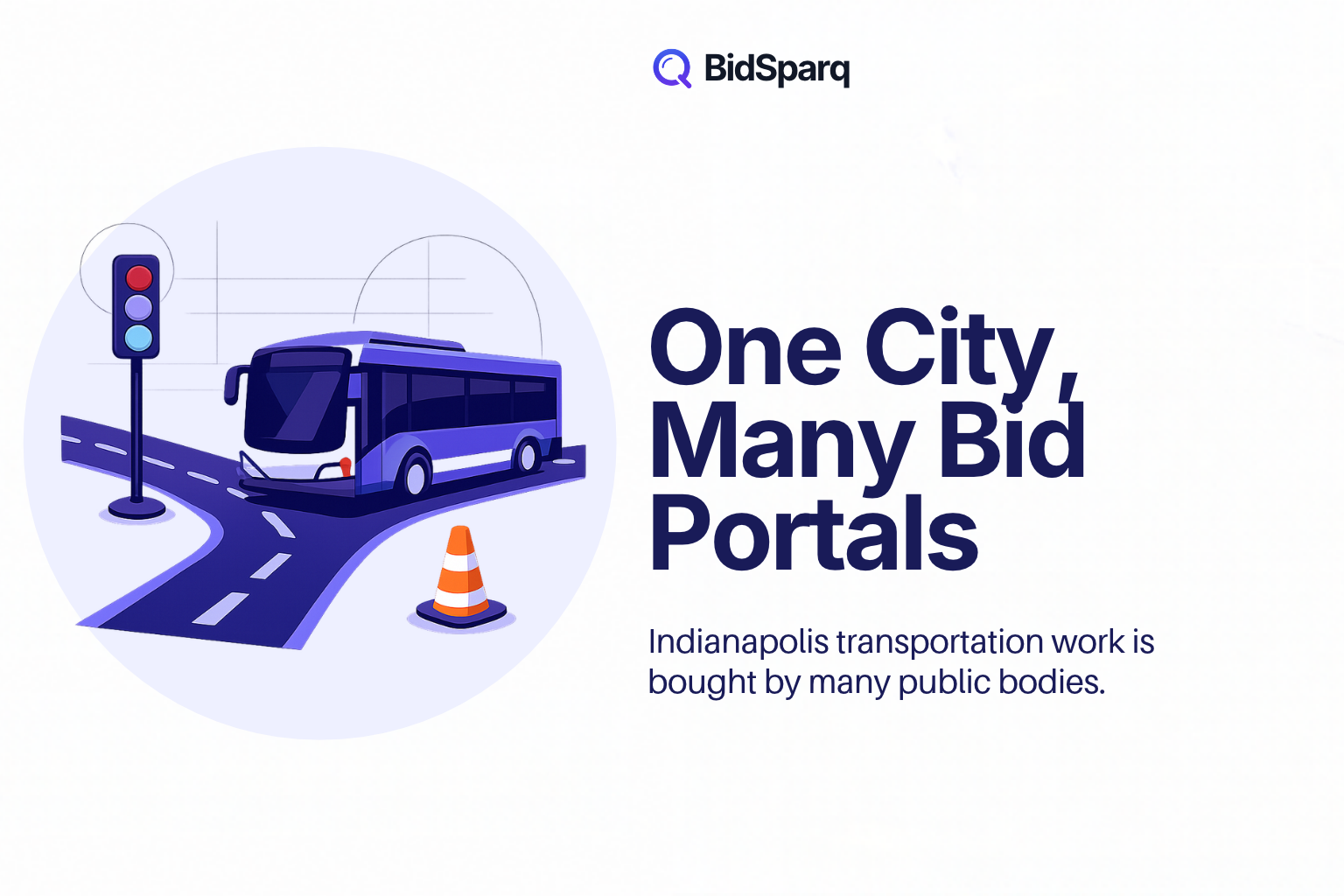
A government transportation contract in Indianapolis is hard to find for one reason: no single site posts them all. IndyGo, the City of Indianapolis and Marion County, INDOT, the Indianapolis Airport Authority, and the school districts each buy transportation work separately, on their own portals and calendars. A vendor watching one of those sites sees a fraction of the market, and usually sees it late.
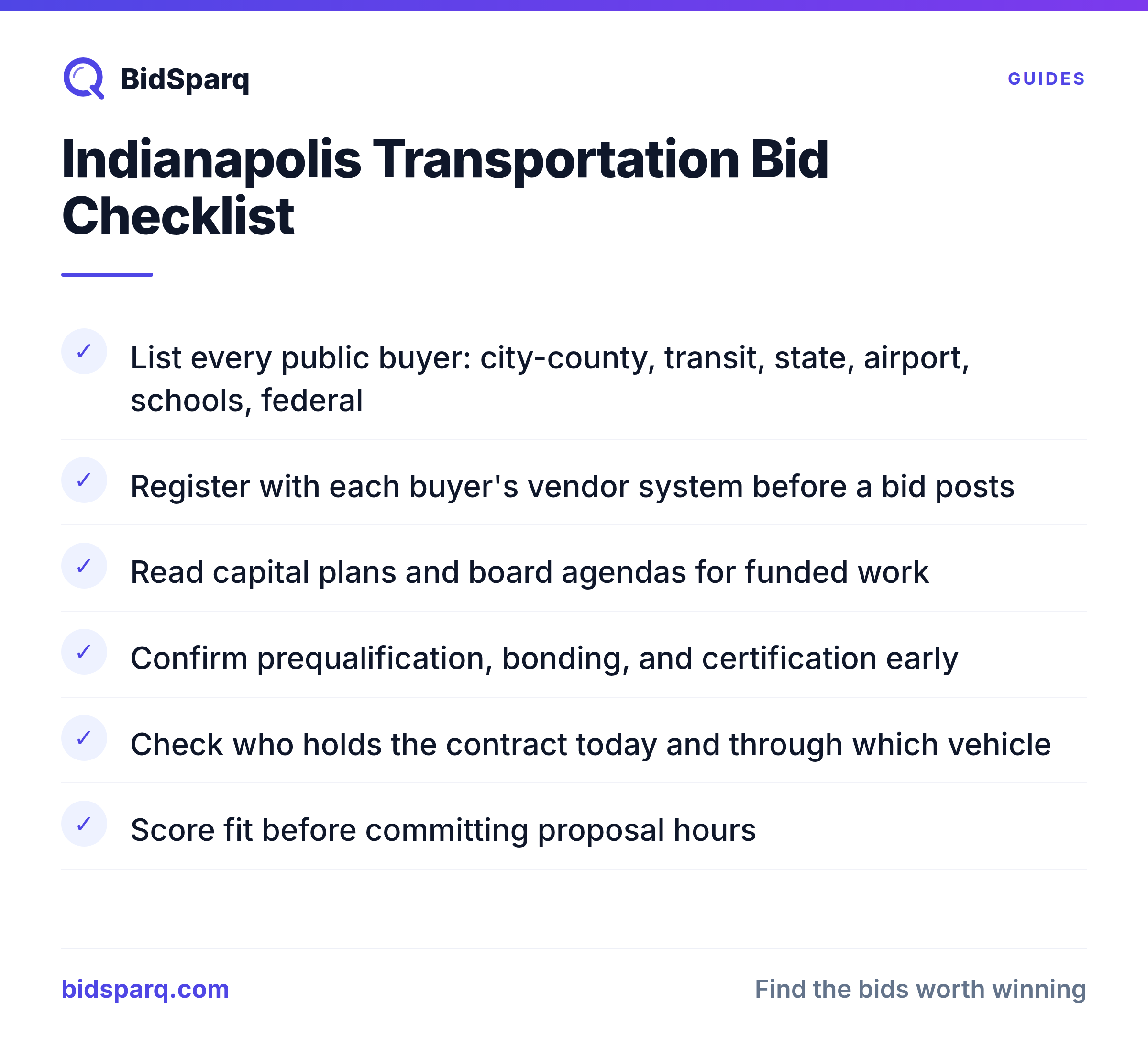
- The market has no front door. At least seven kinds of public buyer purchase transportation work in the Indianapolis area, and none of them share a portal or a registration process.
- A solicitation is the last signal, not the first. Budgets, board agendas, and the Indianapolis MPO's Transportation Improvement Program show funded work well before a bid is advertised.
- Buyers rarely use the word you search. Postings for "demand response" or "pupil conveyance" are transportation work that keyword alerts never surface.
- Prequalification can outlast the bid window. INDOT contractor prequalification, bonding, and certification take longer than most response periods allow.
- The incumbent shapes your odds. Knowing who holds the contract today, and through which contract vehicle, tells you whether a pursuit is winnable.
The short answer
Government transportation contracts in Indianapolis are won in three steps: register, watch early, then qualify. First, register as a vendor with the Indiana Department of Administration, City of Indianapolis and Marion County purchasing, IndyGo, and SAM.gov, and apply for INDOT contractor prequalification if you build roads or bridges. Second, follow the INDOT letting schedule, the Indianapolis MPO's Transportation Improvement Program, and school board agendas so you know what is funded before it is advertised. Third, check each solicitation against your bonding, insurance, and certification status before anyone spends proposal hours on it.
Who buys transportation work in Indianapolis
Seven kinds of public buyer account for nearly all of this market, and each posts in a different place. Use the table below as your watch list, and confirm each buyer's current vendor portal on its official site before you register.
| Buyer | What it buys | Where it posts |
|---|---|---|
| IndyGo (Indianapolis Public Transportation Corporation) | Bus operations support, paratransit service, shelters, fare technology, fleet parts | IndyGo's own procurement page |
| City of Indianapolis and Marion County purchasing | Street resurfacing, traffic signal work, fleet vehicles and maintenance | The city-county purchasing division's bid page |
| Indiana Department of Transportation (INDOT) | Highway and bridge construction, engineering and consulting services | The INDOT letting schedule, open to prequalified contractors |
| Indianapolis Airport Authority | Shuttle and ground transportation services, airfield and roadway projects | The authority's business and procurement pages |
| Indianapolis Public Schools and township districts such as Wayne, Warren, Lawrence, and Perry | Student transportation, bus maintenance, routing software, fuel | Each district's purchasing office and school board agendas |
| Surrounding counties and towns | Local road and bridge programs | Each county's or town's own bid notices |
| Federal agencies with facilities in the area | Transportation and logistics requirements | SAM.gov |
School districts are the row vendors most often skip. A firm that only watches the state portal never sees a student busing or bus maintenance contract, because districts post through their own purchasing offices.
Notice how little these buyers have in common. A paving contractor chasing an INDOT letting and a software vendor selling fare technology to IndyGo are both in the Indianapolis transportation market, yet they will rarely meet on the same portal or fill out the same registration form.
Where funded work shows up before the bid
By the time a solicitation is advertised, the decision to buy was made months earlier in a public document. Reading those documents is how a vendor gets time to register, team, and prequalify. Five sources deserve a recurring look:
- The Indianapolis MPO's Transportation Improvement Program, which lists federally funded road and transit projects in the region by year.
- The INDOT letting schedule, which shows upcoming highway and bridge contracts by letting date.
- Board agendas for the IndyGo board, the Indianapolis Airport Authority board, and the Indianapolis Public Schools and township school boards, where contract renewals and upcoming purchases are discussed in public.
- The Indiana Department of Administration procurement pages for state solicitations and vendor registration.
- SAM.gov and USAspending.gov for federal solicitations performed in the area and for past awards, which show who has held similar work and when it may be recompeted.
Early reading also exposes conditions that cannot be met at the last minute. Federally funded transit and highway projects often carry disadvantaged business participation goals and domestic content rules. INDOT construction work requires contractor prequalification before you can bid. Find these conditions in the planning documents, while there is still time to meet them.
Why manual portal checks and keyword alerts fall short
Monitoring this market by hand fails on two counts: there are too many portals, and the postings do not use your words. Every buyer in the table has its own login, its own notification settings, and its own naming habits. Checking them all takes real hours each week, and a missed week can mean a missed deadline.
The pace leaves little slack. As of November 2026, 2,993 open solicitations mention transportation across the 33,000+ sources BidSparq tracks, and 1,239 of them close within the next 14 days. Another 3,758 new transportation solicitations were posted in the last 30 days. Those counts cover every tracked source, not Indianapolis alone, and they show how quickly this category turns over.
Keyword alerts do not close the gap. IndyGo may ask for demand response service. A township school district may ask for pupil conveyance. City public works may ask for mill and overlay. A vendor searching "transportation" sees none of them.
See the "demand response" and "pupil conveyance" postings your keyword alerts miss, free for 14 days with no credit card.
How to qualify a bid in minutes
A go or no-go call comes down to three questions: does the work fit, can you meet the requirements, and who holds the contract now? Answering them by hand means reading every document in full. Automated tools answer them before an estimator opens the file, and that is where they separate from manual searching and keyword alerts.
Fit comes first. Semantic matching reads a solicitation by meaning, so a paratransit operator sees the demand response posting even when the wording differs from their profile. AI fit-scoring from 0 to 100 then ranks each match against what the firm does, which turns a long list into a short one worth reading.
Requirements come second. Transportation solicitations bury bonding levels, insurance minimums, licensing, and certification requirements deep in long documents. BidSparq extracts those requirements automatically, so the team knows on day one whether an INDOT prequalification or a bonding limit rules the bid out.
Competition comes last. Incumbent and contract vehicle intelligence shows who holds the work today and whether it is being bought through a vehicle you can access. A recompete with an entrenched incumbent deserves a different level of effort than a new requirement.
The same three questions apply outside public transportation work. Healthcare systems, universities, and commercial buyers post logistics and fleet RFPs through equally scattered channels, and the same discipline keeps a team from bidding on work it cannot win.
FAQ
Where are government transportation contracts in Indianapolis posted?
It depends on the buyer. IndyGo, City of Indianapolis and Marion County purchasing, the Indianapolis Airport Authority, and Indianapolis Public Schools and the township districts each post on their own procurement pages. INDOT posts highway and bridge work on its letting schedule, other state solicitations run through the Indiana Department of Administration, and federal work appears on SAM.gov. No single official site lists them all.
Do I need to be prequalified to bid on transportation contracts in Indiana?
For INDOT highway and bridge construction, yes: contractor prequalification with INDOT comes before bidding. IndyGo, the city-county purchasing division, the Indianapolis Airport Authority, and school districts generally require vendor registration before you can submit. Requirements vary by buyer and contract type, so confirm them in the solicitation and on the buyer's vendor pages well before the deadline.
How can a small business win a government transportation contract in Indianapolis?
Start with smaller buyers and subcontracting roles. Township school districts, towns, and surrounding counties post work sized for smaller firms. Federally funded projects listed in the Indianapolis MPO's Transportation Improvement Program often set participation goals that prime contractors meet through certified subcontractors. Register early, check which certifications you qualify for, and study past awards on USAspending.gov to find primes that win the work you support.
These contracts are public, and the advantage goes to the vendor who sees them first and qualifies them fastest. Start your 14-day free trial to get Indianapolis transportation bids matched by meaning and scored for fit, with no credit card required. Pro Max is $249/mo after the trial, or $199/mo billed annually.
Find RFPs that match your business
BidSparq monitors 33,000+ procurement sources and uses AI to score every opportunity against your capabilities. Try it free for 14 days.
Start Free Trial →