RFP Evaluation Criteria: Score Your Bid Before You Write
Find the scorecard hidden inside any RFP evaluation criteria section, then self-score your bid before you write so you only chase work you can actually win.
Score your bid against the buyer's own scorecard before you write a word, and you stop losing proposal weeks to work you were never positioned to win. It is the scoring half of a disciplined bid/no-bid decision. The RFP evaluation criteria section is that scorecard: self-score against it first, and you only chase the deals you can actually take.
Here is the pattern that quietly costs teams the win. Two days before submission, the proposal lead is buffing the executive summary, a solutions engineer is recoloring the architecture diagram, and a writer is rewording the differentiators page again. The evaluation matrix is open on nobody's screen. No one has tallied the score this response would actually earn, so the team is polishing a bid it has never graded.
This happens across every corner of procurement. State and federal agencies are one vertical, but hospital systems, school districts, construction firms, and enterprise IT buyers all run the same play. The evaluation criteria get read like fine print when they are the answer key. The buyer has written down, in plain language, exactly how the points get awarded. Read that math first, and every later decision gets easier.
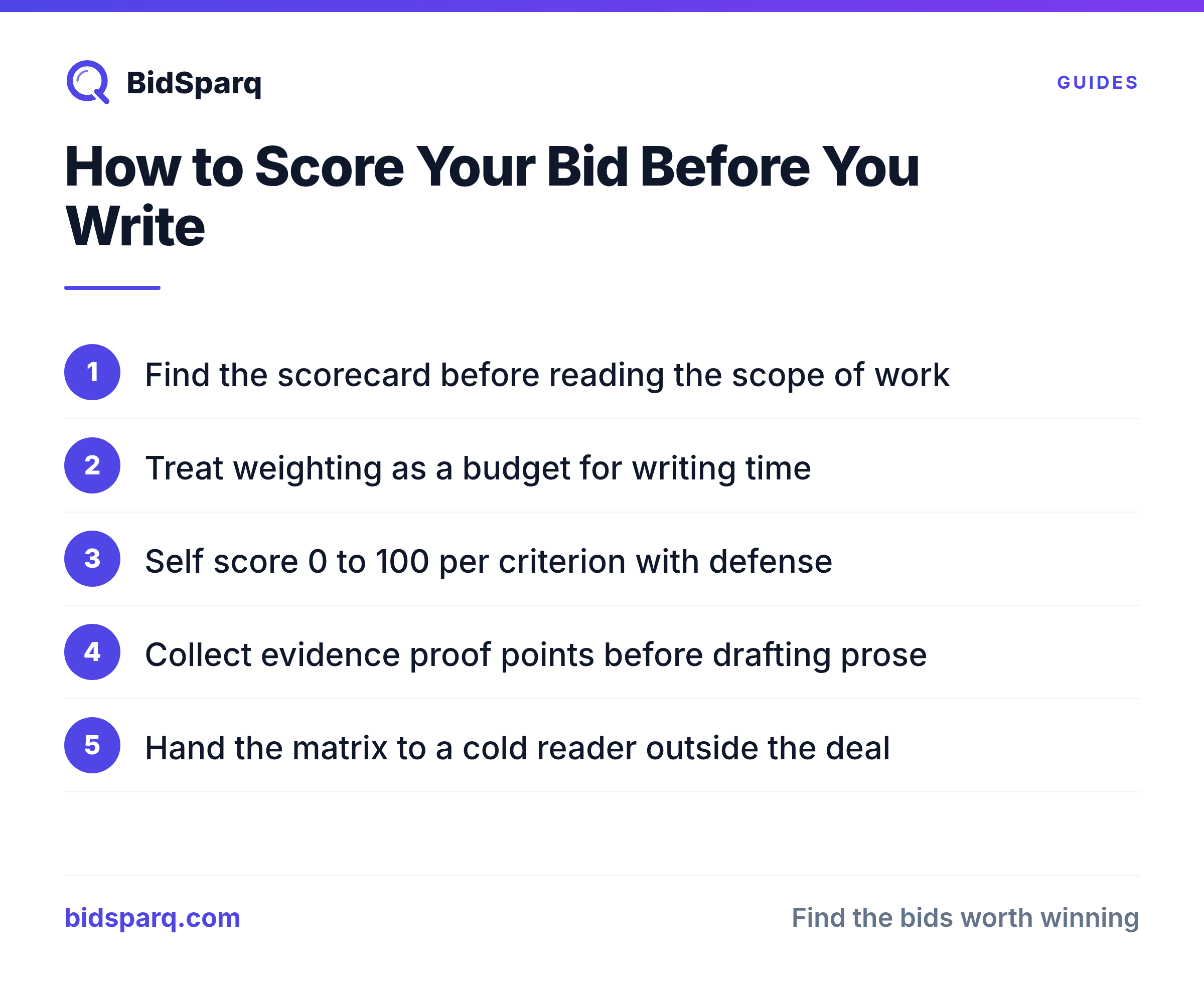
- The evaluation criteria are the answer key. Find that section and read it before you touch the scope of work.
- Weighting is a budget you cannot overspend. Put your writing time where the points actually live, not where you feel most confident.
- Self-scoring beats gut feel. Give every criterion a defensible number from 0 to 100, and your real gaps show up while there is still time to fix them.
- Evidence comes first. Gather the proof, then write the narrative around it, never the reverse.
- A cold reader catches what you cannot. Hand the matrix to someone outside the deal before you submit.
Find the scorecard before you read the scope of work
Open the evaluation criteria section before you read a single line of the scope of work. For a section-by-section map of the rest of the document, see our guide on how to read an RFP. Buyers almost always tell you how they will grade you, usually under a heading like Evaluation Criteria, Basis of Award, Selection Factors, or Scoring Methodology. Pull that section onto its own page before anything else.
Once you have it, the scope reads differently. A line about integration stops being a checkbox and becomes a weighted block of points. A two-sentence aside about implementation timeline turns into the gap between rank one and rank three. The scope describes what the buyer wants; the criteria decide what the buyer rewards, and most responses quietly lose in the space between the two.
Translate vague criteria into a numeric self-score
Turn every criterion into a 0 to 100 number you can defend out loud. Buyers write in soft language: demonstrated experience, technical approach, past performance with similar scope. Treat that softness as your scoring window rather than an obstacle.
For each criterion, write the score an honest evaluator would give your firm today, then write the one sentence that justifies it. If you cannot write that sentence, the number is guesswork and needs to change.
This is where automation earns its keep. A keyword search can tell you a document mentions your industry, but it cannot tell you whether you fit. BidSparq reads every RFP with semantic matching and compliance extraction across 23,000+ live bid sources, lifts the weighted criteria, and returns a defensible 0 to 100 fit score before you have read page one. It also surfaces incumbent and contract-vehicle intelligence on each opportunity automatically, so your past-performance section starts from who actually holds the work instead of from analysts pasting search results into a spreadsheet by hand.
Treat weighting like a budget you cannot overspend
Match your writing effort to the points each criterion is worth, not to the topics your team finds interesting. If references carry the most points and innovation carries the least, you write three pages of references and one tight paragraph on innovation.
Teams break this rule constantly. They love their differentiator, so it swells to eight pages while the heavily weighted section gets recycled boilerplate. The scorecard does not care what you enjoy writing, so move the words to where the points sit.
When two criteria carry equal weight, favor the one a non-expert evaluator can score fastest and stack your proof there. Sections that are easy to score tend to collect points, while sections that force the reader to hunt collect doubt instead. A tired evaluator rewards clarity over effort every time.
Build evidence files before you write prose
Collect proof points before you draft a single sentence of the response. For each criterion, open a small file and dump everything you have into it: reference letters, implementation timelines from past contracts, security certifications, named clients in the same vertical, and the specific metrics that make each one credible.
Sort each file by how directly it answers the criterion, and flag the gaps early, because a criterion with an empty evidence file is a scoring hole you need to know about now rather than in the final hours before submission. Add incumbent context wherever it exists. Knowing who currently holds the work, and on which contract vehicle, reshapes the entire past-performance section and tells you whether you are unseating a strong incumbent or filling a gap they left open.
With the evidence stacked first, the prose almost writes itself, and the evaluator gets concrete proof in place of adjectives.
Get a stranger to score you cold
Hand your self-scored matrix to someone who has never seen the deal and ask them to grade you using only the RFP and your draft. This is the highest-value review step in the whole process, and almost nobody runs it.
The person who wrote the proposal cannot score it fairly, because they grade what they meant to say. The evaluator only ever sees what landed on the page. A cold reader working from the criteria, the weights, and the draft will usually land within a few points of the real score. If that number comes back low, you have either a writing problem or a fit problem, and you still have time to fix one of them. If it comes back high, you spend your last days sharpening rather than rewriting.
FAQ
Where do I find the evaluation criteria in an RFP?
Look for a section titled Evaluation Criteria, Basis of Award, Selection Factors, Scoring Methodology, or Section M in federal-style documents. In healthcare and education RFPs it often sits near the end, sometimes inside an appendix. If you cannot find it after a careful read, ask the buyer during the questions period. A buyer who will not disclose how the response is scored is one to approach with caution.
What is a typical RFP scoring scale?
Most public and enterprise RFPs use a 0 to 100 scale split across four to seven weighted criteria. Some use a 1 to 5 or 1 to 10 score per criterion that rolls up to a weighted total. Either way the math is the same: criterion score times weight, summed across all criteria. Always convert to a single 0 to 100 number for your own use, so you can compare deals against each other and against a clear go or no-go threshold.
Should I bid if my self-score comes back low?
Usually no. A low self-score means at least one heavy criterion is hurting you, and the cost of writing a full response rarely pays back. The exception is a strategic account where you are willing to lose this round to position for the next one. In every other case, the highest-value use of that proposal week is finding two better-fit opportunities and bidding those instead. Choosing not to bid is a strategy, not a failure.
Stop pouring proposal weeks into bids you were never positioned to win. Create a free account and pull an automated fit score on the next RFP in your queue, no credit card required. Move up to Pro Max at $249 a month ($199 billed annually) once you are tracking more bids than you can score by hand.
Find RFPs that match your business
BidSparq monitors 23,000+ procurement sources and uses AI to score every opportunity against your capabilities. Try it free for 14 days.
Start Free Trial →