Commercial Construction RFP Template for GCs and Owners
Copyable commercial construction RFP templates for contractors responding and owners issuing to GCs, plus a compliance matrix and delivery-method adjustments.
This post gives you two copyable commercial construction RFP templates: a 10-module response library for contractors and a 9-section skeleton for owners issuing an RFP to general contractors. You need them because most commercial construction proposals are lost before anyone opens the pricing tab. A missing bid bond, an addendum nobody acknowledged, or an outline that ignores how the owner scores can sink a contractor with the strongest team in the field. A template takes care of the drafting. The harder part is finding the right packages and reading every requirement before they close, and that is where most estimating teams run out of hours.
- The owner's format always wins. Renumber your modules to match the submission instructions, even when your own order reads better.
- Delivery method changes the template more than project type does. Hard-bid, CM at-risk, and design-build each move a different module to the front.
- Two or three matched projects outweigh a full portfolio. Pick past work that shares the owner's occupancy type and delivery method, and cut the rest.
- Owners get comparable bids only when they set the pricing format. An RFP without a required pricing form brings back responses that can't be compared side by side.
- Screen bonding, insurance and licensing thresholds first. Make the go or no-go call on those before an estimator spends an hour on scope.
The short answer
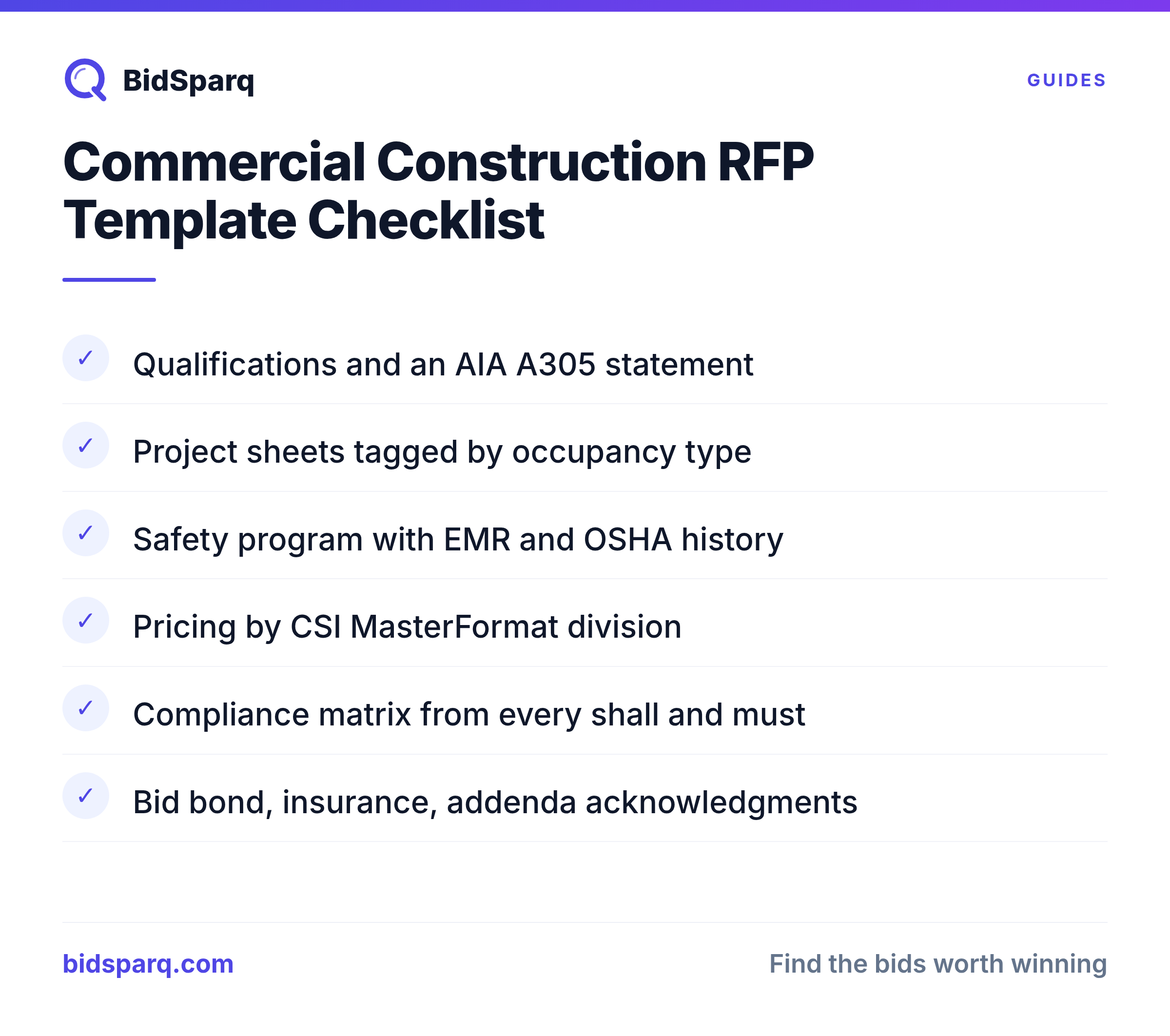
Treat a commercial construction RFP template as a modular library, not a finished document. On the contractor side, keep standing modules for qualifications, experience, approach, safety, personnel, subcontracting, pricing and forms, and rebuild the outline for every bid from a compliance matrix of the owner's "shall" and "must" statements. On the owner side, a usable RFP to general contractors defines scope, schedule, submission rules, weighted evaluation criteria, minimum qualifications, bonding and insurance, contract form, and a mandatory pricing format. Whichever side you are on, the delivery method decides which sections carry the most weight.
Copy this commercial construction RFP template (responding as a contractor)
Paste these 10 modules into your proposal library, fill each one once, then keep it current. Private developers, property managers, hospital systems, and public owners ask for broadly similar content but order and weight it differently, so each numbered block has to stand on its own.
- Cover Letter: [Owner name], [Project name], [Two sentences restating the owner's goals], [One sentence on why your firm fits], [Signatory, title]
- Executive Summary: [Owner's top three priorities from the RFP], [How your approach addresses each], [Your single strongest differentiator for this project]
- Company Qualifications: [License numbers and states], [Bonding capacity, single and aggregate], [Years in business], [Financial references], [Current AIA A305 Contractor's Qualification Statement attached Y/N]
- Relevant Experience (one block per project): [Project], [Occupancy], [SF], [Delivery method], [Occupied Y/N], [Contract value], [Completion date], [Owner reference and contact]
- Project Approach and Schedule: [Phasing logic], [Long-lead items and procurement plan], [Schedule format requested], [Site logistics and access constraints]
- Safety Program: [EMR by year], [OSHA recordable history], [Training certifications], [Site-specific safety plan outline]
- Key Personnel: [Project manager and resume], [Superintendent and resume], [Org chart], [Percent of time committed to this project]
- Subcontracting Plan: [Self-performed scopes], [Planned trade partners by scope], [Participation commitments the owner requires]
- Pricing: [Base bid], [Alternates], [Allowances], [Unit prices], [Fee and general conditions if requested], [CSI MasterFormat division breakdown if requested]
- Forms and Exceptions: [Bid bond], [Addenda acknowledgments], [Insurance certificates], [Signed bid form], [Exceptions to AIA A101 and A201 or ConsensusDocs terms]
Pair the modules with a compliance matrix. Every "shall" or "must" in the package becomes one row, and the matrix works as both your outline and your final QA checklist. Give every reusable module an owner and a last-reviewed date, because stale insurance limits and expired license numbers are the cheapest way to lose.
| RFP reference | Requirement | Type | Response location | Assigned to | Status |
|---|---|---|---|---|---|
| [Instructions to Bidders, para. X] | Submit bid bond of [X]% of base bid on the owner's form | Must | Module 10, p. [#] | [Estimator name] | [Open or Done] |
| [Addendum #, item X] | Acknowledge all addenda on the bid form | Must | Module 10, bid form | [Estimator name] | [Open or Done] |
| [Evaluation criteria, section X] | Describe phasing plan for occupied building | Scored | Module 5, p. [#] | [PM name] | [Open or Done] |
Owner-side commercial construction RFP template (issuing to GCs)
Use this skeleton when you are the owner, developer, or facilities lead asking general contractors to propose. An RFP that leaves sections out gets back a stack of brochures that can't be compared. An RFP that spells out each section gets back responses you can score line by line.
1. PROJECT OVERVIEW
   Owner: [Name, entity type]
   Project: [Name, address, occupancy type, approx. SF]
   Goals: [Three priorities, e.g. schedule, budget certainty, occupied-building operations]
   Delivery method: [Hard-bid / CM at-risk / Design-build]

2. SCOPE OF WORK
   [Narrative scope], [Drawings and specs list or design criteria],
   [Owner-furnished items], [Exclusions], [Phasing or occupied-area constraints]

3. SCHEDULE
   RFP issued: [Date]   Site walk / pre-bid: [Date, mandatory Y/N]
   Questions due: [Date]   Final addendum: [Date]
   Proposals due: [Date, time, time zone]   Interviews: [Date range]
   Notice to proceed: [Date]   Substantial completion: [Date]

4. SUBMISSION RULES
   [Format: portal / sealed / email], [Page limits], [Required order of sections],
   [Single point of contact], [Late or incomplete submissions policy]

5. WEIGHTED EVALUATION CRITERIA
   Relevant experience ............ [X]%
   Key personnel .................. [X]%
   Approach and schedule .......... [X]%
   Safety record .................. [X]%
   Price / fee .................... [X]%
   [Interview, if used] ........... [X]%

6. MINIMUM QUALIFICATIONS (pass/fail)
   [License class and state], [Years in business], [Projects of similar type and size],
   [Maximum EMR], [Financial statements or AIA A305]

7. BONDING AND INSURANCE
   Bid bond: [X]% of bid   Performance and payment bonds: [X]% of contract
   Insurance: [CGL limits], [Auto], [Umbrella], [Builder's risk responsibility],
   [Additional insured requirements]

8. CONTRACT FORM
   [AIA A101/A201, A133, A141, ConsensusDocs, or owner form], [Key modifications],
   [How bidders should submit exceptions]

9. PRICING FORMAT
   [Required bid form], [Base bid], [Alternates], [Allowances], [Unit prices],
   [Fee % and general conditions breakdown for CM or DB], [CSI division breakdown]
Two choices matter most. Section 5 has to publish the actual weights, because contractors write to whatever you tell them counts. Section 9 has to be a required form, not a suggestion, or you will spend the evaluation period normalizing numbers. Public owners should also attach prevailing wage, participation, and agency-specific forms as numbered exhibits so bidders can't miss them.
Adapt the template to the delivery method (hard-bid vs CM at-risk vs design-build)
Reorder and reweight your modules for the delivery method before you tailor anything else. The same contractor library produces three very different proposals depending on how the owner buys the work.
- Hard-bid (design-bid-build): The low responsive, responsible bidder usually wins, so Modules 9 and 10 decide the outcome. Keep the narrative sections short or leave them out if they aren't requested. Put your effort into scope coverage, alternates, addenda acknowledgment, and a bid bond on the owner's exact form. One missed compliance row disqualifies the price.
- CM at-risk: Selection is mostly qualifications-based, with fee and general conditions scored as one factor. Lead with Modules 5 and 7: preconstruction services, estimating and value engineering approach, GMP development process, and the superintendent who will actually be on site. Expect an interview, and prepare the team that will build the job, not the business development staff.
- Design-build: The owner is evaluating a team and a solution. Add a design team qualifications block alongside Module 3, expand Module 5 into a design narrative that responds to the bridging documents or performance criteria, and show how your team controls design risk and cost together. Price usually covers the full design and construction scope, so lay out your assumptions in plain language.
Project type decides which story leads within that structure. A medical office renovation inside an operating facility will ask about infection control risk assessment (ICRA) and after-hours work. A multi-site retail rollout cares about consistent unit pricing and a superintendent who can run several stores at once. A tilt-up distribution warehouse depends on schedule certainty and site work. Tag your Relevant Experience module by occupancy and delivery method so you can pull the two or three matching projects in minutes.
Close the loop after every submission, win or lose. Ask for a debrief when the owner allows one, note which sections scored poorly, and fix the module rather than the single proposal. Over time the library turns into a record of what your owners actually reward.
Why the manual search breaks before the template does
Count the hours spent finding and qualifying bids, not just the hours spent writing them. A template makes drafting faster, but someone still has to find each opportunity and read the package closely enough to make a go or no-go call.
The problem is volume. As of November 2026, 53,028 solicitations are open across the 33,000+ sources we track. Of those, 3,390 mention "commercial," with Pennsylvania (345) and California (170) posting the most. That count is a superset: it includes construction work alongside every other solicitation that happens to use the word, so the packages that fit your firm's trades and bonding are a smaller set hidden inside it. And 1,617 "commercial" solicitations close within the next 14 days. No estimating team can open and sort packages that fast, so most firms fall back on a few familiar plan rooms and owner relationships, and the bids they never see go to someone else.
Keyword alerts make the problem worse. An owner looking for a general contractor may write "tenant improvement" or "interior buildout" and never use the words "commercial construction." A keyword search then either misses the bid entirely or buries it under irrelevant hits.
See which open commercial construction packages fit your bonding capacity, with the compliance rows already extracted. Start a 14-day free trial, no credit card.
That is the gap BidSparq is built to close. Semantic matching finds bids by meaning rather than exact words, so a "fit-out of a leased medical suite" shows up for a contractor who builds healthcare interiors even when no keyword matches. Every match carries an AI fit score from 0 to 100. Your estimators get a ranked shortlist they can triage in one sitting instead of a manual crawl through portals.
Requirement extraction feeds the template directly. Bonding thresholds, insurance limits, licensing, and submission rules are pulled from each package automatically, so the first rows of your compliance matrix are drafted before anyone reads page one. If the bonding requirement exceeds your capacity, you know in seconds rather than after an afternoon in the specs. Incumbent and contract-vehicle intel answers the question that matters before you price: is there an entrenched on-call or job order contracting (JOC) contractor already doing this owner's work, or is the field genuinely open?
The same mismatch between package volume and reading time hits education, healthcare, IT, facilities, and professional services teams across the broader procurement market, and the same automated workflow replaces the same manual one there too.
FAQ
What should be included in a commercial construction RFP template?
For contractors responding: a cover letter, executive summary, company qualifications, relevant experience sheets, approach and schedule, safety program, key personnel, subcontracting plan, pricing, and required forms with any contract exceptions, each self-contained so you can reorder it to match the owner's instructions. For owners issuing to GCs: project overview, scope, schedule, submission rules, weighted evaluation criteria, minimum qualifications, bonding and insurance, contract form, and a required pricing format.
How does delivery method change a construction RFP response?
Hard-bid responses depend on price and strict compliance, so the bid form, bond, and addenda matter most. CM at-risk responses lead with preconstruction approach, the field team, and fee. Design-build responses have to present an integrated design and construction team plus a design narrative that answers the owner's performance criteria.
Where can I find commercial construction RFPs to bid on?
Private work comes through owner and developer invitations, plan rooms, and general contractor relationships. Public work is posted on SAM.gov for federal projects, on your state's eProcurement portal, and on individual city, county, and school district procurement pages, and board agendas on platforms like BoardDocs often preview capital projects before they go out to bid. A tool that matches by meaning lets you cover those sources without checking each one by hand.
Get your ranked commercial construction matches free for 14 days, no credit card needed, then point this template at the work worth winning.
Find RFPs that match your business
BidSparq monitors 33,000+ procurement sources and uses AI to score every opportunity against your capabilities. Try it free for 14 days.
Start Free Trial →