The Bid/No-Bid Decision Framework: Stop Chasing RFPs You Can't Win
Learn the proven frameworks top contractors use to decide which RFPs to bid on. Includes a 10-factor scoring matrix, red flags for wired contracts, and the real math behind bid decisions.
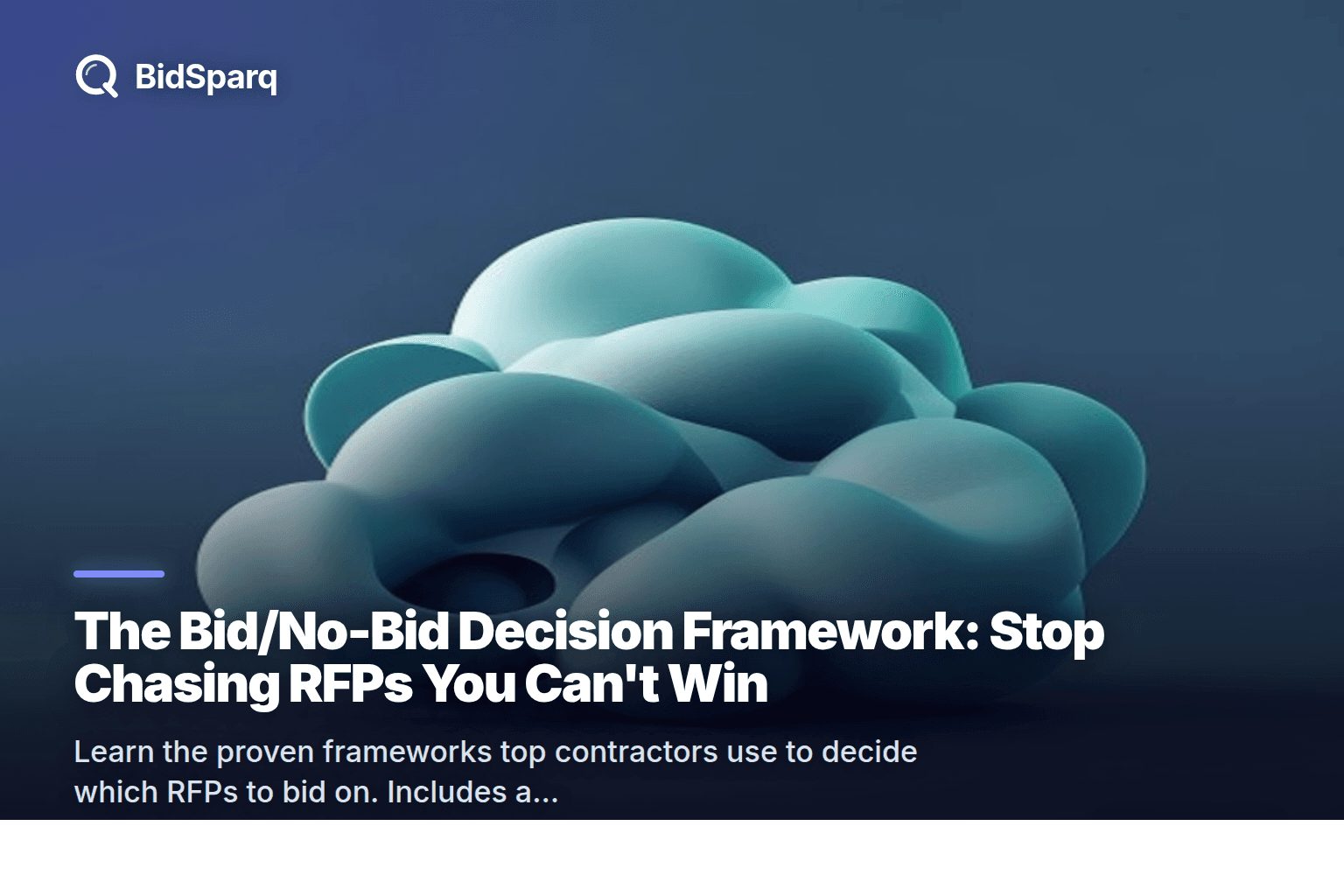
The average government proposal costs $6,000 and 15-20 hours to prepare. If your win rate is 20%: the industry average, you're spending $30,000 in labor for every contract you actually win. That's not a strategy. That's a lottery ticket.
The contractors who grow aren't the ones who bid the most. They're the ones who bid the right ones. A disciplined bid/no-bid process is the single highest-leverage change you can make to your business.
This guide covers four proven frameworks used by experienced government contractors, a unified scoring matrix you can apply today, and the red flags that signal you should walk away.
Why a Bid/No-Bid Process Matters
72% of vendors who regularly win government contracts use a formal go/no-go framework before committing resources to a proposal. The other 28%: the "spray-and-pray" bidders, consistently underperform.
Here's why:
- Opportunity cost is real. Every hour spent on a low-probability bid is an hour not spent on one you could win.
- Proposal quality drops with volume. Spreading your team across 10 proposals means none of them get the attention they deserve.
- Bidding everything signals desperation. Evaluators can tell when a proposal was rushed or generic.
"A small contractor can decline to bid an opportunity that doesn't fit. A prime is locked into bidding everything. By the end of the year the small contractor has written four proposals and won two. The prime has written twenty and won one. Same revenue, very different ratio." (r/GovernmentContracting)
Four Proven Bid/No-Bid Frameworks
We analyzed frameworks from experienced contractors, proposal consultants, and federal CORs. Here are the four most widely used approaches, each with a different level of depth.
Framework 1: The 5-Criteria Quick Screen
This framework comes from a highly-rated post on r/GovernmentContracting (score=83) and is designed for quick initial screening. For each criterion, look for red flags:
| Criterion | What to Check | Red Flag |
|---|---|---|
| Past performance relevance | Do you have directly relevant experience? | "We could do this" instead of "We have done this" |
| Personnel and clearances | Are key staff identified and available on Day 1? | Planning to recruit after award |
| Incumbent visibility | Who holds this contract now? Check USASpending. | Same vendor won 2+ recompetes |
| Timeline vs. scope | Is the response time proportionate to the work? | Short deadline on complex scope (someone had a head start) |
| Scope vs. dollar ratio | Is the statement of work detailed enough for the value? | Thin PWS on a large-dollar contract (incumbent-shaped) |
The rule: Stack three or more red flags on the same opportunity and your win probability drops to near zero. Walk away.
Framework 2: The 10-Factor Scoring Matrix
This more comprehensive framework, adapted from proposal consultant Ray Makela's methodology, scores each factor on a 1-5 scale. It forces you to quantify your gut feeling.
| Factor | Score (1-5) | What It Measures |
|---|---|---|
| Account value | 1-5 | Future revenue potential beyond this single contract |
| Advance warning | 1-5 | Did you know about this before the formal RFP dropped? (Blind RFP = column fodder) |
| Decision maker access | 1-5 | Relationships with real stakeholders, not just the procurement office |
| Discovery process | 1-5 | Is genuine dialogue possible? Can you ask questions? |
| Fit | 1-5 | Directly relevant track record and referenceable customers |
| Competition | 1-5 | Who you're up against and your historical win rate against them |
| Decision criteria clarity | 1-5 | Do you understand how they'll actually score proposals? |
| Solution presentation | 1-5 | Will you get a verbal presentation, or is it written-only? |
| Deadlines | 1-5 | Is the timeline reasonable? Unusually tight deadlines often signal a predetermined winner. |
| Red flags | 1-5 | Competitor-specific language in requirements? Brand names? Suspiciously narrow specs? |
Maximum score: 50. If you score below 35, it's a no-go. If you aren't scoring 4s and 5s on most categories, your chances are low and your resources are better spent elsewhere.
Framework 3: The 3-Gate Qualification
This framework, used by procurement analytics firms, is a sequential filter. You must pass each gate before moving to the next:
- Gate 1: Capability: Does the project align with your core capabilities? If no, stop immediately.
- Gate 2: Eligibility: Do you have the required certifications, past performance, and set-asides? If no, stop.
- Gate 3: Resources: Do you have the team, time, and bandwidth to produce a quality response? If no, stop.
Only after passing all three gates do you move to competitive analysis: How strong is the incumbent? What's your unique value proposition? Is the ROI worth it at an average cost of $6,000 per response?
Framework 4: The 6-Dimension Assessment
This framework evaluates six dimensions of bid attractiveness:
| Dimension | What It Measures |
|---|---|
| Strategic fit | Does this contract align with your ideal customer profile and growth direction? |
| Prior buyer relationship | Warm lead (3-5 bidders) vs. cold RFP (dozens of bidders)? |
| Competitive positioning | Are you a known quantity to this buyer, or a complete stranger? |
| Financial attractiveness | Contract value vs. cost to respond. Is the math worth it? |
| Resource availability | Can you deliver a quality response without burning out your team? |
| Compliance | Insurance, certifications, geographic requirements, security clearances |
The Unified Bid/No-Bid Criteria
Across all four frameworks, the same themes emerge. Here are the 10 dimensions that matter most, ranked by how many frameworks include them:
| Dimension | Frameworks That Include It | Verdict |
|---|---|---|
| Capability/technical fit | All 4 | Non-negotiable: if you can't do the work, don't bid |
| Compliance and eligibility | 4 of 4 | Certs, set-asides, clearances: hard requirements |
| Win probability | 3 of 4 | Honest assessment of your odds vs. incumbent |
| Prior relationship | 3 of 4 | Cold RFPs have dramatically lower win rates |
| Deadline reasonableness | 2 of 4 | Unreasonable timelines signal a predetermined winner |
| Resource availability | 2 of 4 | A rushed proposal loses to a polished one |
| Competition level | 2 of 4 | 5 bidders vs. 50 bidders = very different math |
| Financial ROI | 2 of 4 | $6K response cost vs. contract value |
| Budget transparency | 2 of 4 | Hidden budgets = risk of scope/price mismatch |
| RFP quality/clarity | 2 of 4 | Vague requirements = change orders or disputes |
Red Flags: How to Spot a Wired Contract
A "wired" or "pre-wired" contract is one where the agency already has a preferred vendor. The RFP exists to satisfy procurement rules, but the outcome is essentially predetermined. Experienced contractors estimate that 20-30% of opportunities show wired characteristics.
Watch for these signals:
- Unusually specific requirements. If the spec reads like it was copied from one vendor's product sheet, it probably was.
- Very short response window. A complex RFP with a 5-day turnaround means someone had advance notice.
- Same incumbent, multiple recompetes. Check USASpending: if the same vendor has won this contract 2+ times, the relationship is deep.
- Brand names in the spec. "Must be compatible with [specific product]" narrows the field intentionally.
- Thin statement of work on a large contract. When a $5M contract has a 2-page PWS, the buyer already knows who they want: they don't need to specify because the winner already understands the work.
- No pre-bid conference or Q&A. Agencies that want competition hold industry days. Agencies going through the motions skip them.
"Stop writing proposals you were never going to win." (A sentiment echoed across hundreds of contractor discussions online)
The Math Behind Your Bid Decision
Here's a simple formula to pressure-test any bid decision:
Expected Value = Win Probability x Contract Value - Response Cost
Example scenarios:
| Scenario | Win Prob. | Contract Value | Response Cost | Expected Value | Decision |
|---|---|---|---|---|---|
| Strong fit, warm lead | 40% | $500K | $8K | $192K | Bid |
| Decent fit, cold RFP | 15% | $200K | $6K | $24K | Borderline |
| Stretch capability, wired signals | 5% | $1M | $12K | $38K | No-bid (too risky) |
| Perfect fit, sole source eligible | 70% | $150K | $4K | $101K | Bid aggressively |
Notice the third scenario: even though the contract is worth $1M, a 5% win probability and $12K response cost makes it a bad bet. The expected value looks decent on paper, but you'll need to bid on 20 of these to win one: that's $240K in proposal costs for one $1M win.
How to Build Your Bid/No-Bid Process
You don't need a complex system. Start with these three steps:
Step 1: Set Your Minimum Criteria
Define your hard-stop filters. These are non-negotiable: if the RFP fails any of these, don't bid:
- Must match your NAICS codes
- Must meet your set-aside eligibility (or be full and open)
- Must be in your geographic service area (or remote-eligible)
- Must have a response deadline you can meet with quality work
- Minimum contract value worth your time (e.g., $50K+)
Step 2: Score the Opportunity
For RFPs that pass your minimum criteria, use the 10-factor scoring matrix above. Be honest: optimism bias is the biggest killer of proposal ROI.
Step 3: Check for Wired Signals
Before committing resources, spend 15 minutes on due diligence:
- Search the agency on USASpending.gov: who holds the current contract?
- Check FPDS for the contract history: how many times has it been recompeted?
- Read the RFP carefully for brand names, unusually specific requirements, or references to existing systems
- Note the release-to-due timeline: is it proportionate to the scope?
How BidSparq Automates Your Bid/No-Bid Process
BidSparq's AI scoring applies bid/no-bid intelligence automatically to every RFP in your feed:
- AI Match Score (0-100): Rates every opportunity against your business profile, NAICS codes, and capabilities
- "Should I Bid?" Verdict: Clear Bid / Borderline / Pass recommendation based on fit analysis
- Competitive Intelligence: Shows incumbent contractors from USASpending and FPDS data, so you can spot recompete patterns
- Compliance Checklist: Extracts mandatory requirements so you can quickly check eligibility
- Set-Aside Filtering: Automatically matches your certifications (8(a), HUBZone, SDVOSB, WOSB) to eligible opportunities
Instead of manually screening hundreds of opportunities, you review a scored, ranked feed where the AI has already flagged the ones worth your time.
Next Steps
- Start your free trial: see AI-scored RFPs matched to your business before paying anything
- Before you decide to bid, you need to find the right RFPs: our complete guide covers every source
- Read our guide on writing a winning proposal for the RFPs you decide to bid
- Learn about set-aside programs that can improve your win rate on eligible contracts
- Understand NAICS codes and how they affect which RFPs you see
Find RFPs that match your business
BidSparq monitors 23,000+ procurement sources and uses AI to score every opportunity against your capabilities. Try it free for 14 days.
Start Free Trial →