Best Value Federal Source Selection: Win on More Than Price
A practical guide to best value federal source selection: how tradeoff evaluations really score a win, and how to compete on merit instead of the lowest number.

Two proposals sit open on an evaluator's screen. One quotes 1.2 million dollars, the other quotes 1.45 million, and the higher number is about to win. If that outcome feels backward, you are reading the wrong contest. In a best value federal source selection, the buyer is not shopping for the cheapest compliant bid. The buyer is deciding what added technical merit, past performance, and lower risk are worth paying for, and the team that never proves that math loses to a competitor who quoted more.
The fix is not a lower price. It is showing, in the evaluator's own terms, why your higher number is the better deal. Here is how the scoring actually works and where to spend your effort.
- Best value is a tradeoff, not a race to the cheapest compliant bid.
- The solicitation sets the rules, so read Sections L and M and the evaluation factors before you write a word.
- Non-price factors decide most tradeoff awards, which makes technical approach and past performance the real battleground.
- Unaddressed requirements read as risk, and risk quietly lowers your score.
- Value has to be provable, not asserted, or the evaluator defaults to price.
- Fit comes first, because chasing bids you cannot win burns the hours you need for the ones you can.
Best value shows up across the whole procurement market
Recognize that serious buyers everywhere already pay for value, and federal is just the vertical that writes the rules down. A hospital system replacing imaging equipment scores warranty, uptime, and service response next to cost. A school district picking a food-service partner weighs nutrition standards and delivery reliability, not only the per-meal rate. A commercial owner selects a general contractor on schedule risk and safety record, sometimes over a cheaper bidder. Federal source selection formalizes those same instincts into a published rulebook, which helps you because the discipline you build for one procurement transfers straight to the next.
Know which tradeoff process you are actually in
Read the solicitation to learn exactly how price and non-price factors will be compared. The phrase best value hides two very different processes. FAR 15.101-2 governs lowest price technically acceptable, where the cheapest offer that clears the minimum bar wins and extra polish is wasted effort. FAR 15.101-1 governs the tradeoff process, where the government can and often does pay a premium for a stronger offer, so your proposal has to justify the difference. Section M states which approach applies and the relative weight of each factor, for example whether technical merit is significantly more important than cost or roughly equal to it. Guessing wrong shapes the entire proposal in the wrong direction, so confirm this first and assume it last.
Win the non-price factors, then document the tradeoff for the evaluator
Treat technical approach and past performance as where the award is really decided, and make the evaluator's tradeoff easy to write. When cost is one factor among several, the offer that reads as lower risk usually wins even at a higher price. Under FAR 15.308, the source selection authority has to document a rationale for any tradeoff, including why a higher rated, higher priced offer is worth the extra cost. Give them that language. If you propose a senior engineer where competitors staff a junior, spell out the hours saved and the rework avoided so the evaluator can lift your own words into the award decision. For example, an offer that costs a few percent more while carrying documented lower schedule risk hands the evaluator a defensible reason to pay the premium. Vague strength statements do nothing. Specific, evidence-backed ones move your score.
Turn the evaluation criteria into a compliance map
Map every stated requirement to a specific place in your proposal before you draft anything. Evaluators score against a checklist built from Sections L and M, and anything they cannot find is treated as missing, which reads as risk. A compliance matrix is the fix. Each row ties one requirement to the solicitation citation and the exact spot in your response that answers it:
| Requirement | Solicitation cite | Proposal location | Evidence |
|---|---|---|---|
| NIST SP 800-171 cybersecurity compliance | Section C.3.2, Section L.4 | Volume II, 4.1, page 22 | System Security Plan plus SPRS score |
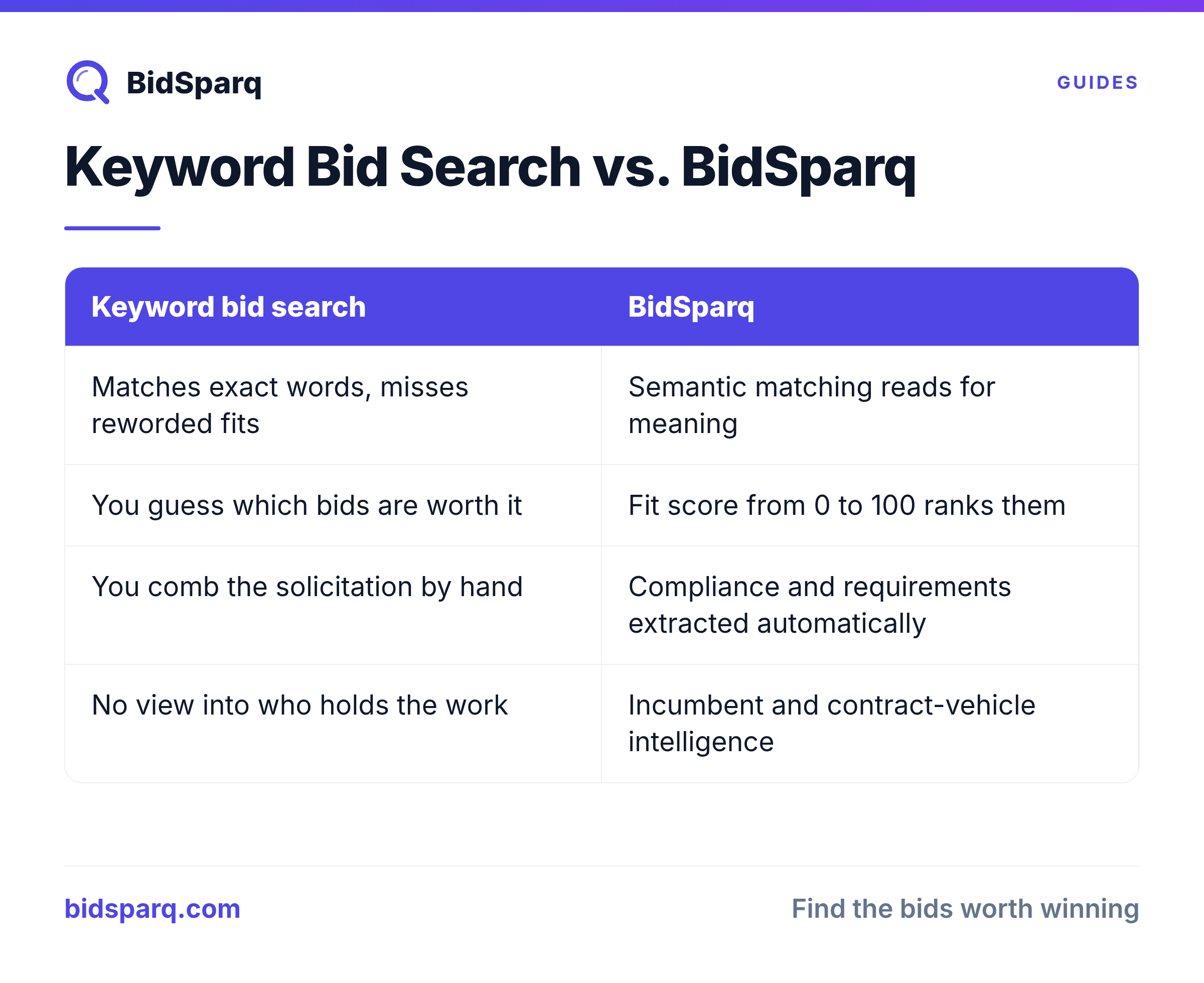
On an eighty page solicitation, building that matrix by hand is slow and easy to fumble, and one overlooked mandatory clause can sink an otherwise winning bid. This is where automation earns its keep. BidSparq extracts the compliance and requirement language from a solicitation automatically, so instead of combing the document line by line you start with a structured list and build your outline around it. The free tier lets you run a live solicitation through it, and the platform monitors 23,000+ sources for those documents in the first place, so you can check the extraction against your own eyes before you trust it. Fewer gaps mean fewer easy points handed to the competition. See how automated requirement extraction and fit scoring works.
Spend your hours on bids you can actually win
Stop chasing every opportunity and start with the ones that fit. Best value proposals are expensive to produce, so pursuit discipline is strategy, not an afterthought. Keyword alerts flood you with near matches and miss the ones worded differently, so you either drown in noise or overlook real fits. Semantic matching reads for meaning instead of exact terms, so a relevant opportunity surfaces even when its wording does not line up with yours. A fit score from 0 to 100 then ranks what is left, and incumbent and contract-vehicle intelligence tells you whether an award is genuinely contestable before you commit a team. That is the difference between automated bid discovery and a spreadsheet full of maybes.
FAQ
What does best value mean in federal source selection?
It means the government awards the contract that offers the best combination of price and non-price factors such as technical merit, past performance, and risk, rather than automatically choosing the lowest bid. The relative importance of each factor is defined in the solicitation.
What is the difference between LPTA and tradeoff source selection?
Under lowest price technically acceptable, described in FAR 15.101-2, the cheapest offer that meets the minimum requirements wins, so exceeding them adds no value. In a tradeoff under FAR 15.101-1, the buyer can pay a premium for a stronger proposal, so demonstrating superior merit and lower risk can justify a higher price.
How do I write a proposal that wins on best value instead of price?
Confirm the evaluation approach first, then map every criterion to a section of your response, write technical and past-performance content in the evaluator's terms, and back every claim with evidence. The aim is to make the added cost of your offer clearly worth it, and to hand the evaluator the language they need to document the tradeoff.
Compete on value, not just the number. Start with the opportunities you can actually win, drawn from 23,000+ sources and ranked by fit, on a free tier that needs no credit card. See your matches free.
Find RFPs that match your business
BidSparq monitors 23,000+ procurement sources and uses AI to score every opportunity against your capabilities. Try it free for 14 days.
Start Free Trial →