RFP Executive Summary: Win the Evaluator in 90 Seconds
Write an RFP executive summary that wins the evaluator in 90 seconds. A practical playbook for the one page that decides your proposal across every procurement market.
One page decides whether the rest of your proposal gets a fair read. That page is the executive summary, and an overloaded evaluator opens straight to it, sorts the pile by first impression, and leans on that snap judgment far more than any scoring guide will admit.
This holds across the whole procurement market: education, healthcare, construction, IT, and commercial buying, with government as one vertical among many. Your summary is the page that earns you the rest of the read, and most teams squander it on a brochure.
Here is what actually wins it.
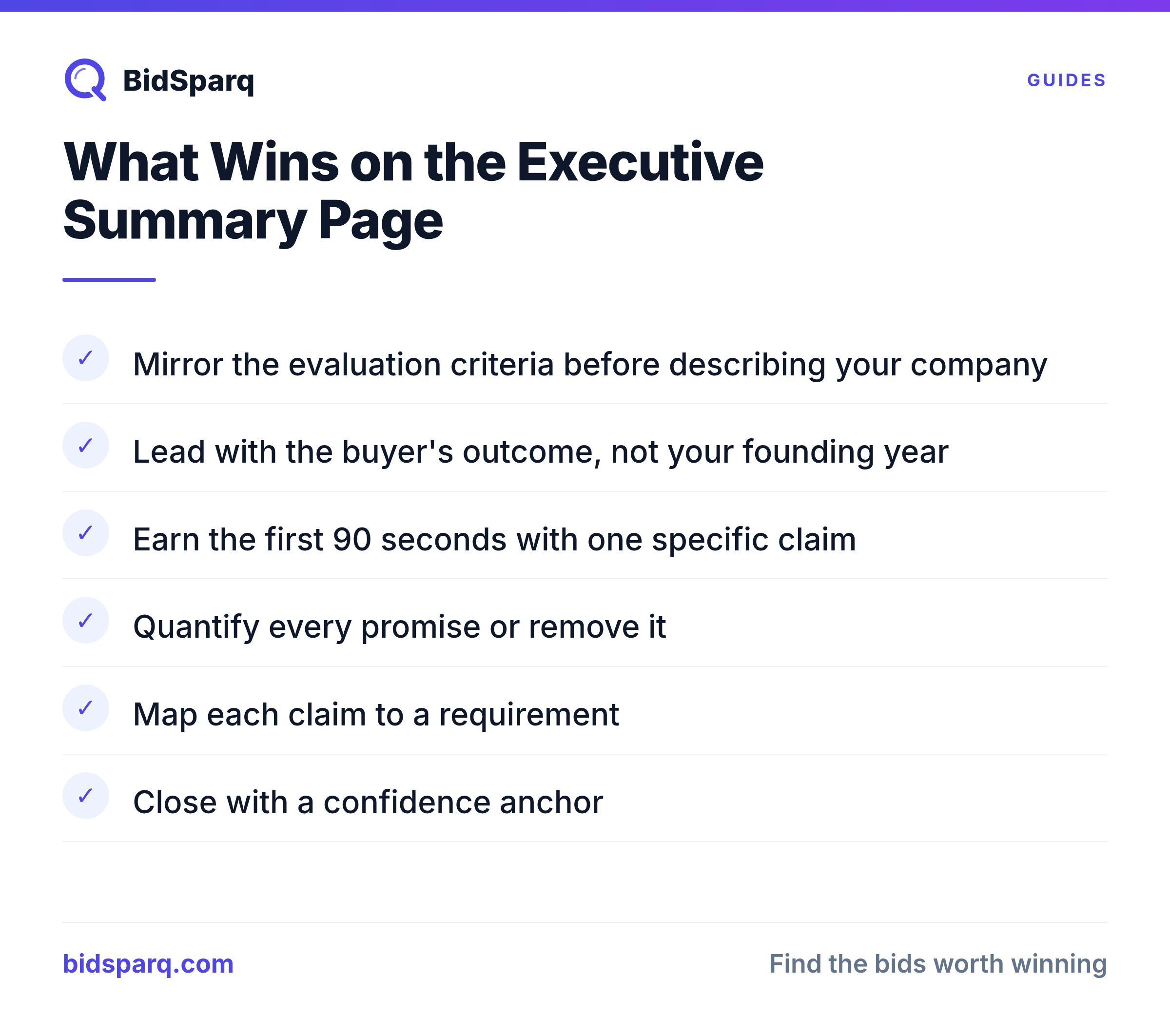
Key Takeaways
- Mirror the evaluation criteria before you write a single word.
- Lead with the buyer's outcome, not your company history or your awards.
- Win the first 90 seconds with one specific claim aimed at their biggest worry.
- Quantify every promise or cut it, because vague verbs cost more points than missing ones.
- Map each claim to a scored requirement so the evaluator never has to translate.
- Close with a line the committee can forward without edits.
Why the Executive Summary Decides Your Proposal
Treat the executive summary as the only page that gets read, because for many evaluators it is. A hospital system and a county public works office weight their scorecards differently, yet their evaluators behave the same way: they reach the summary before pricing or case studies, and they use it to decide where the rest of their attention goes. Read like a brochure and you lose a silent first round that never shows up scored.
The page also travels, and different readers mine it for different lines:
- The CFO skims the summary and little else.
- The technical buyer jumps from it straight into your approach section.
- The procurement lead forwards the strongest sentence to the committee.
Write it so each of those readers finds the one line built for them inside the first paragraph, because there is no follow-up meeting to clarify what you meant.
How to Reverse Engineer It From the Scorecard
Build the executive summary from the evaluator's rubric, not from your boilerplate. Open the RFP, find the section that lists evaluation criteria and weighting, and treat it as your outline. The proportions of your summary should match the proportions of the scorecard:
- If technical approach is forty percent of the score, it earns the first and longest paragraph.
- If price is fifteen percent, it earns a sentence, not a section.
- If a criterion carries no weight, it does not belong on the page at all.
Most teams skip this step because the boilerplate is already drafted and the deadline is tonight. Winners lay the rubric beside the draft and confirm that every weighted criterion has a sentence pointed straight at it. The gaps you find are the same points your competitors are leaving on the table.
How to Structure One for a 90-Second Read
Give the evaluator a structure they can scan in 90 seconds, because that is the real budget you have. A summary that wins reads in a predictable order: six short beats on one page, no detours.
- The buyer's outcome, in their own words, in the first sentence.
- Proof you can deliver it.
- The differentiator that maps to their rubric.
- The risks you have already retired.
- Your price posture, stated plainly so no one has to hunt for it.
- The next step.
Then stress-test the draft. Read it once at reading speed and once at a fast skim. If the skim still carries the argument, an evaluator can use the page under pressure. If the outcome, the price posture, or the next step disappears on the skim, the page is not finished, however polished the prose looks.
Words That Quietly Cost You Points
Strip every word the evaluator cannot score. Points go to evidence, not adjectives, so the following are dead weight on a page where every line competes for space:
- World class, best in breed, innovative, robust, synergistic. Each one is a quiet confession that no number was ready.
- Acronyms the evaluator does not already use.
- Any sentence that opens with "we are excited to." The evaluator is not excited. The evaluator is behind and reading against a clock.
Replace each one with a measurable claim or delete the sentence outright. Writing for the score instead of for your own comfort already sets you apart from half the pile.
How to Close a Summary the Evaluator Can Forward
Close with a sentence the evaluator can paste into their internal recommendation. That is the test. Read your final line aloud and ask whether a procurement lead could drop it into an email to the committee without touching a word. If it sounds like the opening of a sales call, rewrite it before you submit.
The proposals that win are rarely the longest. They are the ones whose summary did the evaluator's job for them, in language the committee can repeat back. Write that page first, and write it as if nothing else will be read.
FAQ
How long should an RFP executive summary be?
One page is the target and two pages is the ceiling. If the RFP specifies a length, respect it exactly. If it does not, hold to one page of dense, scannable prose that mirrors the evaluation criteria in the order the buyer ranked them.
What should the first sentence say?
Name the buyer's outcome in their own words. Not your company name, not a thank-you for the opportunity. Open with the result they wrote into their statement of need, and signal that the page will prove you can deliver it.
What parts of the summary can I automate?
You can automate the mechanical work: finding the right RFPs, extracting evaluation criteria and mandatory clauses, and scoring whether a bid deserves a bespoke summary at all. You cannot automate the argument. The sentence that names the buyer's outcome is still yours to write. Tooling only tells you which bids are worth that effort and hands you the scorecard before you start.
Stop Hunting and Start Writing
Automate the mechanical work so your team can spend its hours on the argument. Every hour spent hunting for the right RFP and decoding its requirements by hand is an hour stolen from the one page that wins it. That is exactly the gap that automated RFP discovery, compliance extraction, and fit scoring close. BidSparq aggregates 23,000+ distinct bid sources daily, spanning public agencies and private enterprise buyers alike, then does the decoding for you.
Two capabilities carry most of the weight, and in both the contrast with manual keyword search is the whole point:
- Semantic matching surfaces opportunities by meaning rather than by keyword guess, so your queue fills with bids you can actually win instead of ones a stray synonym happened to hit.
- Compliance extraction pulls scoring weights and mandatory clauses straight out of the document, work that by hand means a slow afternoon of highlighters and spreadsheets.
Two more layers turn that queue into triage. A 0-100 fit score tells you at a glance which opportunities deserve a bespoke summary and which to skip, so you stop burning unpaid hours on dead ends. Incumbent intelligence shows who holds the contract today and how the renewal is trending, so you can aim the page at the gap the incumbent leaves open. With 23,000+ sources refreshed daily, that scoring does real prioritization instead of ranking a thin list.
Put your hours back into the argument, not the hunt. The Free tier covers discovery, and Pro Max at $249 a month ($199 a month billed annually) adds deeper compliance extraction, fit scoring, and the full incumbent intelligence layer. No credit card required. Start free and see your RFP matches in minutes.
Find RFPs that match your business
BidSparq monitors 23,000+ procurement sources and uses AI to score every opportunity against your capabilities. Try it free for 14 days.
Start Free Trial →