RFP Analysis: How to Read an RFP and Catch Every Requirement
A practical RFP analysis method for any procurement: government, healthcare, construction, IT, or commercial. Extract requirements, spot deal-breakers early, and avoid the mistakes that get bids disqualified.
A dense RFP can run well past 100 pages, and a single missed requirement, wrong submission format, or overlooked amendment is enough to disqualify an otherwise winning bid. RFP analysis solves this: instead of reading front to back, you extract what matters in a fixed order, eligibility first, then how the bid is scored, then the mandatory requirements, then the full scope of work.
- RFP analysis means reading in a fixed order, not front to back: eligibility, scoring, mandatory requirements, then scope.
- A five-minute eligibility screen kills bad-fit bids before they cost you 15 to 20 hours.
- Extract every "shall" and "must" into a compliance matrix; each unmet mandatory line is a disqualification risk.
- The scoring section tells you where to spend effort so you write straight to the points buyers actually award.
- The method fits any RFP: government, healthcare, construction, IT, or commercial. Only the labels change.
- Automated RFP analysis extracts requirements and scores fit in minutes instead of hours.
The RFP Analysis Method: Five Focused Passes
Read every RFP in five targeted passes instead of one linear slog, because each pass answers a different question and lets you quit early when the fit is wrong. Trying to absorb everything in a single read is how mandatory details get lost. These passes work for a federal solicitation, a hospital system's vendor RFP, or a commercial IT bid alike.
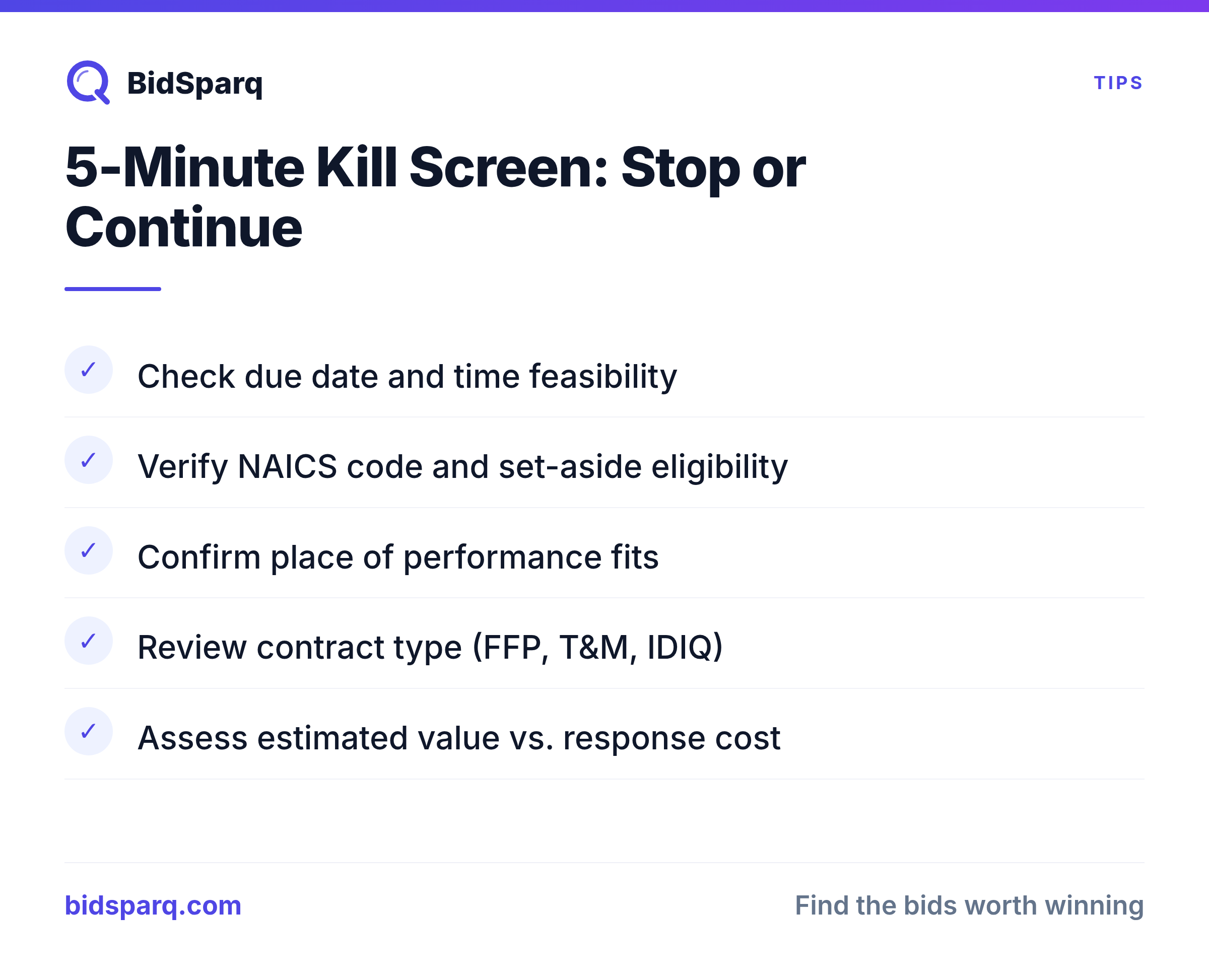
Pass 1: The Five-Minute Eligibility Screen
Before investing real time, answer the kill-or-continue questions:
- Deadline. Can you produce a quality response in the time available? A 500-page RFP with a five-day turnaround is a red flag that someone likely had advance notice.
- Eligibility. Do you meet the buyer's threshold requirements? For federal bids that means NAICS codes and set-aside status; in healthcare, construction, or commercial RFPs it usually means certifications, prequalification, or approved-vendor status.
- Place of performance. Can you deliver where the work needs to happen?
- Contract type. Fixed-price, time-and-materials, or a large multi-award vehicle? Does it fit your business model?
- Estimated value. Is the prize worth the cost to chase it? If the contract is worth $30K and your response costs $6K to prepare, the math rarely works.
If any answer is a clear no, stop. You just saved 15 to 20 hours.
Pass 2: How the Bid Is Scored
Jump straight to the scoring section (Section M in federal RFPs, often labeled evaluation criteria or award methodology in commercial ones). This tells you where to spend your effort:
- Scoring factors and weights. "Technical approach 40%, past performance 30%, price 30%" tells you to invest most of your effort in the technical response.
- Lowest-price vs best-value. Some buyers award to the cheapest compliant bid; others weigh quality, approach, and experience. Your whole strategy changes based on which it is. Federal RFPs formalize this as lowest-price-technically-acceptable versus best-value.
- Mandatory vs desirable. Mandatory means comply or be disqualified. Desirable means bonus points.
- Page limits. These constrain your response and force you to prioritize.
Pass 3: Mandatory Requirements
Now read for compliance. Extract every "shall," "must," "required," and "mandatory" statement. These are your non-negotiables:
- Certifications and clearances, such as security clearances, insurance minimums, or professional licenses
- Experience requirements, such as a minimum number of similar contracts, dollar thresholds, or recency limits
- Submission format, including number of copies, file type, page limits, font size, and margins
- Required forms, such as certifications, pricing templates, and subcontracting plans
- Mandatory attachments, such as org charts, key-personnel resumes, and financial statements
Pass 4: Scope of Work
Now read the statement of work in detail (called a performance work statement in some federal contracts). This is where you learn what you would actually deliver:
- Deliverables. What exactly are you producing: reports, software, services, hardware?
- Timeline and milestones. When are deliverables due, and what is the period of performance?
- Staffing. Which roles, labor categories, and hours, and is the work on-site or remote?
- Performance standards. Service levels, response times, quality metrics, reporting?
- Buyer-furnished property or information. What will they provide, and what is on you?
Watch for scope that seems thin relative to the contract value. A vague scope on a big-dollar deal can signal that an incumbent helped shape the requirements and already understands the work.
Pass 5: Questions and Amendments
- Pre-bid conferences. Attend if you can; this is where buyers reveal what they really want.
- Question deadlines. Submit questions early. The answers, shared with all bidders, often expose scoring priorities.
- Amendments. RFPs change. An amendment can move the deadline, add requirements, or alter scoring, and missing one can invalidate your bid.
Build a Compliance Matrix as You Read
Turn your analysis into a compliance matrix, the one document that maps every requirement to a response and a proposal section so nothing slips through. It is the backbone of a disciplined bid.
| RFP Section | Requirement | Type | Our Response | Proposal Section | Status |
|---|---|---|---|---|---|
| C.3.1 | Provide 24/7 help desk support | Mandatory | Yes, via NOC | Technical Vol., 3.1 | Complete |
| C.3.2 | 15-minute response time for P1 incidents | Mandatory | Yes, SLA documented | Technical Vol., 3.2 | In progress |
| L.5 | 3 past performance references, $1M+ each | Mandatory | Have 4 qualifying | Past Performance Vol. | Complete |
| M.2.3 | Staffing plan with resumes | Scored | 5 key personnel identified | Management Vol., 2 | Draft |
Every row marked "Mandatory" that is not "Complete" by submission day is a potential disqualification.
Avoid the Most Common RFP Analysis Mistakes
Most disqualifications trace back to a handful of avoidable reading errors, so check yourself against this list before every submission.
- Reading front to back. Most front matter is boilerplate. Start with scoring and mandatory requirements.
- Ignoring attachments. Critical requirements often hide in attachments, appendices, and referenced documents. Read all of them.
- Skipping the Q&A period. Other bidders' questions are intelligence about what competitors are thinking.
- Not tracking amendments. A change issued the day before the deadline can rewrite the deal. Set up alerts.
- Assuming "should" means "optional." In many RFPs, especially government ones, "should" means "you had better." When in doubt, treat it as mandatory.
- Burying exceptions. If you cannot meet a requirement, flag it plainly and offer an alternative. Hidden gaps found during evaluation are worse than upfront deviations.
Once your analysis is done, a bid or no-bid framework helps you decide which opportunities to pursue, and knowing how RFPs differ from RFQs and IFBs adjusts how you read each one.
Write to What Evaluators Actually Reward
Evaluators score how you will deliver, not how many superlatives you can stack, so give them evidence they can find fast.
- How, not what. What moves the needle is how you will deliver: communication plans, risk mitigation, team structure, and day-to-day coordination.
- Evidence over adjectives. "Robust," "seamless," and "world-class" are credibility killers. Show metrics and examples instead.
- Follow the RFP structure exactly. Match your response to the buyer's scoring structure so evaluators can find everything without hunting.
- Price clarity. Hidden costs, unclear assumptions, and vague line items raise flags. Be transparent.
FAQ
What is RFP analysis?
RFP analysis is the process of reading a request for proposal to extract its requirements, scoring criteria, and deal-breakers before you commit to bidding. Done well, it is a structured pass in a fixed order rather than a linear read, so you catch every mandatory requirement and quit early on bids you cannot win.
How long should RFP analysis take?
A trained reader can screen eligibility in about five minutes and complete a full first analysis of a 100-page document in roughly an hour. Automated tools cut the extraction work to minutes by pulling requirements and scoring fit for you.
Does this work for non-government RFPs?
Yes. The method applies to any procurement, including healthcare, construction, IT, and commercial RFPs. Only the labels change; a federal Section M becomes a commercial evaluation-criteria section, while the underlying steps stay the same.
Automate the First Pass with BidSparq
Let automated RFP analysis handle the extraction so you spend your time deciding, not digging. Manual analysis means hours of document archaeology on every opportunity, and keyword alerts surface the wrong bids while burying the right ones. BidSparq automates the parts that eat your time. Its AI RFP software reads each document before you do and turns it into a decision:
- Automatic compliance extraction. Every "shall" and "must" is pulled into a checklist in seconds, so your compliance matrix starts built instead of costing you the first 30 minutes.
- 0 to 100 fit score. Each opportunity is scored against your capabilities, so you can make a bid or no-bid call at a glance instead of reading 100 pages to learn it was never winnable.
- Semantic matching across 23,000+ sources. Rather than keyword alerts that miss anything phrased differently, semantic matching finds relevant opportunities across more than 23,000 bid sources.
- Incumbent and contract vehicle intel. See who holds the work today and how it is bought, so you know whether the deck is stacked before you invest in a response.
Start your free trial, get AI-extracted requirements and a fit score for your next RFP.
Find RFPs that match your business
BidSparq monitors 23,000+ procurement sources and uses AI to score every opportunity against your capabilities. Try it free for 14 days.
Start Free Trial →