What Are Popular Tools for Managing Government RFPs?
From SAM.gov to AI-powered aggregators, a practical breakdown of the tools procurement teams use to find and manage government RFPs across federal, state, and local opportunities.
Finding bids is not the bottleneck. Government solicitations pour in from federal agencies, state departments, municipalities, and institutional buyers every day, scattered across hundreds of portals and jurisdictions.
Qualification is the real problem. Most teams spend hours reviewing solicitations that were never a real fit, while aligned opportunities slip past because the agency used different phrasing than the vendor searched for.
The tools you choose determine whether your team runs on intelligence or guesswork.
- SAM.gov covers federal bids only, leaving state, local, and institutional opportunities entirely off the radar without additional tools.
- Keyword search fails when agencies phrase requirements differently than vendors search, causing real matches to go unseen.
- Manual multi-portal tracking does not scale past a handful of active pursuits without significant headcount or costly misses.
- AI fit-scoring turns a firehose of solicitations into a shortlist ranked by how well your capabilities match each stated requirement.
- Compliance requirements buried in attachments are the hidden disqualifier; automated extraction surfaces them before a response is drafted.
- Incumbent and contract-vehicle data reshapes bid strategy before a single page of a proposal is written.
The short answer
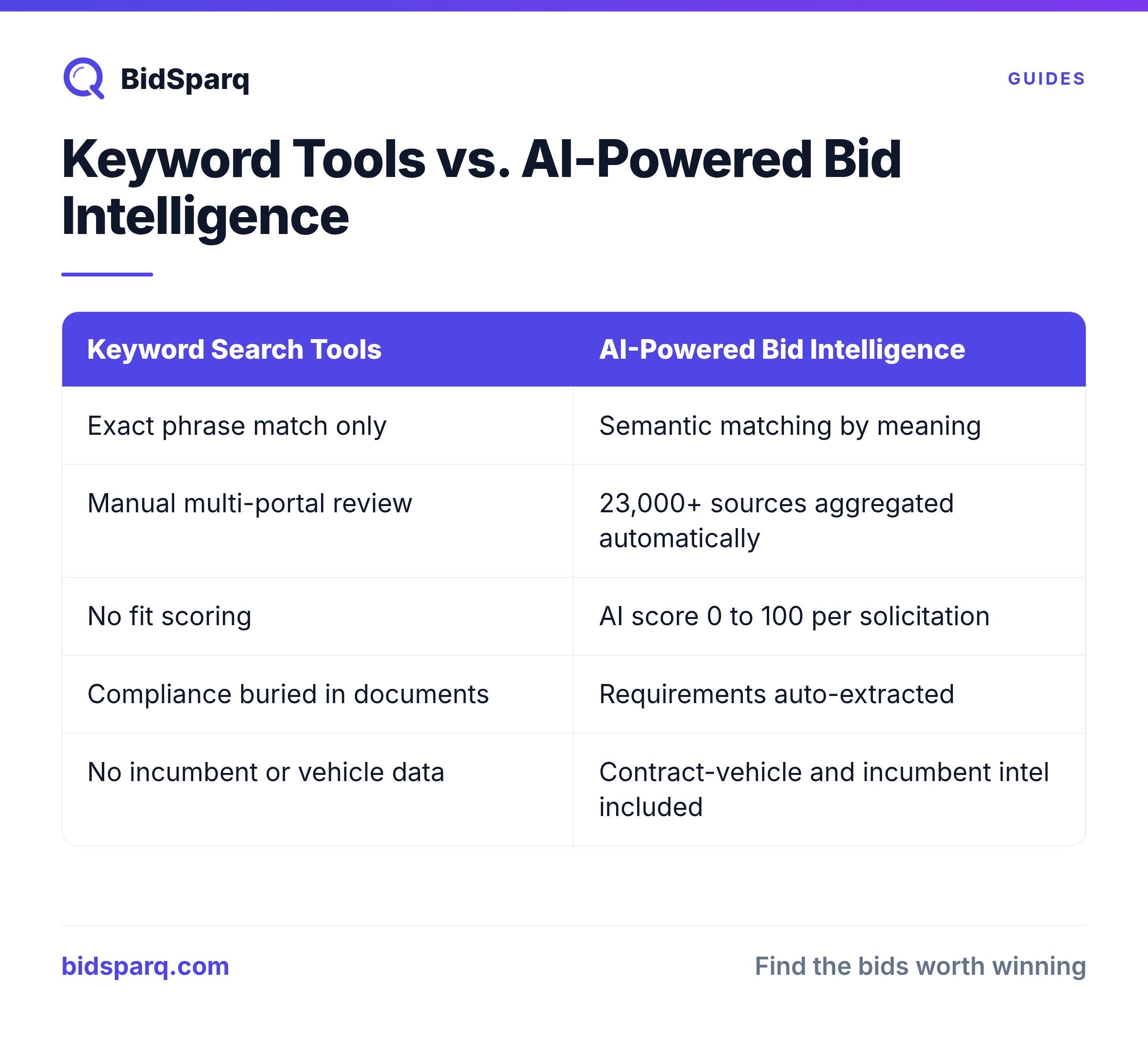
Popular tools for managing government RFPs fall into three tiers: official government portals, traditional aggregators, and AI-powered bid intelligence platforms. SAM.gov is the authoritative source for federal opportunities and is non-negotiable for any team pursuing federal contracts. Traditional aggregators collect from multiple portals in one interface, reducing tab-switching but rarely solving the deeper problem of opportunity qualification. AI-powered platforms add semantic matching, automated fit scoring, and compliance extraction so teams spend time on the pursuits most likely to convert.
| Tier | Representative Tool | What It Does |
|---|---|---|
| Official portal | SAM.gov | Federal solicitations direct from awarding agencies; free, authoritative, keyword search only |
| Traditional aggregator | GovWin IQ | Pulls federal and state bids into one interface; adds market intelligence and pipeline tracking |
| AI platform | BidSparq | Semantic matching, AI fit scoring (0 to 100), and compliance extraction across 23,000+ sources |
Official government portals: the mandatory starting layer
Every government contractor needs at minimum one official portal in their workflow, and for federal work that means SAM.gov. The System for Award Management is the U.S. federal government's official source for contract opportunities above the micro-purchase threshold. FPDS.gov, the Federal Procurement Data System, is where awarded contract data lives: useful for researching incumbents and understanding a buyer's historical spend patterns. USASpending.gov layers on top with a more accessible interface for exploring that same award data. Beyond federal, most states run their own eProcurement platforms where state agencies post solicitations. Cities, counties, and school districts often use their own systems or publish directly to their websites. The result is a landscape of hundreds of portals, each with its own search interface, alert logic, and format.
Traditional aggregators: broad reach, shallow qualification
Aggregators solve the fragmentation problem by pulling solicitations from hundreds of sources into a single search interface, but they leave the hard work of qualification to the user. The major traditional aggregators each take a slightly different angle on the market:
- GovWin IQ (Deltek): A comprehensive federal and state opportunity database that pairs bid listings with market intelligence, pipeline tracking, and competitor data, widely used by defense and IT contractors pursuing federal and civilian agency work.
- DemandStar: A bid distribution network used by thousands of state and local government agencies to post and distribute solicitations to registered suppliers, making it a practical source for municipal, county, and public-sector institutional work.
- BidSync: Aggregates solicitations from thousands of government buyers across federal, state, local, and education markets into a single searchable interface, with alert delivery based on NAICS and commodity codes.
- Bonfire: A procurement management platform used by municipalities and public institutions to post and manage competitive solicitations, surfacing those bids to registered vendors as a searchable secondary source.
The limitation common to all of these is search logic. Most aggregators rely on keyword matching, which means a bid titled "managed services operations" goes unseen if a vendor searches for "IT support." Relevance becomes a function of the phrase you happen to type, not the underlying fit between your capabilities and the buyer's need. As of August 2026, 450 new solicitations mentioning "managing" were posted in the last 30 days across the 23,000+ sources we track; California led with 56 and Texas with 28, and 195 of those solicitations close within the next 14 days. At that velocity, keyword misses are not edge cases. They are a structural blind spot. Private healthcare networks, construction owners, and institutional buyers face the same keyword-search gap at comparable RFP volumes.
Explore open solicitations matched to your capabilities, free, no credit card required: see your bid matches now.
What AI-powered platforms add to the stack
The shift from keyword tools to semantic matching changes what "finding a bid" actually means. Instead of matching a phrase you typed, a semantic engine reads the full text of a solicitation and compares it against what your business actually does. The result is a ranked list where the top matches are the ones your capabilities genuinely address, regardless of how the buyer chose to title the opportunity. Fit scores that run from 0 to 100 reflect that semantic alignment, not surface-level phrase overlap. Compliance extraction adds another layer: rather than reading through lengthy solicitation documents to identify bonding requirements, insurance minimums, certifications, or set-aside restrictions, the platform surfaces them automatically. Incumbent intelligence, drawing on awarded contract history, shows who currently holds the work and through which contract vehicle, reshaping the competitive picture before a single word of a response is drafted. As of August 2026, 63,007 solicitations are open across the sources we track, and at that scale manual review is not a strategy.
Matching the tool to your pursuit volume
The right tool tier depends on how many solicitations your team actively pursues each quarter, not on how many exist in the market. Teams submitting fewer than a dozen proposals per year can often get by with SAM.gov plus their state portal and disciplined keyword alerts. Teams pursuing 20 or more opportunities per quarter will find that keyword-based tools generate too many irrelevant results to review efficiently and miss too many relevant ones to trust. The cost of a missed opportunity, measured in proposal-ready staff time spent on the wrong bids, typically exceeds the annual subscription cost of a dedicated platform. The question is not whether to invest in better tooling. It is when the manual approach starts costing more than it saves.
Start your free search across 23,000+ bid sources, no credit card and no commitment: find government RFPs that fit your work.
FAQ
What is the best free tool for finding government RFPs?
SAM.gov is the best free source for federal contract opportunities, maintained directly by the U.S. government. For state and local opportunities, your state's official eProcurement portal is the authoritative free source. Both rely on keyword search, so coverage depends on searching the right terms. BidSparq offers a free tier that adds semantic matching across 23,000+ sources, extending free coverage well beyond what any single portal provides.
How do procurement teams manage large volumes of government RFPs?
Teams handling high pursuit volumes rely on aggregation plus qualification: a platform that pulls from multiple sources and filters by fit, not just by keyword. AI fit-scoring, automated compliance extraction, and incumbent intelligence reduce the time spent on solicitations that are not worth pursuing. Manual review at scale is not sustainable; the economics favor purpose-built tooling once pursuit volume reaches double digits per quarter.
What is the difference between SAM.gov and a bid aggregator?
SAM.gov is an official U.S. government portal that publishes federal contract opportunities directly from awarding agencies. A bid aggregator collects solicitations from SAM.gov plus state, local, and institutional portals, presenting them through a unified search interface. The tradeoff: aggregators offer broader coverage, but search quality depends on how current their data is and whether their matching logic goes beyond keywords. Platforms with semantic search and AI scoring add a qualification layer that neither SAM.gov nor traditional aggregators provide.
Find RFPs that match your business
BidSparq monitors 23,000+ procurement sources and uses AI to score every opportunity against your capabilities. Try it free for 14 days.
Start Free Trial →