RFP Software Opportunity Pipeline Tracking That Wins Bids
Learn how RFP software opportunity pipeline tracking replaces fragmented manual discovery with semantic matching, fit scoring, and compliance extraction. With more than 65,000 solicitations active across 23,000+ sources, a disciplined pipeline is how competitive BD teams stay ahead.

- Keyword alerts miss most bids because agencies write requirements in domain language, not vendor language: semantic matching closes that gap.
- Ranking by fit score (0 to 100) shrinks a list of hundreds into the handful actually worth pursuing.
- Buried compliance criteria in long attachments can be extracted automatically, before you spend a single pursuit hour on the wrong opportunity.
- Knowing the incumbent vendor before you write changes the entire go/no-go decision and is data most alert tools never surface.
- The real scale problem: 65,994 solicitations are open right now across more than 23,000 tracked sources, and that number turns over daily.
- Pipeline tracking replaces the shared spreadsheet with live status, deadlines, and team ownership in one workspace.
The short answer
RFP software opportunity pipeline tracking is the practice of continuously discovering, scoring, and managing relevant solicitations in a structured workspace, so your team reviews qualified leads instead of raw lists. The firms that maintain a disciplined pipeline tend to win more not because they submit more proposals, but because they bid on better-fit opportunities and disqualify poor fits earlier. Across construction, healthcare, IT, and education markets, that discipline compounds: earlier discovery means more time for proposal quality, and better fit data means fewer wasted pursuits.
Why Manual Tracking Breaks at Scale
Most business development teams start with portal bookmarks and saved searches, then discover the list grows faster than any team can review it. A healthcare technology company monitoring a dozen hospital networks, a construction subcontractor watching bid boards across three states, and an IT firm covering county governments alongside commercial clients all face the same math: the volume of relevant solicitations exceeds what any team can track by hand.
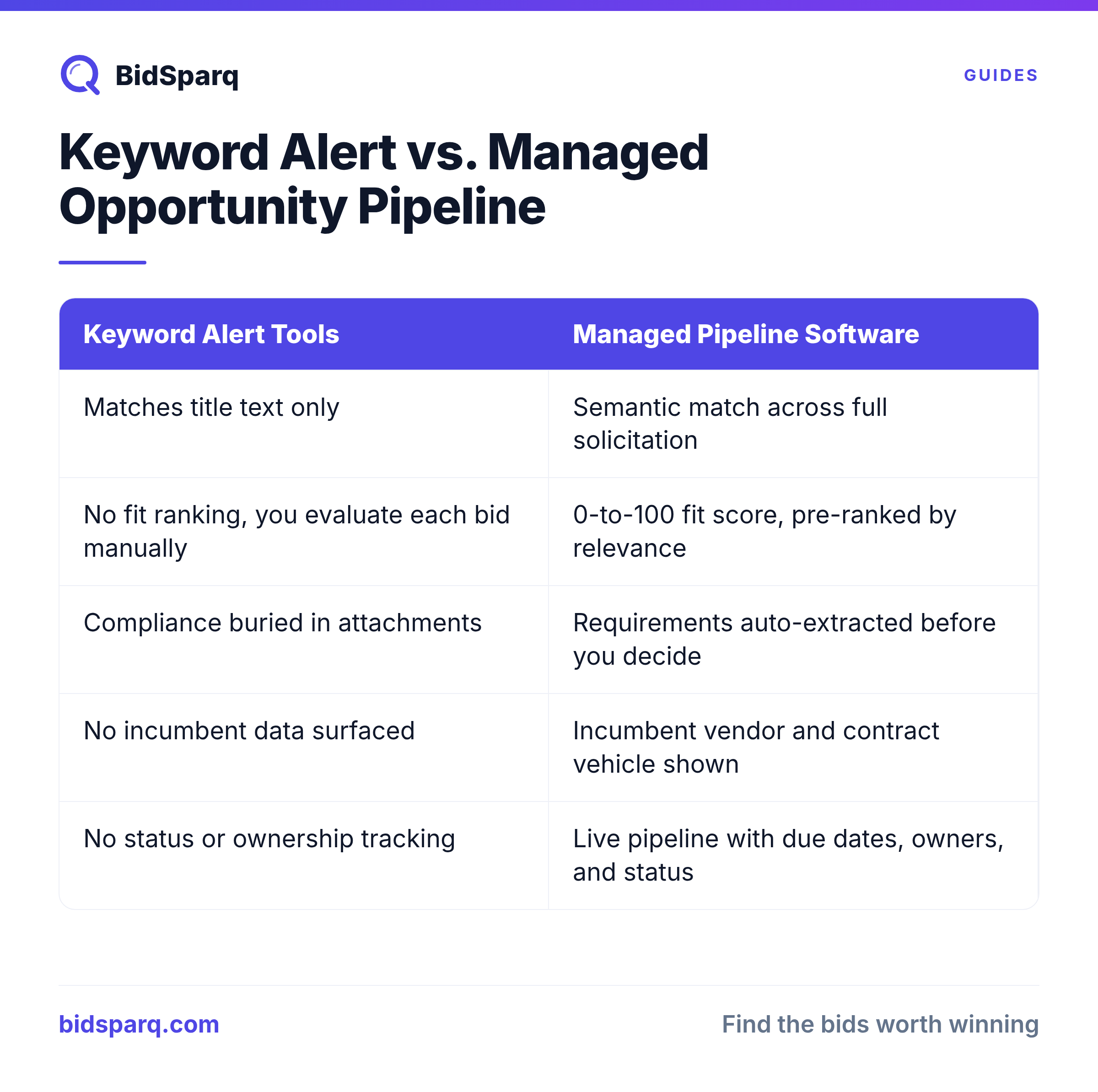
Three structural problems compound this. First, agencies use inconsistent terminology: a service you call "managed IT" appears as "information technology infrastructure support" in one solicitation and "technology operations and maintenance" in another. A keyword alert catches neither. Second, compliance requirements live in attachments, not in the public summary, so reviewing them means opening every document before you even decide whether to pursue. Third, there is no single workspace showing all opportunities, their status, and who on your team owns each one.
The sources exist and are worth monitoring: SAM.gov for federal procurement, your state's official eProcurement portal for state and local awards, school board agenda platforms for K-12 purchasing, and sector-specific bid boards for healthcare and construction. The problem is not finding these sources. The problem is reading across all of them at the speed and volume a small BD team cannot match without purpose-built software.
Search 65,994 open solicitations free, no credit card needed.
From Saved Search to Managed Pipeline
A managed pipeline differs from a saved search the way a CRM differs from a contact list: the pipeline tracks what is happening to each opportunity, not just that it exists. Every solicitation in a real pipeline carries a fit score, a status, a due date, and an owner. When a deadline shifts, the pipeline flags it. When your team advances a pursuit to active proposal, the pipeline reflects it.
For a construction firm, this means seeing at a glance which bids are in active pursuit, which are parked pending more information, and which were disqualified because a bonding requirement or prevailing wage clause ruled them out. For a healthcare vendor, it means compliance mandates including HIPAA provisions and certification requirements extracted from long attachment pages before the go/no-go call. The pipeline is a prioritization and coordination tool, not just a discovery feed.
Semantic matching is what makes discovery tractable at this volume. Instead of matching your keywords against title text, a semantic engine reads the full solicitation and measures how closely its meaning aligns with your business profile. That surfaces the behavioral health RFP titled "integrated care coordination services" when you sell care management platforms, and it filters out the superficially similar bids that fall outside your category.
The Mechanics That Separate Real RFP Software from Bid Alerts
Bid alert emails deliver a list; RFP software with pipeline tracking delivers a workspace that retains what your team already knows about each opportunity. The core mechanics include a 0-to-100 fit score that reflects how closely each solicitation aligns with your capability profile, automatic extraction of compliance requirements from attached documents rather than only the public summary, and incumbent vendor and contract-vehicle data that tells you who currently holds the work and what procurement vehicle it rides on.
Together, these turn an unstructured stream of new postings into a ranked, contextualized queue. A managed care organization pursuing state behavioral health contracts, an IT integrator tracking federal task orders alongside county projects, and a commercial construction firm covering both public and private bids all benefit from the same structural gain: less time on discovery and triage, more time on response quality.
The tracking layer ties it all together. Fit scores and compliance data are only useful if your team can see them alongside status, due dates, and notes in one view. A pipeline without tracking is just a better search. Tracking without scoring is just a better spreadsheet. The combination is what makes the approach defensible as a repeatable BD process.
Reading the Live Market Right Now
Understanding current opportunity volume helps calibrate how aggressive your pipeline strategy needs to be and where to concentrate team effort. As of August 2026, BidSparq tracks 65,994 open solicitations across more than 23,000 sources. Of those, 3,279 close within the next 14 days, representing the near-term decisions a well-run pipeline should already have prioritized and scored. Over the last 30 days, 15,030 new solicitations were posted in this category, meaning the market adds roughly 500 relevant opportunities per day.
Geographic concentration matters for resource planning. Maryland and Massachusetts currently lead in active solicitation volume, at 765 and 712 open solicitations respectively. State-level velocity like this signals where procurement budgets are actively moving, and a pipeline tool surfaces that signal automatically rather than requiring a cross-state manual audit.
The practical implication: the market is large, active, and uneven. Not every geography or agency class is equally active at any moment. A well-configured pipeline shows where the velocity is, so your team concentrates effort where it returns the most.
FAQ
What is RFP software opportunity pipeline tracking?
RFP software opportunity pipeline tracking is a workflow in which software automatically discovers relevant solicitations across bid sources, scores each one for fit, extracts compliance requirements, and organizes all active pursuits in a workspace with status, deadlines, and ownership. The goal is to replace a fragmented, manual process with a structured, continuously updated view of your opportunity market.
How is pipeline tracking different from a keyword alert?
Keyword alerts notify you when a specific phrase appears in a solicitation title or summary. Pipeline tracking goes further: semantic matching finds opportunities even when agencies use different terminology, a fit score ranks them so you can prioritize, compliance details are extracted from attachments rather than only the public summary, and each opportunity's status is tracked as your team reviews and pursues it. An alert tells you something exists. A pipeline tells you whether it is worth pursuing and what your team needs to do next.
What bid sources should I monitor for an opportunity pipeline?
The right sources depend on your target markets. For federal work, SAM.gov is the required starting point. For state and local contracts, your state's official eProcurement portal and comptroller procurement pages cover the bulk of public spend. For K-12, school board agenda platforms and district purchasing portals publish most solicitations. For healthcare and construction, a mix of public bid boards and sector-specific aggregators fills the gap. Monitoring all of these manually across multiple states is exactly where purpose-built RFP software earns its place in a BD workflow.
Start your free pipeline search across 23,000+ bid sources, no credit card required.
Find RFPs that match your business
BidSparq monitors 23,000+ procurement sources and uses AI to score every opportunity against your capabilities. Try it free for 14 days.
Start Free Trial →