GSA Rates San Diego: Stop Underpricing Travel in Bids
What GSA rates for San Diego actually control in a bid, where to verify the current per diem, and how to find every solicitation that references them.

Travel is one of the easiest lines to get wrong in a bid that puts people on the ground in San Diego. Price it from memory and one of two things happens: you eat the overage when the buyer caps reimbursement at the federal per diem, or you pad the number and lose on price to a competitor who read the clause. Getting it right means knowing what GSA rates for San Diego actually govern, where the current figure lives, and which of the solicitations in your pipeline reference it at all.
- GSA per diem is a ceiling, not a quote. On federal work it caps billable lodging and meals, and many hospitals, districts, and prime contractors adopt the same table by reference.
- San Diego figures move. GSA publishes new rates every October 1, and lodging in many Southern California destinations shifts by season as well.
- The solicitation's travel clause wins. Some buyers reimburse at GSA rates, some fold travel into a fixed price, and some will not pay it at all.
- Two different things get called "GSA rates": per diem for travel and ceiling labor pricing on a GSA Schedule contract. Bidders regularly mix them up.
- Volume is the hidden problem. As of October 2026, 5,174 open solicitations mention "rates" in some form, far more than any team can read by hand.
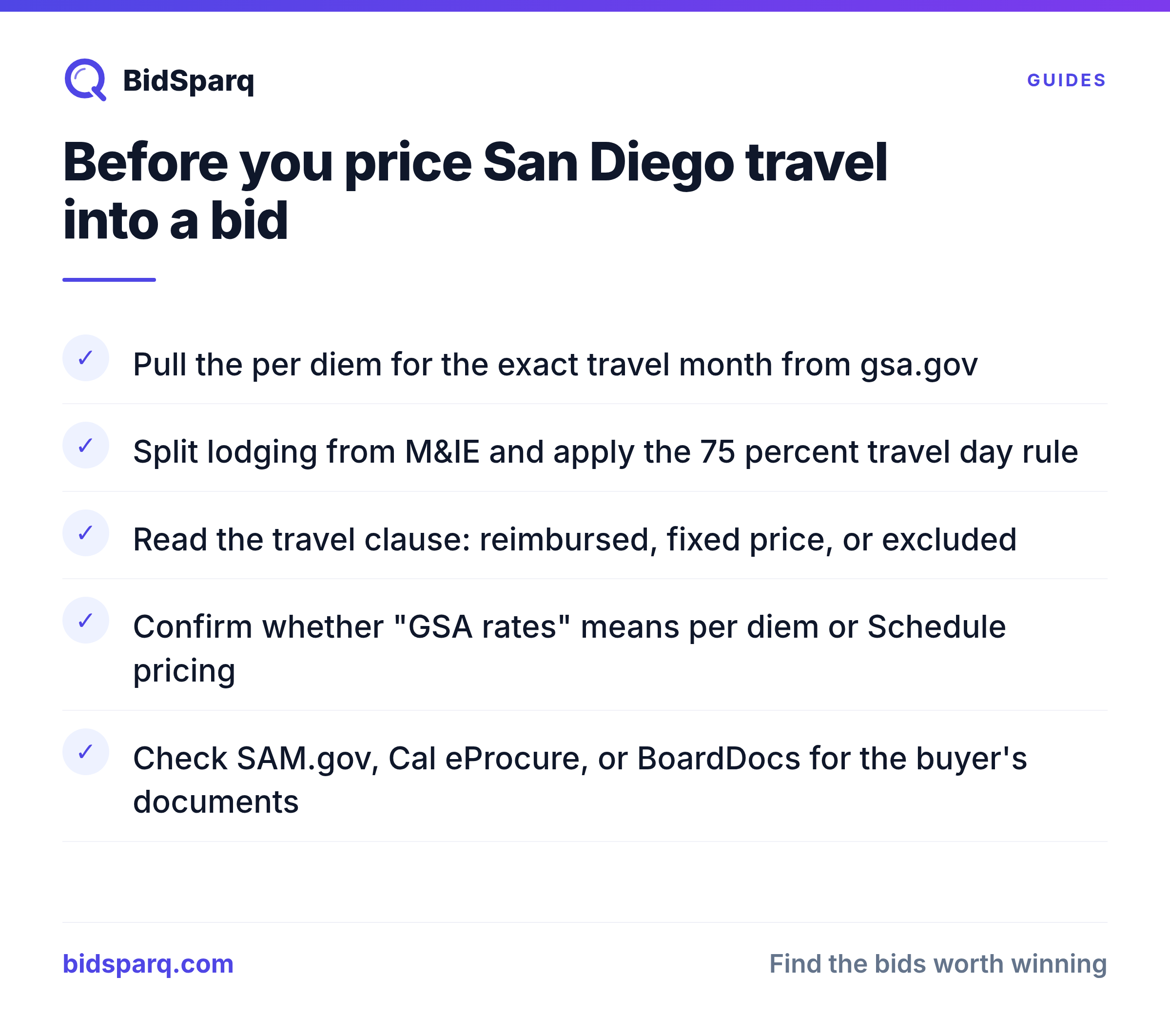
The short answer
GSA rates for San Diego are the federal per diem amounts for lodging and for meals and incidental expenses (M&IE) that apply to business travel in San Diego County, published by the U.S. General Services Administration and refreshed each fiscal year on October 1. They matter to bidders because the Federal Acquisition Regulation caps reimbursable travel on federal contracts at those amounts, and a large share of hospitals, universities, school districts, and prime contractors point to the same table in their own terms. Pull the figure for the specific month of travel from GSA's official per diem lookup rather than from a saved spreadsheet, because the San Diego lodging rate is not guaranteed to be flat across the year. If a solicitation refers instead to GSA Schedule rates, it means the ceiling labor prices on a vendor's Multiple Award Schedule contract, which is a separate question with a separate source.
What the per diem actually controls in your price
Treat the GSA figure as the most you can recover, then decide what you will actually charge. The per diem has two parts. The lodging rate is the nightly room cost before taxes, and the M&IE rate covers meals and small incidentals for a full day, with the first and last travel day paid at 75 percent. Those are reimbursement limits under the federal travel cost principle, so if your team books a room above the lodging ceiling on a cost-reimbursable federal job, the difference comes out of your margin, not the buyer's.
Consider a healthcare analytics firm bidding a multi-week on-site implementation at a San Diego hospital system. The hospital is not a federal agency, but its master services agreement says travel is reimbursed "at prevailing GSA rates." That single phrase decides whether the firm's travel line is a pass-through or a loss. The same thing happens when a specialty contractor sends an out-of-area crew to a community college renovation and the district's terms cap per diem at the federal table. In both cases the number in the bid has to be built from the current rate, the number of nights, and the 75 percent rule on travel days, not from what the last project paid.
On fixed-price work the rate still matters, just differently. Nobody will reimburse you line by line, so the per diem becomes your internal estimating assumption. Use it as the floor for what San Diego lodging will realistically cost in the month you will be there, and add a cushion if your travel dates land in peak season.
Where to verify the rate and the terms before you submit
Check the official source, the solicitation, and the buyer's own documents, in that order. The only authoritative source for per diem is the GSA per diem lookup on gsa.gov, searchable by city, state, or zip code and broken out by month. Do not rely on a travel site or a prior proposal. Rates can change within the fiscal year when GSA issues a mid-year adjustment, so confirm the figure close to submission.
Second, read the travel language in the solicitation itself. Look for whether travel is reimbursable, capped at GSA rates, included in the fixed price, or excluded entirely, and whether receipts or pre-approval are required. For federal opportunities, the full package lives on SAM.gov. California state agency work posts on Cal eProcure, the state's official eProcurement portal. Local buyers, including school districts and community colleges, often publish the board packet that authorized the purchase on BoardDocs, which can reveal the budget behind the line item and whether travel was anticipated.
Third, if the "GSA rates" in question are labor rates on a Multiple Award Schedule, the place to look is GSA eLibrary for contract holders and GSA Advantage for awarded pricing. Those tell you what incumbents and competitors are already permitted to charge, which is a very different input from the per diem table.
Why finding the right solicitations is the harder half
Assume the bids that reference rates are scattered across more portals than you are watching. Pricing travel correctly only pays off if you found the solicitation in the first place, and the market that touches San Diego is spread across federal, state, county, city, district, hospital, and university portals, each with its own login and search box. As of October 2026, 54,932 solicitations are open across the 23,000+ sources BidSparq tracks, and 12,889 new solicitations mentioning "rates" were posted in the last 30 days alone. Of the ones open right now that mention "rates," 3,119 close within the next 14 days.
Reading that volume by hand is not a staffing problem that more hours can solve. A keyword search for "San Diego" misses the hospital system that names only its campus, the water agency that lists a service area, and the prime that posts a subcontracting opportunity under a project name. A search for "per diem" misses the solicitation that says "travel reimbursed per federal guidelines." Every miss is either a bid you never saw or a travel clause you never read.
Start on the free tier and see which open bids match your work, no credit card needed.
How automated matching changes the economics
Let software do the reading so your estimators only touch bids worth pricing. Semantic matching reads solicitations by meaning rather than by exact phrase, so a request for "on-site deployment support in the San Diego region" and one for "field engineers at a coastal Southern California campus" both surface for a vendor who does that work, without anyone guessing the right keyword. Each match carries a fit score from 0 to 100 built from your capabilities, past pursuits, and the requirements in the document, so the queue sorts itself before a human opens it.
The piece that matters most for this topic is automated compliance and requirement extraction. BidSparq pulls the travel terms, insurance limits, prevailing wage language, and submission mechanics out of the document and puts them next to the fit score, so the question "does this buyer cap travel at GSA rates?" is answered before you commit an estimator. Incumbent and contract vehicle intelligence rounds it out: if the buyer is purchasing through a GSA Schedule or another cooperative vehicle, you know whether you need to hold that vehicle or partner with someone who does. A keyword alert tool hands you a link. This hands you a decision.
FAQ
What is the GSA per diem rate for San Diego right now?
Look it up on the official GSA per diem page on gsa.gov for the specific month of travel. We deliberately do not reprint the figure here because it changes every fiscal year on October 1 and can vary by season, and a stale number in a bid costs real money.
Do GSA rates apply to non-federal contracts in San Diego?
Only when the buyer's terms say so, but many do. Hospital systems, universities, school districts, and prime contractors frequently reference GSA per diem as their reimbursement cap because it is published and updated for them. Read the travel clause in each solicitation rather than assuming either way.
Is "GSA rates" the same as GSA Schedule pricing?
No. Per diem rates cover lodging and meals for travelers. GSA Schedule rates are the ceiling labor and product prices on a vendor's Multiple Award Schedule contract, found through GSA eLibrary and GSA Advantage. A solicitation can reference both, so confirm which one a given clause means.
Try the free tier and get fit scores on your first matched bids today, no card required.
Find RFPs that match your business
BidSparq monitors 23,000+ procurement sources and uses AI to score every opportunity against your capabilities. Try it free for 14 days.
Start Free Trial →