NTE Amount, Value and Budget in RFPs: Bidding Under the Cap
NTE (Not to Exceed) is the ceiling a buyer will pay. Where NTE amount, value and budget terms hide in RFPs, and how to price competitively inside the cap.

An NTE amount is a hard ceiling set by the buyer, and proposals priced above it are typically ruled non-responsive before evaluators read a single line of your technical approach. Understanding what the term means, where it hides inside long solicitation documents, and how to price competitively within it is not optional for any vendor competing on volume.
Key takeaways
- NTE stands for "not to exceed": a hard ceiling above which proposals are typically disqualified before evaluation begins.
- Across sectors, the phrasing changes: construction says "not to exceed," healthcare uses "maximum authorized amount," and IT task orders specify "ceiling value," all governed by the same compliance rule.
- The ceiling may apply at multiple contract levels, from total engagement value to individual line items, so reading only the cover page creates real pricing risk.
- Late addenda are where NTE figures change most often; automated extraction catches revisions across the full document set without manual monitoring.
- Pricing inside the ceiling starts with incumbent award history: prior values show where vendors have actually landed, giving you a real anchor instead of a guess.
- As of August 2026, 2,356 open solicitations with contract-amount terms close within 14 days, compressing the window for manual compliance review.
The short answer
An NTE amount is the contractual maximum a buyer will pay, and any proposal priced above it is non-responsive. The term appears in every procurement market: construction subcontracts, hospital staffing agreements, school district technology RFPs, and government task orders all use not-to-exceed language to cap budget exposure. The ceiling is set by the buyer at solicitation time and is firm. Vendors who identify and price inside the NTE amount advance to evaluation; those who miss it do not.
What an NTE amount actually means in a contract
An NTE amount creates a unilateral spending ceiling, not a target price. Under a not-to-exceed arrangement, the actual cost billed can come in anywhere below the cap. The buyer simply will not approve invoices above it. This differs from a fixed-price contract, where the price is locked in both directions. Many buyers use NTE amounts when the full scope is uncertain at solicitation time, making the ceiling their risk-management tool and your hard constraint as a vendor.
NTE amounts also appear at different levels of a contract. A solicitation may set a global ceiling for the entire engagement, separate ceilings for each line item or service category, or both. The controlling NTE clause is often in the pricing exhibit or the terms and conditions, not the scope narrative. Reading only the cover page to find the figure is one of the most common and costly errors in proposal development.
In federal contracting, the NTE mechanic is most consequential under Indefinitely Delivered, Indefinitely Quantity vehicles. An IDIQ contract establishes a ceiling, sometimes called the maximum ordering value, that bounds the entire ordering period. Individual task orders are then issued against that ceiling as separately funded delivery documents: the funded amount on each task order is the actual obligation, while the IDIQ ceiling is the aggregate cap no combination of task orders can breach. Vendors competing on an IDIQ must price each task order within both the task order ceiling and their share of remaining vehicle headroom, making the NTE figure the controlling mechanic at every layer of the contract.
NTE vs. fixed-price vs. cost-plus: why the difference matters
Fixed-price contracts pay a single negotiated figure regardless of actual cost; cost-plus contracts reimburse documented costs plus a fee; NTE contracts set a ceiling while letting the final invoice float below it. In a fixed-price deal, one number gets paid whether actual costs landed higher or lower. In a cost-plus arrangement, the buyer reimburses documented costs plus an agreed fee, sometimes without any ceiling at all. NTE threads between them: the vendor invoices actual hours and materials up to the stated maximum, then stops. This structure is especially common in construction, where scope change is expected on almost every project, in managed IT services, where monthly ticket volume varies, and in healthcare facility management, where regulatory requirements can shift mid-contract and create unpredictable work demands.
How NTE language appears across sectors
Every major procurement sector uses spending ceilings, but the terminology varies by industry and contract type. When the goal is controlling staffing cost exposure, healthcare systems typically phrase the limit as "maximum authorized hours at the contract rate" or "total engagement ceiling per discipline" rather than using the NTE label directly. The subcontract agreement itself, in construction, is where the ceiling appears most explicitly: a single NTE line that every subcontractor pricing the work must honor before the scope narrative is even relevant. For a school district implementing a student information system, the dollar consequence is often layered, with a separate ceiling for the implementation phase and a different cap on the annual subscription creating two compliance tests in one procurement. IT services RFPs from commercial buyers tend to substitute "budget envelope" or "maximum engagement value" for the formal NTE term, but the compliance weight is identical.
The common thread across all of them: exceeding the cap, or failing to acknowledge it in your pricing exhibit, signals that you either did not read the documents carefully or cannot work within the buyer's financial constraints. Neither impression advances your proposal.
Where NTE language actually hides in the RFP package
Look past the cover page: NTE budget language almost never appears in the first section of a solicitation. Buyers embed the ceiling in pricing exhibits, scope attachments, contract templates, or special conditions addenda. A healthcare system RFP may state its NTE in a single line deep in the document. A construction solicitation may express it as a per-phase or per-trade cap buried in an appendix. Education and commercial buyers sometimes encode it in a boilerplate contract exhibit that only careful readers open. In each case, the location is inconvenient and the consequence of missing it is total.
That makes manual discovery expensive. Scanning every document, attachment, and addendum across dozens of active pursuits takes hours per bid and scales poorly as your pipeline grows. As of September 2026, 18,276 new budget solicitations were posted in the last 30 days across the 23,000+ sources we track, and 6,194 of those open opportunities close within the next 14 days. The volume alone makes exhaustive manual review impractical for any team competing across more than a handful of categories at once.
How NTE shapes your go/no-go decision
Treat NTE as the first filter in your pursuit process, not a detail you revisit after scoping the work. The gap between your true cost floor and the NTE ceiling tells you whether a bid is worth pursuing at all. If your floor is above the NTE, you cannot win without losing money. If the gap is narrow, scope risk and change-order exposure matter more than they would on a looser contract. If you are comfortably below the ceiling, check whether you are pricing in scope you have overlooked, or whether incumbency or a preferred contract vehicle is driving the NTE in a way that limits your realistic chance of winning.
Go/no-go decisions made before writing a single page of a proposal save far more capacity than any template library. NTE is the number that makes those decisions faster and cleaner. Pair it with a fit score and you can triage an entire week of incoming solicitations in a morning.
The compliance risk hiding in NTE clauses
The greater risk is not exceeding the ceiling; it is missing that a ceiling exists at all. Long RFP documents spread NTE language across multiple exhibits, addenda, and incorporated-by-reference attachments. A solicitation may introduce the NTE figure in a budget attachment posted several days after the original release, which is easy to miss on a manual monitoring schedule. Construction solicitations routinely revise NTE figures through addenda during the question period. Healthcare RFPs amend pricing exhibits. IT task orders update ceiling values through modification notices. Missing any one of these puts your entire submission at risk of disqualification.
As of August 2026, BidSparq tracks 62,571 open solicitations across 23,000+ sources, with 5,715 currently mentioning contract amount terms. California leads with 664 active solicitations in this category; Texas follows with 578. No manual monitoring routine covers that volume reliably.
Search open solicitations free on BidSparq, with contract amount terms surfaced automatically. No credit card needed.
Pricing competitively inside the ceiling
Knowing the NTE amount is the starting point, not the end, of your pricing analysis. Once you have confirmed the buyer's hard cap, the real question is where prior vendors have actually landed inside that range. Incumbent contract data and prior award values, when available in procurement records, tell you whether the last vendor came in well under the ceiling or close to it. That information shapes every pricing decision: whether to propose a base scope with optional add-ons, whether to hold margin or compete on rate, and whether the ceiling signals that cost control is a genuine buyer priority or a standard template clause.
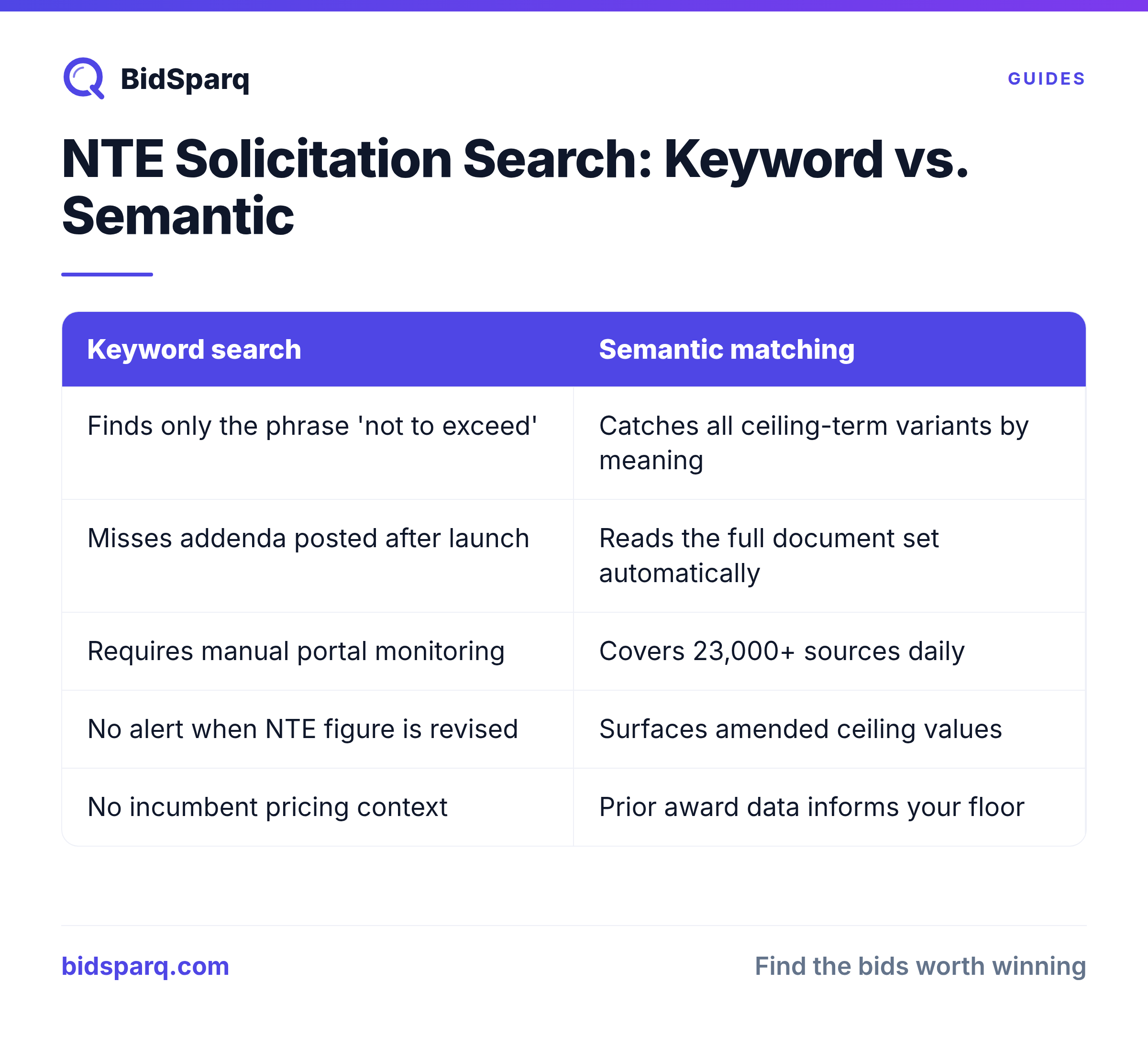
BidSparq's 0-100 fit score, measured against your capability profile, tells you before you price whether a ceiling reflects a real opportunity or a budget-clearing solicitation your firm is unlikely to win, a distinction keyword-only searches cannot make. Semantic matching across bid sources also surfaces opportunities where NTE language is present but the phrase "not to exceed" does not appear. Buyers phrase spending caps in dozens of ways, and keyword-only tools miss the variations. For market-wide coverage, federal solicitations and contract ceilings are published on SAM.gov; state and local work appears on each state's official eProcurement portal; and construction solicitations are commonly posted on owner-published plan rooms and sector-specific bid boards. Tracking amendment-driven NTE changes across those sources is where manual pipelines fall short.
How AI procurement platforms surface NTE terms automatically
Compliance extraction is the capability that changes how bid teams handle NTE value at scale. Instead of manually reading every attachment to locate the NTE clause, an AI procurement platform reads the full document set, extracts pricing constraints, and surfaces them before cost modeling begins. That sequence matters: knowing the ceiling at the research stage means your estimate is shaped by the constraint from the start, not forced to conform to it under deadline pressure at the end.
Semantic matching adds a second layer of value. A keyword search for "not-to-exceed" returns nothing when the solicitation phrases the same concept as "maximum compensation," "upset price," "price ceiling," or "not to exceed contract amount." Semantic search finds solicitations with NTE intent regardless of how the language is phrased, which matters because procurement offices across healthcare, education, construction, and government are not consistent in their terminology. California, Texas, and Virginia currently lead in active solicitations mentioning value-based contract terms, with 14,304 new solicitations posted across these and other markets in the last 30 days alone, according to BidSparq data from September 2026.
Fit scoring contextualizes the NTE within your firm's actual capability profile. A solicitation with a ceiling your overhead structure cannot competitively meet scores low regardless of how attractive the scope looks, which keeps bid-no-bid decisions grounded in margin reality rather than surface-level opportunity interest.
FAQ
What does NTE amount mean in a government contract?
NTE stands for "not to exceed." In a government contract, the NTE amount is the maximum total the agency will pay, and the vendor cannot invoice above it without a formal contract modification. Under IDIQ vehicles, the ceiling operates at two levels: the base contract maximum ordering value and the funded ceiling on each individual task order. Proposals priced above the stated NTE are typically ruled non-responsive and disqualified before technical evaluation. The same principle applies in education, healthcare, and commercial contracts that use equivalent language, regardless of sector.
Can you negotiate an NTE amount after award?
In most cases, no. The NTE amount is established by the buyer at solicitation time and is part of the executed contract terms. If the scope changes materially during performance, either party can initiate a formal modification, but the NTE does not automatically increase because costs run higher than planned. Accurate pricing within the ceiling at proposal time is the only reliable strategy; relying on a post-award amendment to cover overruns is not a sound approach.
How do I find RFPs that include an NTE amount?
NTE amounts are disclosed inconsistently: some buyers publish the ceiling on the cover page, others embed it in pricing exhibits or late addenda, and many use equivalent terms like "maximum contract value" or "budget not to exceed." For federal opportunities, SAM.gov is the authoritative source and includes solicitation attachments where ceiling language typically appears. State and local work is published on each state's official eProcurement portal, and construction solicitations often appear on plan rooms by region and sector. For broad coverage across all markets, semantic matching scans 23,000+ sources and surfaces ceiling-constrained solicitations regardless of the exact phrase used, filtered by sector, region, and closing date.
See every open NTE opportunity in your market before your window closes. Try BidSparq free and start matching now.
Is an NTE contract the same as a fixed-price contract?
No. A fixed-price contract pays exactly the agreed amount regardless of actual cost. An NTE contract pays documented actual costs up to the ceiling amount. If final costs land below the NTE, the buyer pays the lower amount. If they exceed it, the vendor absorbs the overage. The NTE structure is most common in services and construction where scope variability is expected and a single fixed number would force the vendor to price in excessive contingency risk.
Can you bid below the NTE value, and does it help you win?
Yes, and in best-value procurements it often does. Pricing below the NTE value with a credible, itemized cost narrative signals to evaluators that you analyzed the work rather than defaulted to the ceiling. Pricing at the NTE, by contrast, can read as a placeholder, particularly in evaluations where cost realism is scored alongside technical approach.
Is an NTE budget the same as a contract ceiling price?
In most solicitations, yes. NTE, contract ceiling, and maximum contract value describe the same hard limit on what the buyer will pay. Some contracts distinguish between an NTE for individual task orders and a separate ceiling for the total contract vehicle, so it is worth reading the main solicitation and all attached contract language, not just the summary page.
Find RFPs that match your business
BidSparq monitors 23,000+ procurement sources and uses AI to score every opportunity against your capabilities. Try it free for 14 days.
Start Free Trial →