Won First Government Contract: Now What?
Winning your first government contract is just the beginning. This guide covers what to do immediately after your award to document past performance, stay compliant, and build the pipeline that turns one win into a sustainable procurement business.
The award lands, the contract is signed, and then comes the question nobody prepares vendors for: what actually happens next? Most first-time winners focus entirely on getting the award. Very few have a clear plan for what follows.
The vendors who build lasting procurement businesses treat a first award as a starting point, not an endpoint. Here is what the transition from first-time winner to repeat contractor actually looks like.
- Past performance is your most valuable bidding asset and starts accumulating from the moment you sign.
- Compliance obligations buried in contract language create performance problems if you miss them before the first deliverable.
- Your next pipeline should already be building by the time you sign, not after the contract expires.
- Incumbent status on an active award improves your position on every related re-bid.
- Semantic matching surfaces follow-on opportunities that keyword searches routinely miss across education, healthcare, and government.
- Multi-vertical diversification turns one contract into a sustainable procurement business.
What Your First Award Actually Unlocks
Treat this contract as credentials, not just revenue. Whether you won through a school district procurement office, a hospital network supply chain team, a state agency, or a municipal department, the most important asset this award gives you is past performance. That record is what separates you from hundreds of vendors who arrive at a future re-bid without one.
Before your first invoice, document everything: scope, timeline, deliverables, performance metrics, and the names of contracting officers on the buyer's side. Award databases are noisy; your own records are clean and portable. Your first contract also establishes your standing in vendor portals, procurement databases, and contract vehicle registrations that every future bid will draw on. Administrative registration is not a formality.
Extract Every Compliance Requirement Before Work Begins
Pull every compliance clause and reporting deadline out of the contract before your first deliverable date. Procurement agreements across education, government, and healthcare embed obligations that are easy to overlook at the proposal stage and consequential during performance. These include insurance requirements, subcontractor reporting thresholds, prevailing wage provisions, diversity certification renewals, and product substitution restrictions.
A careful read-through catches the obvious ones. The obligations that cause problems are buried in referenced specifications or addenda. Automated compliance extraction surfaces requirements by category rather than requiring a manual hunt through hundreds of pages, reducing the risk of a missed obligation that affects your performance record and future eligibility.
Build Your Next Pipeline While You Are Delivering
The worst time to start your next bid is after your current contract expires. Procurement timelines are long. A contract ending in several months typically has a re-bid process that opened before that. Waiting until the expiration date often means missing the submission window entirely.
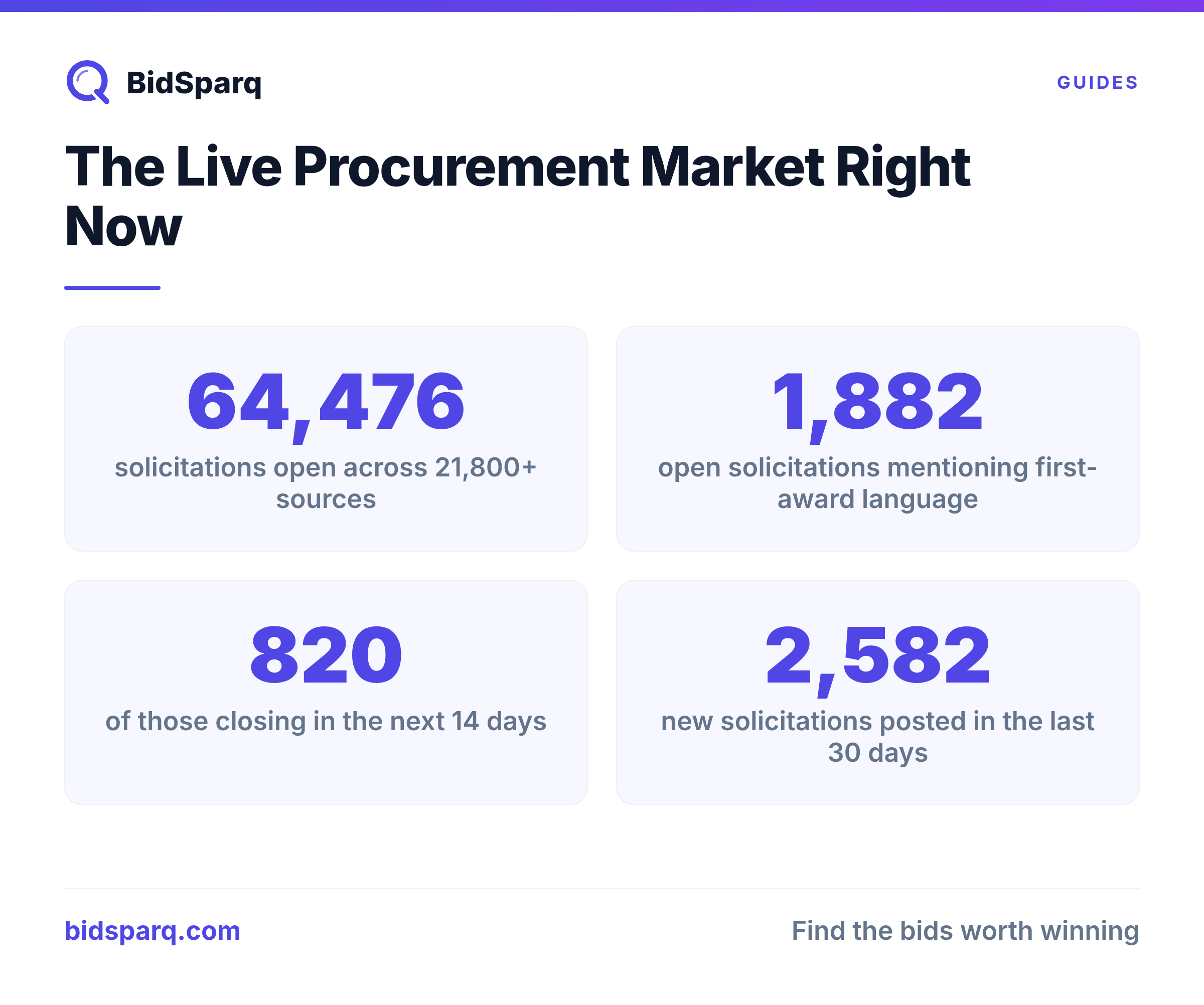
As of August 2026, 64,476 solicitations are open across the 23,000+ sources BidSparq tracks, with states like Virginia and Pennsylvania among the most active. Of those, 820 solicitations close within the next 14 days. The vendors who sustain themselves in procurement run continuous opportunity monitoring filtered by meaning rather than keyword, catching bids that use different terminology for the same scope. That matters because language varies significantly across healthcare, education, and construction procurement, where jurisdiction-specific terminology can make the same scope invisible to a standard keyword search.
Make Incumbent Status Work for You
The moment your contract is active, you are the incumbent, and that position is worth protecting deliberately. Incumbents carry documented past performance, established relationships with the buying team, and direct knowledge of the performance environment that challengers cannot replicate in a written proposal. That advantage compounds across renewal cycles.
What most first-time winners miss is the intelligence layer. A contract vehicle has a re-compete timeline. Adjacent vehicles open and close in the same category. Follow-on awards appear in related scopes. None of that information surfaces automatically in one place. It requires aggregating across portals, tracking over time, and matching back to specific capabilities. Incumbent and contract-vehicle intelligence closes that gap, surfacing re-competes alongside fit scores before a competitor identifies them first.
Expand Across Verticals Before You Need To
One contract in one vertical is exposure; a diversified portfolio is a business. The certifications and past performance that made you competitive for one award often transfer directly to adjacent markets. A facilities management company that wins a government services contract can use that record to compete for school district maintenance agreements, hospital system facility work, or commercial property services. The overlap is real, and competition in adjacent verticals is frequently thinner.
AI fit-scoring that runs from 0 to 100 across a full category makes cross-vertical discovery systematic rather than speculative. As of August 2026, 2,582 new solicitations were posted in the last 30 days matching early-stage procurement activity. The opportunity pool extends well beyond the agency that issued your first award.
FAQ
What should I do immediately after winning my first government contract?
Document your scope, performance metrics, and contracting contacts before your first deliverable. Extract all compliance requirements and reporting deadlines from the full contract, including any referenced addenda. Begin monitoring re-bid timelines and related opportunities so your pipeline does not run dry when this contract ends.
How do I use my first government contract to win more contracts?
Past performance from your first award is the most persuasive element of any future proposal. Reference it with specific deliverables, timelines, and measurable outcomes. Identify adjacent scopes where your existing certifications already qualify you, and use AI fit-scoring to prioritize the opportunities where your profile is strongest before committing proposal resources.
How do I find follow-on contracts after my first government award?
Start by identifying the contract vehicle your award sits on and tracking when it comes up for re-compete. Then broaden your search to adjacent categories and verticals using semantic matching rather than keyword tools. As of August 2026, 1,882 open solicitations mention first-award language across the 23,000+ sources tracked, and 2,582 new ones were added in the last 30 days. A procurement intelligence platform surfaces those matches continuously, so you are not relying on manual searches across dozens of portals.
See your live matches free, no credit card needed.
Find RFPs that match your business
BidSparq monitors 23,000+ procurement sources and uses AI to score every opportunity against your capabilities. Try it free for 14 days.
Start Free Trial →