Government Contract Recompete Process: Keep the Work
A practical guide to the government contract recompete process: how recompetes are triggered, why incumbents and challengers both lose, and how to track opportunities before they close.
Recompetes are a defining event in every procurement sector. Education technology contracts, healthcare system agreements, construction management programs: they all follow the same arc. Award, performance, rebid. The government contract recompete process is among the most codified of these cycles, with published timelines, formal acquisition strategies, and competitive intelligence that is often available months before a solicitation drops. Most vendors, incumbent or challenger, treat recompetes reactively. That is where the opportunity lives.
- Recompetes follow a predictable arc: solicitation release, questions period, proposal submission, evaluation, and award. Every stage is trackable with the right intelligence.
- Incumbent advantage erodes when agencies change scope: agencies routinely modify requirements at recompete, and missing those changes is the most common loss reason for incumbents.
- Contract vehicle and NAICS code shifts signal open competition: when an agency moves to a different vehicle or code, the field opens for new entrants who might not have qualified before.
- Semantic tracking finds recompetes that keyword search misses: solicitations use inconsistent language, and matching by meaning surfaces opportunities that keyword tools drop.
- Early intelligence determines late-stage outcomes: proposals built over months with competitive intelligence almost always outperform proposals assembled in the final week.
- Timing is as consequential as quality: as of August 2026, 145 recompete solicitations close within the next 14 days, most already past the questions period.
The short answer
The government contract recompete process is the re-bidding cycle agencies run when an existing contract expires or is due for renewal, and any vendor, incumbent or challenger, can win by tracking the opportunity early and submitting a proposal that directly addresses the agency's evolved requirements. Agencies are required to re-compete most contracts when the base period and all options are exhausted, or sooner if the scope changes materially. The solicitation almost always builds on the existing contract's statement of work, which is public record, giving challengers the raw material to reconstruct what the incumbent delivered and price accordingly. Incumbents who treat the recompete as a formality regularly lose to challengers who treat it as a new competition.
What triggers a government contract recompete
A recompete is triggered by expiration, scope change, or a policy mandate, and knowing which trigger applies determines how much preparation time you have. Most base contracts run one to five years with options. When the final option period ends, the agency must re-solicit unless it has a valid justification for sole source. Agencies also recompete early when the original scope no longer matches the mission, when a new contract vehicle becomes mandatory, or when an incumbent's performance record raises concerns. Vendors who track contract expiration dates, vehicle transitions, and NAICS code shifts can identify recompetes six to twelve months before the solicitation appears on any portal.
How incumbents lose recompetes they should have won
Incumbents lose recompetes for three consistent reasons: complacency, scope blindness, and late mobilization. Complacency means assuming past performance is enough to carry the next award without continuing to engage the customer. Scope blindness means proposing the same solution to a modified problem because the incumbent did not track how agency priorities shifted during the base period. Late mobilization means starting the proposal process after the solicitation drops instead of building the approach from advance acquisition plans, draft RFPs, and industry day materials that almost always precede final release. Challengers who complete the pre-solicitation work can outpropose an incumbent who waited for the RFP.
What challengers need to do differently
Challengers win recompetes by knowing more about the incumbent's performance than the incumbent expects. The sources are largely public: prior contract awards, contractor performance assessment reports, prior year deliverables referenced in the statement of work, and the agency's published strategic plan. From those sources, a challenger can identify where the incumbent underdelivered, where requirements will likely evolve, and where to price aggressively. The second requirement is finding the opportunity early enough to build a technical approach and teaming strategy before the solicitation drops. As of August 2026, 2,349 open solicitations mention recompete across the 23,000+ sources BidSparq tracks, with 2,408 new recompete postings in the last 30 days alone.
How to track recompete opportunities at scale
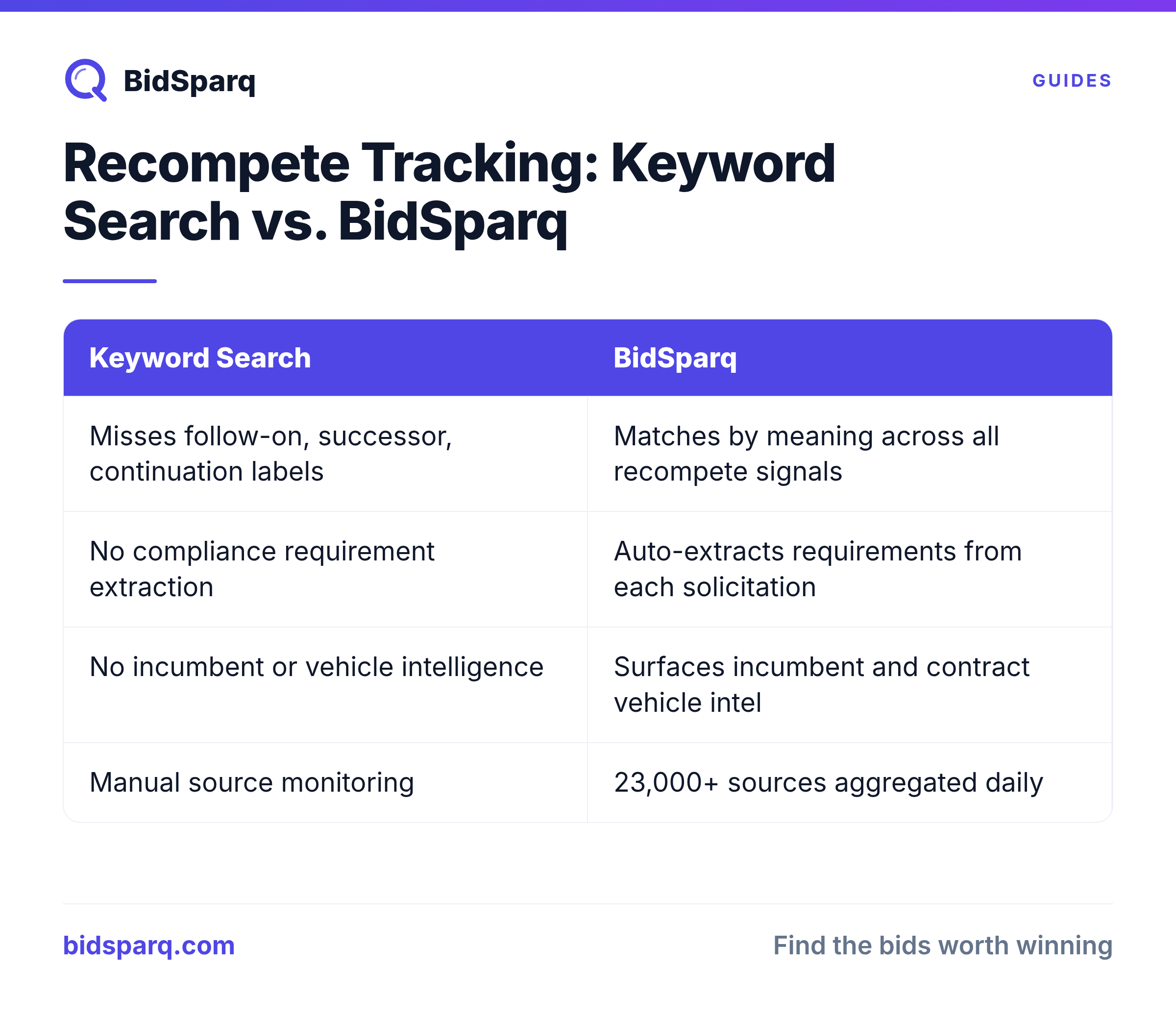
Tracking recompetes manually across agency portals fails because the volume and inconsistency of language across sources produce false negatives as often as actual hits. Solicitations labeled "follow-on," "successor contract," "bridge extension," or "continuation" are all recompete signals that a keyword search for "recompete" will miss entirely. Semantic matching, which surfaces opportunities by meaning rather than exact term, closes that gap. Automated compliance extraction then surfaces the certifications and requirements from each matching solicitation, so vendors can filter for fit before committing to the proposal process. Incumbent and contract vehicle intelligence alongside each match lets a team move from discovery to competitive positioning without switching tools. As of August 2026, Massachusetts, Maryland, and Washington lead in open recompete postings, at 610, 575, and 411 respectively, a concentration that reflects both procurement volume and active contract cycles in those markets.
FAQ
How long does the government contract recompete process take?
The timeline varies by contract value and complexity. Simple service contracts can recompete in 90 to 120 days from solicitation release to award. Complex technical or systems contracts often take 6 to 18 months. The pre-solicitation phase, from advance acquisition plan to draft RFP to final solicitation, can add another 3 to 12 months before the official clock starts. Vendors who track the pre-solicitation phase have the most preparation time and almost always submit stronger proposals.
Can an incumbent lose a government recompete on price alone?
In most competitive acquisitions, price is one evaluation factor among several. Best value source selections weigh technical approach, past performance, and management approach alongside cost. Lowest price technically acceptable evaluations, often abbreviated LPTA, do award primarily on price, but the incumbent can still lose if a challenger meets all technical requirements at a lower price point. Understanding which evaluation methodology the agency will use is a critical early intelligence step in any recompete strategy.
What is the difference between a recompete and a bridge contract?
A bridge contract is a short-term extension of an existing contract, typically sole-sourced to the incumbent, that keeps services running while the agency completes a delayed recompete. It is not a new competition. A recompete is a full re-solicitation where any qualified vendor can compete. Vendors sometimes mistake bridge activity for a decision not to recompete, but a bridge almost always signals a recompete is coming, making bridge periods an important tracking signal rather than a reason to stand down.
See your recompete matches free: BidSparq's free tier surfaces live opportunities across 23,000+ sources with no credit card required.
Find RFPs that match your business
BidSparq monitors 23,000+ procurement sources and uses AI to score every opportunity against your capabilities. Try it free for 14 days.
Start Free Trial →